The short answer
Paddletek and Pickleball Studio put fiberglass on the power side, and Paddletek puts graphite on the touch side; Selkirk calls fiberglass a balance; retailer Pickleball Central reverses the split. To compare faces from one maker, take one of the two pairs below.
Our Top Picks
Fiberglass and graphite are face materials, the sheets over a paddle’s core. We compare 6 paddles, 3 per side, including two pairs: the Onix Stryker 4 in both faces, and two HEAD Radicals with the same listed size, thickness and core.
Names first. Many makers call a fiberglass face “composite”. Pickleball Studio (2022) writes: “I’ve talked to some manufacturers, and they said that composite often means fiberglass if it doesn’t specify.” Our rule: a paddle is on the fiberglass side only when its maker’s product text says fiberglass, and on the graphite side only when it says graphite.
All paddle guides are on our pickleball paddles page; for one material, see our best fiberglass pickleball paddles and best graphite pickleball paddles.
Fiberglass picks:
- Fiberglass Stryker 4: Onix Stryker 4 Composite, Red | Check Price on Amazon
- Fiberglass HEAD Radical: HEAD Radical Pro, Black/Green | Check Price on Amazon
- Fiberglass Elongated XL: Selkirk SLK Evo Hybrid, XL, Green | Check Price on Amazon
Graphite picks:
- Graphite Stryker 4: Onix Stryker 4 Graphite, Purple | Check Price on Amazon
- Graphite HEAD Radical: HEAD Radical Tour, Black/Red/Blue | Check Price on Amazon
- Graphite Elongated XL: HEAD Radical XL, Black/Red | Check Price on Amazon
Compare the 6 paddles by face material
Maker figures for each linked paddle. “USA Pickleball” is the approved-paddle list entry and its date, read 2026-11-10.
 Onix Stryker 4 CompositeFiberglass Stryker 4Fiberglass, standard shapePolymer7.0-7.5 oz$44.03 Prime
Evidence: maker specs only, no independent test
 Onix Stryker 4 GraphiteGraphite Stryker 4Graphite, standard shape, lightPolymer7.0-7.4 oz$54.39 Prime
Evidence: maker specs only, no independent test
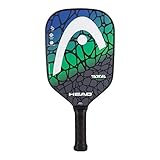 HEAD Radical ProFiberglass HEAD RadicalFiberglass, standard shapePolypropylene230 g / 8.1 oz$39.95
Evidence: HEAD's product text on the Amazon listing; no independent test
 HEAD Radical TourGraphite HEAD RadicalGraphite, standard shape, touchPolypropylene225 g / 7.9 oz$45.49
Evidence: The Dink, Radical Tour GR (later generation with Control Stabilizer Technology), not this 2017-18 Radical Tour
 Selkirk SLK Evo Hybrid XLFiberglass Elongated XLFiberglass, elongated13 mm polymerNot listed by Selkirk$59.88
Evidence: Selkirk's product text on its Amazon listing; no independent test
 HEAD Radical XLGraphite Elongated XLGraphite, elongatedPolypropylene215 g / 7.6 oz$34.95
Evidence: HEAD's product text on the Amazon listing; no independent test
Side by Side: Fiberglass vs Graphite, Source by Source
Tendencies, each with whose view it is. The Dink (June 9, 2022) tested HEAD’s Radical Tour GR (graphite/carbon face) against the Radical Tour CO (composite face), which it says differ only in face material. HEAD calls the CO’s face a “Composite Hitting Surface”, so The Dink’s scores have their own row, labelled composite.
| Attribute | Fiberglass face | Graphite face |
|---|---|---|
| Power | More, per Paddletek and Pickleball Studio; Selkirk: a balance (next row) | Moderate, per Paddletek; retailer Pickleball Central: more (below) |
| Control and touch | Selkirk: a balance of power, control and spin | Paddletek: touch over power; Selkirk: control and pop |
| Sweet spot | Smaller, per Paddletek and Pickleball Studio | Pickleball Studio: less forgiving than carbon fiber in its experience; not sure it is a graphite trait |
| Feel | Less stiff, per Paddletek | Rigid and stiff, per Paddletek |
| Durability | Paddletek rates it highly | Paddletek expects carbon fiber to outlast graphite |
| The Dink, HEAD Tour GR vs composite Tour CO | Composite Tour CO (HEAD: composite): power 5/5, control 4/5, touch and spin 4/5; very stiff at the net, though HEAD’s text on that page calls it soft | Tour GR: power 4/5, control 5/5, touch and spin 4/5; a softer face, per The Dink |
Where sources disagree, retailer Pickleball Central reverses the split: “If you’re an aggressive player, the power of graphite or carbon fiber might appeal to you. On the flip side, if control and spin are your forte, fiberglass might be your best bet.”
How We Chose the Paddles
How this guide was built
This guide was built from manufacturer product text, the USA Pickleball approved-paddle list, and published views from Pickleball Studio, The Dink, Paddletek, Selkirk, Pickleball Central and Pickleball Galaxy. We have not tested these paddles ourselves.
What a pick had to show
- On Amazon, New, in stock and in the buy box on 2026-11-10, at or below any maker list price; each review names the seller.
- Pairs where possible: the Onix Stryker 4 in both faces, and HEAD’s Radical Pro and Radical Tour, which HEAD lists at the same size, thickness and core.
Why several picks are older models and who the sources are
Why several picks are older models
HEAD’s paddle shop lists none of the three HEAD paddles here, and Selkirk’s site no longer lists the Evo Hybrid (both checked 2026-11-10); in-stock graphite paddles new to the site were mostly older models. Our graphite roundup covers others; for carbon fiber, see our best carbon pickleball paddles.
Who the sources are
Pickleball Studio publishes affiliate links and discount codes. The Dink offers paid partnerships, and its review urges readers to get a HEAD Radical paddle. Pickleball Central and Pickleball Galaxy are retailers. Paddletek, Selkirk, HEAD and Onix are makers.
Detailed Reviews
Onix Stryker 4 Composite, Fiberglass Stryker 4
Players who want a fiberglass face in Onix's medium-weight class.
$44.03 from AmazonAs of Nov 12, 11:12 UTCVerdict
The fiberglass twin of #2.
Evidence: No independent test; maker specs. Source: Onix (maker page).
Onix calls it composite, but its description names the face: “The polypropylene core provides the Stryker’s incredible touch at the net, while the paddle’s fiberglass face fuels the power.” An unsigned answer on retailer Pickleball Galaxy‘s Q&A (July 12, 2022), to whether this paddle’s composite is graphite: “No composite is fiberglass while graphite is graphite.” Amazon’s family title for both Stryker 4s says “Graphite Face” and “Nomex, Paper Honeycomb Core”, where Onix’s description and the Amazon bullets say polypropylene core. The variation is “ONIX Composite Stryker 4 – Red”. Onix’s spec list gives “Paddle Shape: Standard”, while its description calls the shape oversized. Amazon.com sold it on 2026-11-10.
Specs (Onix Stryker 4 Composite, Red)
- Core: polymer (polypropylene); paddle thickness 14 mm (Onix)
- Weight: 7.0-7.5 oz, medium-weight (Onix)
- Size: 15.5 x 7.8 in; 5 in handle; 4.25 in grip (Onix); Amazon’s Grip Size field: 4 1/2 in
- Approval: “Stryker 4 Composite”, added 2017-06-01
Pros
- The fiberglass version of the Stryker 4 model
- Onix aims it at beginner to intermediate players
Cons
- Weight range tops out 0.1 oz higher (7.5 vs 7.4 oz), per Onix
Onix Stryker 4 Graphite, Graphite Stryker 4
Players who want the Stryker 4 with a graphite face and a lighter weight range.
$54.39 from AmazonAs of Nov 12, 11:12 UTCVerdict
The graphite twin of #1, which Onix calls light-weight.
Evidence: No independent test; maker specs. Source: Onix (maker page).
Onix’s description: “The polypropylene core provides the Stryker’s incredible touch at the net, while the paddle’s graphite face fuels the power.” Its spec list still says “Face: Composite”, and the Amazon title’s Nomex core conflicts here too. On 2026-11-10 the buy box rotated between RacquetGalaxy and Amazon.com.
Specs (Onix Stryker 4 Graphite, Purple)
- Core: polymer (polypropylene); paddle thickness 14 mm (Onix)
- Weight: 7.0-7.4 oz, light-weight (Onix); 6.9-7.4 oz (Amazon bullet)
- Size: 15.5 x 7.8 in; 5 in handle; 4.25 in grip (Onix)
- Approval: “Stryker 4 Graphite”, added 2017-09-15
Pros
- The graphite version of the Stryker 4 model, in Onix’s light-weight class
Cons
- Onix’s own spec list labels the face “Composite”
- Low stock on Amazon on 2026-11-10
Who should buy it
Players who want the Stryker 4 with a graphite face and a lighter weight range.
HEAD Radical Pro, Fiberglass HEAD Radical
Players who want a 16 x 7 7/8 in HEAD Radical with a fiberglass face.
$39.95 from AmazonAs of Nov 12, 11:12 UTCVerdict
The fiberglass side of HEAD’s older Radical pair; same series as #4 and #6.
Evidence: No independent test; maker specs. Source: HEAD (product text on the Amazon listing; HEAD’s site no longer lists the model).
HEAD’s product text on the Amazon listing: “FIBERGLASS FINISH: The lightweight pickleball paddles feature HEAD’s fiberglass hitting surface that offers excellent feel and ample power for the competitive player.” HEAD lists “PP + GF” materials against the Radical Tour’s “PP plus CF”; Amazon’s material field adds carbon fiber. RacquetGalaxy sold it (shipped by Amazon) on 2026-11-10.
Specs (HEAD Radical Pro, Black/Green)
- Core: polypropylene honeycomb; thickness 13.0 mm (HEAD)
- Weight: 230 g / 8.1 oz (HEAD)
- Size: 16 x 7 7/8 in; grip 4 1/4 in; handle length not listed (HEAD); Amazon’s Grip Size field: 4 1/8 in
- Approval: “Radical Pro” entries added 2017-04-19, 2021-08-24 and 2023-01-28; generation not stated
Pros
- Fiberglass face at the Radical Tour’s listed size and thickness
Cons
- 5 g heavier than the Radical Tour, per HEAD
- Older model with no maker list price
Who should buy it
Players who want a 16 x 7 7/8 in HEAD Radical with a fiberglass face.
HEAD Radical Tour, Graphite HEAD Radical
Black/Red/Blue · Polypropylene
Players who want a 16 x 7 7/8 in HEAD Radical with a graphite face for touch at the net.
$45.49 from AmazonAs of Nov 12, 11:12 UTCVerdict
The graphite side of HEAD’s older Radical pair, for touch-first players.
Evidence: Independently reviewed, same series. The Dink: Radical Tour GR (later generation) and Radical Tour CO.
HEAD’s product text on the Amazon listing: “THE GRAPHITE ADVANTAGE: The lightweight carbon pickle ball paddles feature HEAD’s Graphite hitting surface that offers a superior feel and increased control for the competitive player.” The Dink‘s side-by-side scores are for the later Tour GR, which added HEAD’s Control Stabilizer Technology. PickleballCentral sold it (shipped by Amazon) on 2026-11-10.
Specs (HEAD Radical Tour, Black/Red/Blue)
- Core: polypropylene honeycomb; thickness 13.0 mm (HEAD)
- Weight: 225 g / 7.9 oz (HEAD)
- Size: 16 x 7 7/8 in; grip 4 1/4 in; handle length not listed (HEAD); Amazon’s Grip Size field: 4 1/8 in
- Approval: “Radical Tour” entries added 2017-04-19 and 2021-10-11; generation not stated
Pros
- Graphite face at the Radical Pro’s listed size and thickness
Cons
- Needs more swing for the same power, per The Dink (later GR)
- Older model with no maker list price, and limited stock
Who should buy it
Players who want a 16 x 7 7/8 in HEAD Radical with a graphite face for touch at the net.
Selkirk SLK Evo Hybrid XL, Fiberglass Elongated XL
Players who want an elongated fiberglass paddle and do not need a confirmed list entry.
$59.88 from AmazonAs of Nov 12, 11:12 UTCVerdict
The elongated fiberglass pick, which Selkirk says suits players of all levels; no USA Pickleball entry names the XL.
Evidence: No independent test; maker specs. Source: Selkirk Sport (product text on its Amazon listing).
Selkirk Sport’s product text on the Amazon listing: “LIGHTWEIGHT FIBERGLASS FACE – Master every play with our C7-Flex Hybrid Fiberglass Face, engineered to provide optimal power and control on the court.” Selkirk’s product page returns “404 Not Found”. Selkirk Sport sold it (shipped by Amazon) on 2026-11-10.
Specs (Selkirk SLK Evo Hybrid, XL, Green)
- Core: 13 mm Rev-Hybrid polymer (Selkirk)
- Weight: not given in Selkirk’s product text
- Size: length and width not given; 5.25 in handle; 4.25 in grip (Selkirk)
- Approval: no entry names the XL (Evo Hybrid Max, 2.0 and 2.0 Max entries only)
Pros
- Elongated fiberglass paddle sold by the brand
Cons
- No USA Pickleball entry names the XL
- Selkirk’s product text gives no weight, length or width
- Selkirk no longer lists it; no maker price
Who should buy it
Players who want an elongated fiberglass paddle and do not need a confirmed list entry.
HEAD Radical XL, Graphite Elongated XL
Verdict
The elongated graphite pick, for reach with a graphite face; same series as #3 and #4.
Evidence: No independent test; maker specs. Source: HEAD (product text on the Amazon listing; HEAD’s site no longer lists the model).
HEAD’s product text on the Amazon listing repeats the Radical Tour’s graphite bullet word for word, with “PP + CF” materials, at 17 x 7 in. RacquetGalaxy sold it (shipped by Amazon) on 2026-11-10.
Specs (HEAD Radical XL, Black/Red)
- Core: polypropylene honeycomb; thickness 13.0 mm (HEAD)
- Weight: 215 g / 7.6 oz (HEAD)
- Size: 17 x 7 in; grip 4 1/4 in; handle length not listed (HEAD)
- Approval: “Radical XL”, added 2018-05-01
Pros
- Elongated graphite paddle with a USA Pickleball entry, at 7.6 oz per HEAD
Cons
- Narrower face (7 in) than the Radical Pro and Tour (7 7/8 in), per HEAD
- Older model with no maker list price
Choose Fiberglass if… Choose Graphite if…
- More pace from the paddle: fiberglass, per Paddletek and Pickleball Studio; Selkirk calls fiberglass a balance; retailer Pickleball Central says graphite. Picks: Stryker 4 Composite, Radical Pro.
- Touch at the net: graphite, per Paddletek and Selkirk; Pickleball Central says fiberglass. Picks: Radical Tour, Stryker 4 Graphite.
- A lighter paddle: both makers list the graphite version slightly lighter. Picks: Stryker 4 Graphite, Radical XL.
- Reach: an elongated frame in either face. Picks: Radical XL, Evo Hybrid XL.
- Newer players: Onix aims both Stryker 4s at beginner to intermediate players; see our best beginner pickleball paddles. Picks: Stryker 4 Composite, Stryker 4 Graphite.
- Sanctioned events: a model with a list entry; none names the Evo Hybrid XL, and the HEAD entries state no generation. Picks: Stryker 4 Composite, Radical XL.
Frequently Asked Questions
Q. Which is better, fiberglass or graphite?
Neither for everyone. Paddletek: “Whether graphite or fiberglass is better depends on what you’re looking for in a pickleball paddle.” It sends power seekers to fiberglass and touch players to graphite; retailer Pickleball Central reverses that. None of our sources ties a face to tennis players; see our paddles for tennis players and paddles for reducing vibration.
Q. Composite vs graphite: what is the difference?
Pickleball Studio: “Composite is just a combination of several materials.” Onix uses “Face: Composite” on both Stryker 4 pages, so we follow the maker’s description of the face. See our best composite pickleball paddles.
Q. Is graphite good for a pickleball paddle?
For touch, per Paddletek: “In general, graphite is considered a material best suited for players that rely on touch over power.” Graphite is a face material, not a core material; every pick here has a polymer core. On the related carbon fiber, see whether a carbon fiber paddle is worth it.
Q. What is the best material for a pickleball paddle?
No source here names one for everyone. Pickleball Studio: “At this point, I would say that carbon fiber is probably the most common face material in the higher-end range of paddles, and you won’t see as many using fiberglass strictly.” For wood, see whether wooden paddles are any good.
Q. Are fiberglass pickleball paddles any good?
Pickleball Studio: “If you like playing with a lot more pace and power, a fiberglass face might be a great fit.” It adds: “One of the other main drawbacks to fiberglass is they generally don’t get as good of spin as other paddles on the market.” For lower-priced paddles, see our best budget pickleball paddles and paddles under $150.
Final Verdict
Pick the face for how you play, by the use cases above; the Onix Stryker 4 pair and the HEAD Radical Pro and Tour let you compare faces from one maker.
Product prices and availability are accurate as of the date/time indicated and are subject to change. Any price and availability information displayed on Amazon.com at the time of purchase will apply to the purchase of this product.