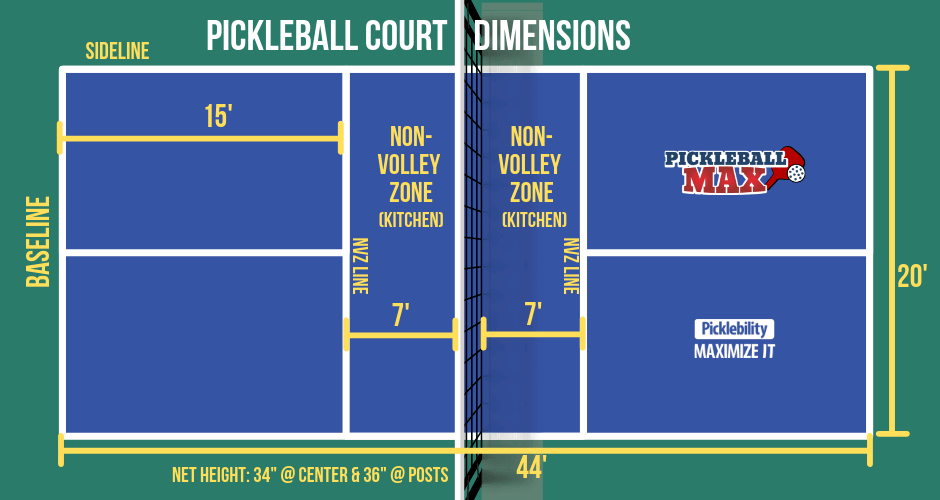
A standard pickleballl court measures 20 feet by 44 feet for actual play.
I’ve measured, built, and played on dozens of courts, so I know the size of pickleballl court inside and out. This guide breaks down exact court dimensions, recommended clearances, net and line specs, surface tips, and smart DIY advice. Read on to get the full picture and make confident choices when planning or marking a court.
Official dimensions and measurements
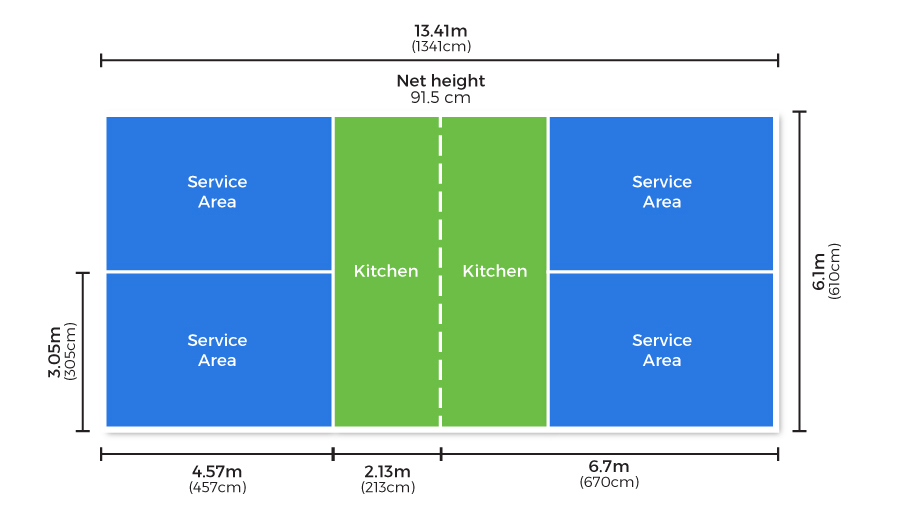
A regulation size of pickleballl court for play is 20 feet wide and 44 feet long. These dimensions apply to both singles and doubles play. The net runs across the middle, splitting the 44-foot length into two 22-foot halves.
Key measurements:
- Court width: 20 feet (6.1 meters).
- Court length: 44 feet (13.41 meters).
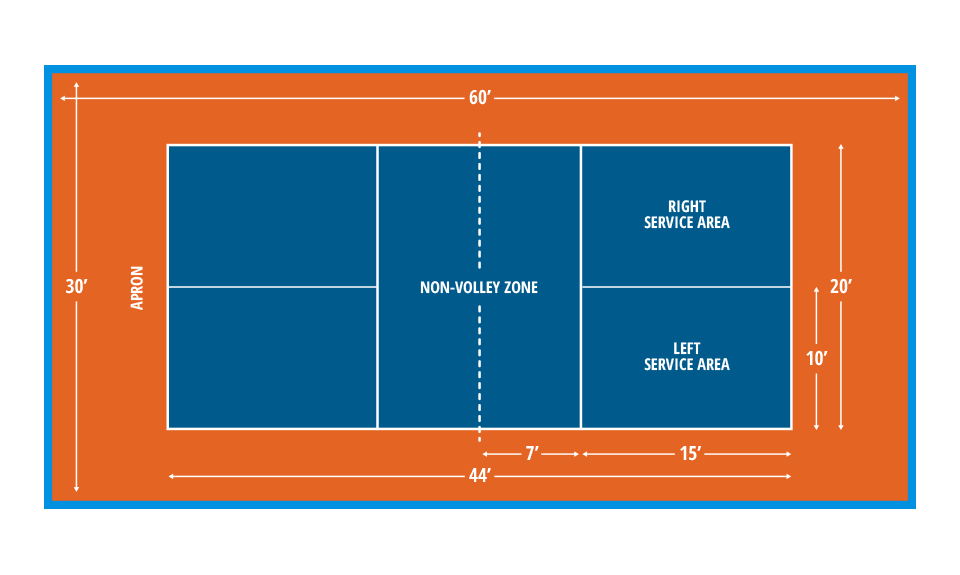
- Non-volley zone (kitchen): 7 feet from the net on each side.
- Distance from baseline to kitchen line: 15 feet on each side (7 + 8? — note, total from net to baseline is 22 feet).
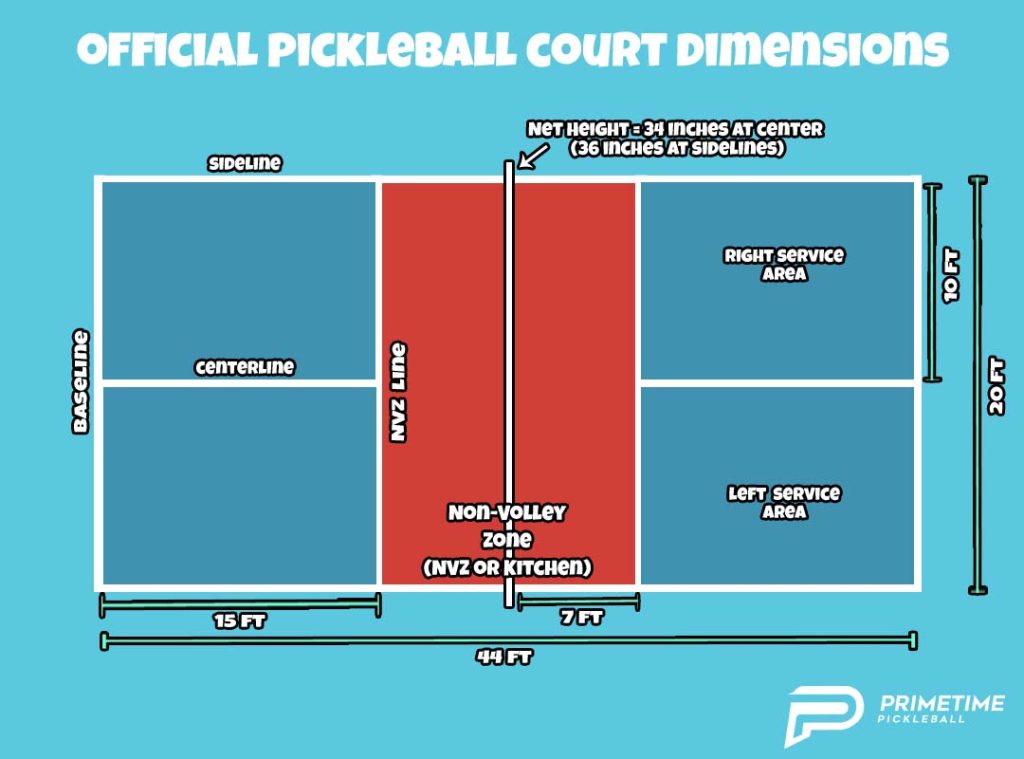
- Net height: 36 inches at the sidelines and 34 inches at the center.
I use these numbers whenever I design a court. They are the baseline for all planning and play. Knowing the official size of pickleballl court ensures accurate marking and proper play conditions.
Court layout: zones, lines, and what they mean
Understanding the layout helps players and builders alike. The lines define play zones and rules.
Main features and their purpose:
- Baseline: Marks the back edge of the court. Serves and returns must reference this line.
- Sidelines: Define court width for singles and doubles. Singles use the same sidelines as doubles.
- Centerline: Divides the service courts on each side.
- Kitchen (non-volley zone): 7 feet from the net. No volleying while standing inside this zone.
- Service courts: Two on each side, created by the centerline and kitchen line.
Each line is usually 2 inches wide. When I mark a court, I measure twice and paint once. Clear, consistent lines prevent disputes and make the court look professional.
Recommended clearances and full playing area
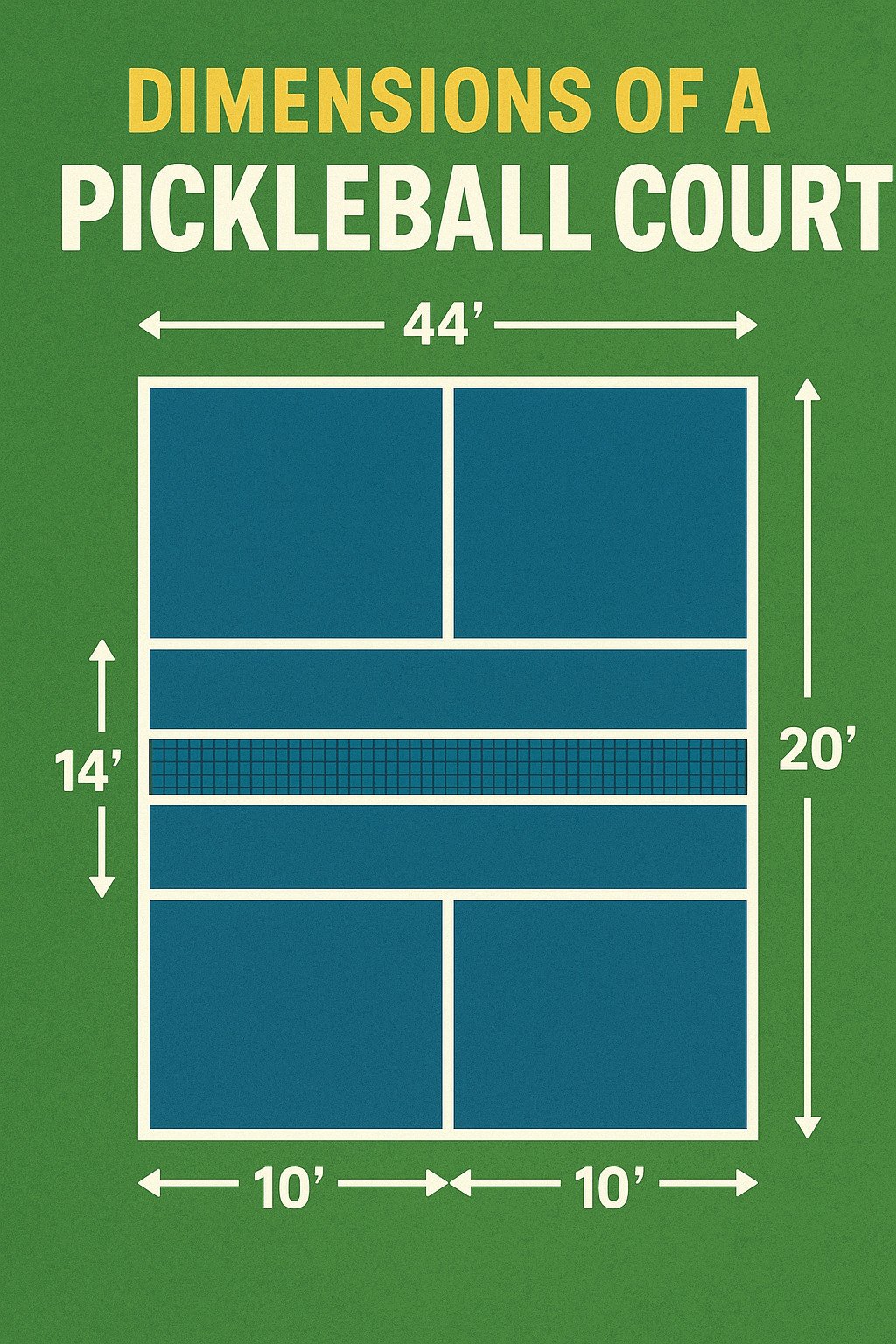
The official playing surface is 20 x 44 feet, but the recommended total area around the court is larger. You want room to move, chase balls, and ensure safety.
Recommended clearances:
- Minimum recommended area: 30 feet by 60 feet (9.14 x 18.29 meters).
- Preferred full area for tournaments and tall players: 34 feet by 64 feet (10.36 x 19.51 meters).
- Ceiling height for indoor courts: at least 18 to 20 feet to avoid interference on lobs.
In my projects, I aim for the preferred full area. It makes play comfortable and helps when planning lights, fences, and seating. Remember, the size of pickleballl court matters less than the space around it for real play quality.

Net height, paddles, and line specs
The net and lines are as important as the court footprint. Small deviations change play feel.
Specifications to follow:
- Net center height: 34 inches (0.86 meters).
- Net height at posts/sidelines: 36 inches (0.91 meters).
- Line width: 2 inches (5.08 cm) is standard. Some local courts use up to 4 inches, but 2 is common.
- Service box: The area between the kitchen line and baseline, split by the centerline.
When I set up nets, I always check the center sag. A net too low changes volley dynamics. If you’re converting a space, invest in an adjustable net system for accuracy.
Surface types, paint, and traction
The court surface affects ball bounce, speed, and injury risk. Choose a surface that fits your budget and climate.
Common surface options:
- Asphalt or concrete with acrylic sport coating: Affordable and durable for outdoors.
- Modular polypropylene tiles: Good for quick installation and drainage.
- Resin or polyurea coatings: Offer softer landings and long life for indoor courts.
Color choices matter. Contrasting colors for the playing area and out-of-bounds area improve visibility. I prefer medium-grit coatings for traction. Too smooth a surface increases slips. Proper drainage and crack repair are musts in colder climates.

Converting spaces and DIY tips
Turning a driveway, tennis half-court, or unused lot into a court is common. Planning saves time and money.
Steps to convert or build:
- Measure the available space and compare it to the recommended playing area.
- Repair cracks and level the surface before painting.
- Use proper court tape or templates to mark lines for precision.
- Install a regulation net system or a high-quality portable net.
From my experience, leveling and surface prep take the most time. Don’t cut corners here. A well-prepped surface paints easier and lasts longer. If converting a tennis court, you can mark two pickleballl courts side-by-side on one tennis court area if space allows.

Common mistakes and pro tips
Avoid these mistakes that I’ve seen often when folks set up a court.
Common errors:
- Using the wrong net height or not tensioning the net properly.
- Marking lines off-center or using uneven line widths.
- Ignoring recommended clearances and leaving too little run-off.
- Choosing a surface that’s too slick or not weatherproof.
Pro tips:
- Use chalk or temporary markers to test a layout before painting.
- Invest in a net that lets you fine-tune the center height.
- Add windbreaks or fences if you’re in a breezy area.
- Consider lighting placement early if the court will be used at night.

Maintenance and longevity
A good court needs care. Regular maintenance keeps play safe and fun.
Maintenance checklist:
- Clean debris and leaves daily in active seasons.
- Sweep and hose off surfaces regularly.
- Repair cracks promptly to prevent larger damage.
- Repaint lines and coatings as they fade, typically every 5-7 years.
I personally walk my courts weekly and inspect for hazards. Small repairs cost far less than full resurfacing.
Frequently Asked Questions of size of pickleballl court
What are the exact dimensions of the size of pickleballl court?
A regulation size of pickleballl court is 20 feet wide by 44 feet long for singles and doubles. This includes the kitchen and service areas within those lines.
How big should the area around the size of pickleballl court be?
The minimum recommended area is 30 by 60 feet, while the preferred tournament-style area is 34 by 64 feet. More clearance improves safety and playability.
What is the net height for the size of pickleballl court?
The net should be 36 inches high at the sidelines and 34 inches at the center. Use a level or a net system to get this right.
Is the kitchen size included in the 20 by 44 size of pickleballl court?
Yes, the kitchen or non-volley zone is part of the 20 by 44 court and extends 7 feet from the net on each side. You cannot volley while standing in this zone.
Can you play singles on a size of pickleballl court?
Yes, singles uses the same 20 by 44 size as doubles. The court lines and zones do not change between singles and doubles play.
How much does it cost to build a basic size of pickleballl court?
Costs vary widely by location and surface. A basic convert-and-paint job can be a few hundred to a few thousand dollars, while full resurfacing and lighting will cost more. Local labor and material prices have the biggest impact.
Conclusion
The size of pickleballl court is clear: 20 feet by 44 feet for the playing area, with recommended clearances of 30×60 feet or larger for comfort. Follow proper net heights, line specs, and surface choices to make a court that plays well and lasts. Start by measuring your space, prepare the surface carefully, and mark lines precisely. If you’re ready to build or convert a court, take these tips, plan thoughtfully, and jump into play—then share your experience or questions below.