No, you cannot step into the kitchen for a volley, but you can enter after the ball bounces.
The "kitchen" is one of the most misunderstood areas on the pickleball court, and for good reason. I’ve seen countless games where confusion over this seven-foot zone leads to arguments, lost points, and missed opportunities. The question of whether you can step into the kitchen anytime the ball bounces in pickleball is a fundamental one that separates beginners from intermediate players. Mastering this rule is not just about avoiding faults; it’s about unlocking a whole new level of strategy at the net. This guide will break down the rule in simple terms, clear up common myths, and show you how to use the kitchen to your advantage.

Understanding the Non-Volley Zone (The Kitchen)
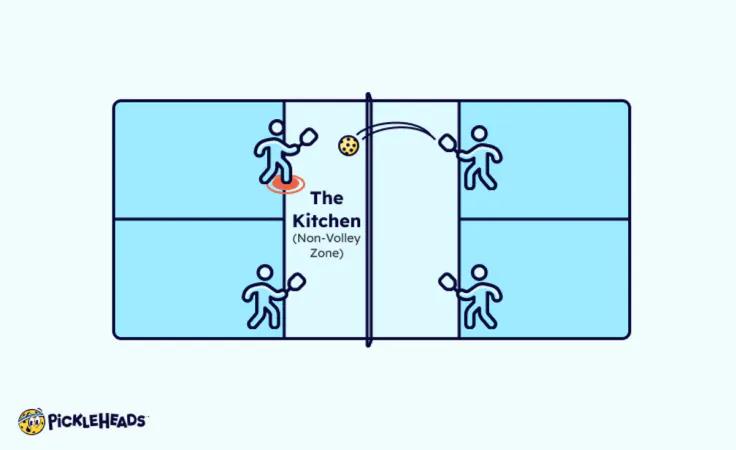
First things first, let's define our terms. The area on either side of the net, extending seven feet back, is officially called the Non-Volley Zone, or NVZ. But among players, it's affectionately known as "the kitchen." If you're in the kitchen, you can't be cooking up a volley.
The primary purpose of the kitchen is to prevent players from standing at the net and smashing the ball down on their opponents. It promotes a softer, more strategic game of dinks and controlled shots, which is a hallmark of pickleball. The main rule is simple: you are not allowed to hit the ball out of the air (a volley) while any part of your body is touching the Non-Volley Zone. This includes the lines themselves. Your momentum from hitting a volley also cannot carry you into the kitchen.
The Bounce Rule: Your Ticket into the Kitchen
Now we get to the heart of the matter. The question is, "can you step into the kitchen anytime the ball bounces in pickleball?" The answer lies in the bounce itself. The bounce is your all-access pass to enter the kitchen without committing a fault. Once the pickleball has hit the ground inside the kitchen, the non-volley rule no longer applies to that specific shot.
This means if your opponent hits a soft dink that lands at your feet in the kitchen, you are perfectly welcome to step inside and hit the ball. The key distinction is that you are now hitting a groundstroke, not a volley, because the ball has already bounced. I remember when I first started playing, I was terrified of the kitchen line. I'd let perfect shots drop because I thought the whole area was forbidden. The moment I realized the bounce was my invitation, my confidence at the net soared. It’s a game-changing piece of knowledge.

Common Kitchen Rule Misconceptions and Violations
The kitchen rule seems simple on the surface, but a few details trip up even experienced players. Understanding these common mistakes will help you play with more confidence and accuracy. The confusion often stems from the difference between a volley and a groundstroke after the bounce.
Here are a few common scenarios where players commit faults:
- The Momentum Fault: This is a big one. You might hit a perfectly legal volley with your feet behind the kitchen line. But if your forward momentum causes you to step on the line or into the kitchen after you've made contact, it is a fault. You must maintain complete control and stay out of the zone until the point is over or the ball bounces.
- Touching the Line: The kitchen line is part of the kitchen. If even the tip of your shoe touches the line while you are hitting a volley, you have faulted. Think of it like a wall you cannot touch or cross during that specific action.
- The Partner Position: Your position doesn't affect your partner. If you are in the kitchen to hit a dink that has bounced, your partner can still be behind the kitchen line hitting volleys. Their actions are independent of yours.
Clarifying whether you can step into the kitchen anytime the ball bounces in pickleball is crucial, and these examples highlight when it is and isn't allowed.
.jpg)
Strategy: When and Why You Should Enter the Kitchen
Knowing you can enter the kitchen after a bounce is one thing; knowing when you should is another. Moving into the kitchen is a strategic decision that can either win you the point or leave you vulnerable. It's not just about if you can step into the kitchen anytime the ball bounces in pickleball, but why you would want to.
You should step into the kitchen to handle a short dink. If a ball bounces low and near the net, stepping in allows you to get under it and hit a controlled, un-attackable shot back to your opponents. This keeps you in the dink rally and prevents you from popping the ball up. You can also step in to be aggressive. A bounce that sits up a little higher in the kitchen is an opportunity. By moving in, you can take the ball earlier, cut off the angle, and direct it for a winner. However, always remember to re-establish your position outside the kitchen as soon as possible to be ready for the next shot, especially a potential volley.

Frequently Asked Questions
What happens if the ball bounces on the kitchen line?
If the ball lands on any line, including the non-volley zone line, it is considered in. So, if a dink bounces on the kitchen line, you are free to step into the kitchen to hit it.
Can my paddle cross the kitchen line to hit a volley?
Yes, your paddle can cross the plane of the kitchen line to hit a volley. The rule applies to where your feet and body are, not your paddle, as long as you do not touch the court surface inside the kitchen.
If I step in the kitchen for a bounce, do I have to get out immediately?
You don't have to leap out, but it's strategically smart to re-establish your position behind the kitchen line as soon as you can. This gets you ready to hit a volley on the next return if the opportunity arises.
Can my partner be in the kitchen when I hit a volley?
Yes, your partner's position is independent of yours. They can be standing in the kitchen (perhaps after hitting a bounced ball) while you are legally hitting a volley from behind the NVZ line.
Does the kitchen rule apply on the serve?
The kitchen rule does not directly apply to the serve itself, but other rules do. The serve must land in the service court diagonally opposite you, which is behind the kitchen line. Neither the server nor the receiver can volley the serve or the return of serve.
Conclusion
The pickleball kitchen is not a forbidden zone, but a strategic area with one major rule: no volleys. The key to unlocking its potential is understanding the bounce. Once the ball hits the court within that seven-foot area, you are welcome to step in and play your shot. It’s the answer to the crucial question, "can you step into the kitchen anytime the ball bounces in pickleball?"
Mastering this concept moves you beyond just playing defense at the net and allows you to control the dinking game. Instead of fearing the kitchen line, see it as a boundary that dictates your strategy. Get comfortable moving in for dinks and quickly getting back out, and you'll see a dramatic improvement in your net play.
Now it's your turn. Go practice your kitchen footwork and see how it changes your game. What's the trickiest kitchen situation you've faced? Share your experiences in the comments below