The short answer
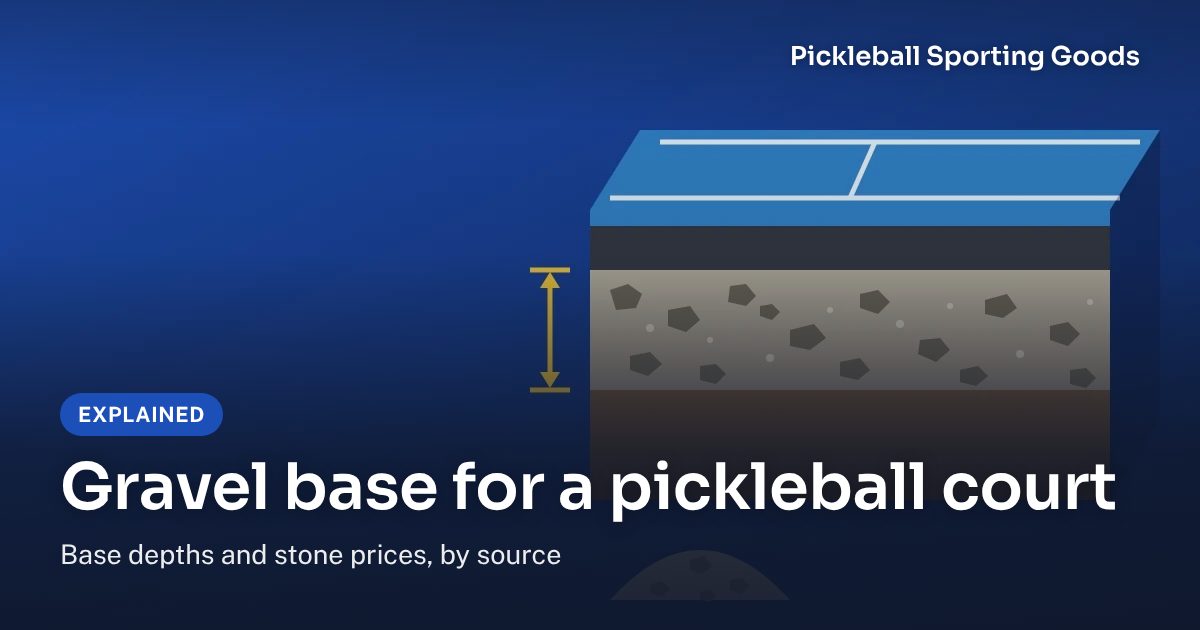
The 2020 construction manual from ASBA and USA Pickleball calls for a gravel base generally 4 to 6 inches thick under an asphalt court (page 30). In 2025 court bids, contractors priced that stone at $20.00 to $49.00 a ton (Maple Grove, Minnesota) and $13.00 to $14.00 a square yard for a 6-inch base (Garfield Township, Michigan).
Every figure below comes from a named manual, agency, contractor, supplier, rental yard or city bid, with its date and scope. All were read in November 2026, and none is added up or averaged here.
This page covers the stone layer under an outdoor court. Whole-court prices are on our page about what it costs to install a pickleball court, indoor projects are on our page of indoor court cost figures by source, and the rulebook’s court and playing-area sizes are in our pickleball court dimensions guide.
What the Construction Manual Specifies for the Base
Pickleball Courts: A Construction & Maintenance Manual (2020, Second Edition), from the American Sports Builders Association (ASBA) and USA Pickleball, describes the base for each court type. The copy quoted here is hosted by the Town of Salem, New Hampshire. It introduces its asphalt and concrete descriptions with a note: “The descriptions here are an overview of the processes. Please consult a qualified court builder or design engineer.”
| Source and page | Court type | Stone base | Layers above it |
|---|---|---|---|
| Manual, p. 30 (text) | Asphalt | Generally 4 in to 6 in (10 to 15 cm) | Intermediate asphalt 1-1/2 in to 2 in, surface course 1 in to 1-1/2 in |
| Manual, p. 31 (drawing) | Asphalt, non-freeze/thaw climate | 4 in (10 cm) or more | Asphalt 1-1/2 in or more |
| Manual, p. 31 (drawing) | Asphalt, freeze/thaw climate | 6 in (15 cm) or more | Asphalt 3 in or more, in two courses |
| Manual, pp. 30 and 36 | Post-tensioned concrete | 4 in to 6 in “drainage layer of aggregate” | Vapor retarder of “a minimum of two layers of 6 mil polyethylene sheeting”, then slab, typically 5 in |
| Manual, pp. 53-54 | Clay or fast-dry | Not less than 3 in after compaction | Screenings leveling course, then surface |
| PickleTile, July 15, 2026 | Asphalt | 4 to 6 inches of compacted aggregate | 2 to 3 inches of asphalt |
The centimetre figures are our conversions; the manual prints inches only. For asphalt, the manual says a gravel base is installed, generally 4 to 6 inches thick, “depending on the type of native subsoils and local climatic conditions”. Its drawing of asphalt sections, marked “not to scale”, shows the deeper base under the freeze/thaw section. Under post-tensioned concrete, the manual says the aggregate layer “helps to prevent ground water from moving up to the concrete and also helps to minimize friction between the slab and the base”. PickleTile, a court-systems supplier, says the compacted stone layer “creates a capillary break that keeps ground moisture from migrating into the slab.”
None of these sources prints one excavation depth. Each lists the base and the court layers above it as separate thicknesses, and the manual’s edge drawing notes that asphalt pavement thickness “varies depending upon site conditions” and freeze-thaw conditions (page 33).
The soil under the stone gets its own lines on page 26: “the subgrade has to be properly shaped, compacted and sloped”. Fill, it says, goes in 8-inch lifts, each “compacted thoroughly before the next layer is put down.” The manual adds: “Contact a geotechnical engineer if the soils are suspect or unknown.” Slope, layer and cure figures are on our page about how to build a pickleball court.
Crusher Run, ABC and #57 Stone
“Gravel” covers several materials that do different jobs. L & S Excavation, a family-run excavation and concrete crew in the Chattanooga area, explains the terms on a page dated June 26, 2026:
- Crusher run: “Crusher run is the catch-all term for dense-graded base stone.” It adds: “This is the material that goes under driveways, building pads, and concrete slabs as a base course.”
- ABC: “ABC stands for Aggregate Base Course. It’s a spec, not a single product”. It adds: “In practice, ABC and crusher run are often the same thing or very close, but ABC has tighter quality control because it’s used on road bases.”
- #57 stone: “#57 is a clean, washed stone roughly 1/2 to 1 inch in size. No fines. It drains aggressively and doesn’t compact into a hard layer”. Its listed uses include French drains and “Underslab drainage layers”, with the advice: “Use it where you want water moving, not where you want a stable surface.”
The manual names a dense-graded stone only for clay and fast-dry courts. There, it says, the base “should be dense graded aggregate (DGA), a mixture of stone of various sizes” from 3/4 inch down to fine aggregate. For hard courts its drawings label the layer “compacted crushed stone base course”. Its page 26 advice concerns drains: “Drainage and drains should be placed outside the fenced area or court playing area. Do not put drainage underneath the court surface, since it could lead to settling of the surface.” It describes a French drain as “a trench filled with gravel or rock and containing a perforated pipe that redirects water away from the courts”, and its French drain details at the court edge show clean crushed stone (page 28). Under post-tensioned slabs, page 30 does call for a 4- to 6-inch “drainage layer of aggregate”.
Note
A compacted stone base with no slab on top is a different build. VersaCourt, a modular court tile maker, publishes a stone base spec using 3/4″ minus crusher run for its tiles, but states: “VersaCourt does not recommend utilizing a stone base for Pickleball or Tennis applications.” Its 2026 cost guide says: “The ideal base is a 4 in concrete slab using 3000 PSI concrete with #4 rebar.”
What Gravel Costs by the Ton
| Source and date | Who they are | Material | Published price |
|---|---|---|---|
| Golden Landscaping Supply, listed Nov. 2026 | Landscape supply yard, Cumming, Georgia | Crusher run | $50.00 per ton |
| Golden Landscaping Supply, listed Nov. 2026 | Same yard | #57 stone (½ to 1 inch) | $64.99 per ton |
| U.S. Geological Survey, Feb. 2026 | Federal agency | Crushed stone, all U.S. producers, 2025 | $18.50 per metric ton, estimated average unit value |
Golden’s page offers pickup or delivery, prints no delivery fee, and gives one ton of crusher run as covering “80 sq. ft. at a 4-inch depth”, along with 160 sq. ft. at 2 inches and 100 sq. ft. at 3 inches.
The USGS figure is its national “Price, average unit value, dollars per metric ton” for crushed stone, from its Mineral Commodity Summaries for February 2026. It lists an estimated $17.50 for 2024 and $18.50 for 2025. It describes stone across the whole market, not one yard’s retail price.
What Contractors Bid for Aggregate Base on City Court Projects
City bid tabulations print the stone base as its own line, so the price for the base can be read apart from the asphalt and surfacing. They list bids received, not contract awards.
| City and bid date | Project | Base line | Unit prices bid |
|---|---|---|---|
| Garfield Township, Mich., Nov. 12, 2025 | Silver Lake Recreation Area pickleball courts | Aggregate base, 6-inch, 1,100 sq yd | $13.00 and $14.00 per sq yd (2 bidders) |
| Maple Grove, Minn., June 12, 2025 | Elm Creek School tennis/pickleball hybrid and basketball court | Class 5 aggregate base, 100 tons | $20.00, $29.19, $35.00 and $49.00 per ton (4 bidders) |
| Town of Man, W.Va., Aug. 6, 2025 | Guyandotte Riverfront Park paving, with a pickleball court topcoat | Aggregate base course, Class 1, 500 tons | $40.00 per ton (1 responsive bid) |
| Fairfield, Ohio, July 19, 2021 | Harbin Park, 8 pickleball courts on a 144 x 120 ft asphalt surface | 8″ of aggregate base, 640 tons | $30.00 and $40.00 per ton (2 bidders) |
The same tabulations show the work around the stone as separate lines. Garfield Township’s two bids for “site excavation and grading” were $13,500 and $5,975, each a lump sum. Town of Man’s bid priced 2,460 square yards of separation fabric at $0.69 a square yard. Fairfield’s bid sheet notes that “all fence work and net posts” were by others; nets and posts for a finished court are compared in our pickleball net set roundup.
Maple Grove’s bid covers rebuilding existing courts: each site lists 1,900 square yards of bituminous pavement removal and two new asphalt courses alongside its 100 tons of base. Town of Man’s bid covers the park project as a whole; the pickleball court appears only as a 3,600-square-foot acrylic topcoat line.
Site Preparation, Equipment and Other Costs
A court installer and a rental yard publish figures for site work:
| Source and date | Who they are | Scope | Published figure |
|---|---|---|---|
| Lob Shot Courts, Oct. 17, 2025 | Court installer, Michigan | “Removing grass, leveling soil, adding gravel base. Sloped yards cost more.” | $3,000 – $8,000 |
| Arapahoe Rental, listed Nov. 2026 | Equipment rental yard, Windsor, Colorado | Plate compactor rental | $65.00 per day ($46.00 per 4 hours) |
VersaCourt’s backyard tile price excludes excavation, subsurface preparation and concrete. None of the sources here prints an hourly labor rate, a delivery fee or a soil-test fee.
On permits, the manual (page 13) says: “Be sure to investigate zoning, permitting and compliance requirements for the site being considered before buying the land or breaking ground”. PickleTile adds that on multi-court projects “a geotechnical review of the subgrade is standard practice before design.” More court pages sit in our Rules, Courts & Play section.
Frequently Asked Questions
Q. How much gravel does a pickleball court base need?
Golden Landscaping Supply gives one ton of crusher run as covering 80 square feet at a 4-inch depth. Fairfield, Ohio’s bid sheet lists about 640 tons for an 8-inch base under eight courts on a 144 x 120 ft surface. The manual’s recommended total playing area for new construction is 34 x 64 feet. None of these sources gives a tonnage for one court.
Q. How deep should the gravel base be?
The 2020 manual gives generally 4 to 6 inches under asphalt, with its freeze/thaw drawing showing 6 inches or more, and 4 to 6 inches under post-tensioned concrete. For clay or fast-dry courts it sets a minimum of 3 inches after compaction.
Q. Does the gravel base price include the court surface?
No. The bids above list asphalt, surfacing and fencing as separate lines from the aggregate base. Whole-court figures by source are on our installation cost page linked above.
Q. Can a pickleball court be built on gravel alone?
VersaCourt “does not recommend utilizing a stone base for Pickleball or Tennis applications.” The manual’s hard-court sections all put asphalt or concrete over the stone.
Q. Is crusher run the same as ABC stone?
L & S Excavation says they are “often the same thing or very close, but ABC has tighter quality control because it’s used on road bases.” #57, it says, is “a clean, washed stone” with “No fines.”
Sources (14)
- ASBA and USA Pickleball, Pickleball Courts: A Construction & Maintenance Manual, 2020 Second Edition (PDF, Town of Salem, N.H. copy)
- PickleTile, Pickleball Court Base: Concrete, Asphalt, and Subgrade
- L & S Excavation, Crusher Run, ABC, and #57: What These Aggregate Terms Mean
- VersaCourt, Crushed Stone Base
- VersaCourt, Backyard Pickleball Court Cost (2026 Guide)
- Golden Landscaping Supply, Crusher Run (per ton)
- Golden Landscaping Supply, Gravel #57 Stone (per ton)
- U.S. Geological Survey, Mineral Commodity Summaries 2026: Stone (Crushed) (PDF)
- Charter Township of Garfield, Mich., Silver Lake Recreation Area Pickleball Courts, tabulation of bids prepared by Gourdie-Fraser, Inc. (PDF)
- City of Maple Grove, Minn., 2025 Maple Grove Paving Project, bid tabulation, Stantec project (PDF)
- Town of Man, W.Va., Guyandotte Riverfront Park, bid tabulation, Thrasher project (PDF)
- City of Fairfield, Ohio, Harbin Park 8 Pickleball Courts, bid tabulation (PDF)
- Lob Shot Courts, Adding a Pickleball Court to Your Backyard: What It Really Costs
- Arapahoe Rental, Plate Compactor Rental (Windsor, Colo.)