
No, padel and pickleball are not the same; they are distinct sports with unique courts, rules, and equipment.
You've probably seen them popping up everywhere—courts filled with people laughing, lunging, and hitting a ball with a paddle. From a distance, they might look alike, but as someone who has spent countless hours on both types of courts, I can tell you they offer wonderfully different experiences. If you're trying to figure out if padel is the same as pickleball, you've come to the right place. Let's dive deep into what sets these two wildly popular racket sports apart, so you can decide which one is calling your name.
)
The Court: A Tale of Two Arenas
The first and most obvious difference you'll notice is the playing area. This is a key reason why the answer to "is padel the same as pickleball?" is a firm no. The court itself defines how each game is played.
A padel court is like a mini tennis court enclosed in glass and mesh walls. It measures 10 meters wide by 20 meters long. The walls are not just boundaries; they are an active part of the game. Much like in squash, you can play the ball off the glass walls, leading to longer, more strategic rallies. I remember my first padel match; learning to use the back wall to return a smash felt like unlocking a superpower!
A pickleball court, on the other hand, is much smaller and has no walls. It’s the same size as a doubles badminton court, measuring 20 feet wide by 44 feet long. The most unique feature is the seven-foot non-volley zone on either side of the net, affectionately known as "the kitchen." You cannot hit a volley while standing in the kitchen, a rule that prevents players from simply smashing the ball at the net and encourages the softer, more strategic "dink" shots.

The Gear: Paddles and Balls
While both sports use paddles instead of stringed rackets, the equipment is tailored to their specific gameplay. This is another area that clearly shows that padel and pickleball are not the same.
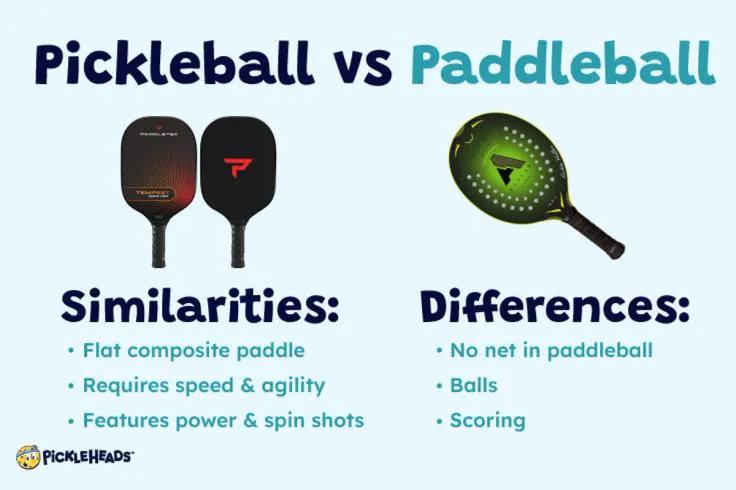
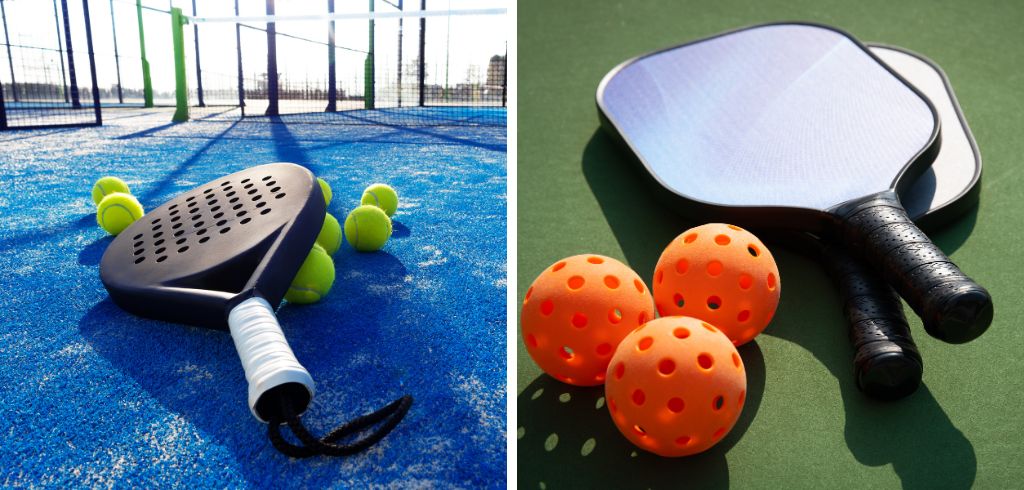
Padel paddles, or "palas," are stringless and made of a foam or rubber core with a composite shell. They are thicker than pickleball paddles and have holes drilled into the hitting surface. This design helps reduce air resistance and provides a good mix of power and control. They also have a wrist strap, which is mandatory during play for safety.
Pickleball paddles are also solid but are thinner and lighter. They are typically made from a variety of materials, including wood, composite, or graphite, with a honeycomb core. The paddle face is smooth and has no holes. The ball is perhaps the biggest difference. A pickleball is a lightweight, perforated plastic ball, similar to a wiffle ball. It travels much slower than a padel ball, making the game accessible for all ages. A padel ball looks like a tennis ball but has less internal pressure, which gives it a lower bounce.

The Rules: Scoring and Gameplay Explained
The rules and scoring systems are where the sports truly diverge, cementing the fact that we're asking "is padel the same as pickleball?" for a good reason. They may share a net, but their souls are different.
Padel is almost exclusively played in doubles and uses the same scoring system as tennis (15, 30, 40, deuce, ad, game). The biggest gameplay difference is the serve. In padel, you must serve underhand after bouncing the ball once behind the service line. As mentioned, the walls are in play, which adds a fascinating, three-dimensional element to the strategy.
Pickleball can be played as singles or doubles. It uses a different scoring system where points can only be won by the serving team. Games are usually played to 11, and you must win by two points. The serve must also be underhand, but you hit the ball out of the air. The "kitchen" rule and the two-bounce rule (the ball must bounce once on each side after the serve) create a unique rhythm and demand a different kind of court awareness.
The Vibe: Social Scene and Athleticism
Beyond the technicalities, each sport has its own distinct culture and feel. From my experience, both are incredibly social, but they attract people for slightly different reasons.
Padel has a fast-paced, energetic vibe. The rallies can be long and dynamic, requiring quick reflexes and teamwork. Since it's a doubles game, communication with your partner is key, making it a fantastic social activity. It feels a bit like a blend of tennis and squash, offering a great cardiovascular workout.
Pickleball is known for its friendly, inclusive, and community-driven atmosphere. The smaller court and slower ball make it extremely easy for beginners to pick up and start having fun right away. It's less about raw power and more about placement and patience. This low barrier to entry is why you see people of all ages and fitness levels enjoying the game together on the same court.
Frequently Asked Questions
Is padel or pickleball more physically demanding?
Generally, padel is more physically demanding due to the larger court and faster pace. The constant movement and longer rallies provide a more intense cardiovascular workout, whereas pickleball focuses more on quick reflexes and strategy in a smaller space.
Can you play padel on a tennis court?
No, you cannot play official padel on a tennis court. Padel requires a specific enclosed court with glass and mesh walls that are used during play, which a standard tennis court does not have.
Is it easy to switch from pickleball to padel?
While having racket skills helps, there is a learning curve when switching. A pickleball player moving to padel will need to adjust to the different bounce, the use of walls, and the tennis-style scoring. The transition is manageable but requires practice.
Which sport is more expensive to play?
Building a padel court is significantly more expensive than a pickleball court due to the walls and materials. Consequently, court rental fees for padel are often higher. The initial equipment costs for paddles and balls are comparable for both sports.
Is padel the same as pickleball in popularity?
Both sports are exploding in popularity worldwide, but their strongholds differ. Pickleball is currently more dominant in the United States, while padel has a massive following in Spain, Latin America, and is rapidly growing across Europe and the Middle East.
Conclusion
So, is padel the same as pickleball? Absolutely not. While they both share the fun of a paddle, a ball, and a net, they are unique games with their own charm. Padel offers a fast-paced, strategic game inside an enclosure, while pickleball provides an accessible, social experience on an open court with a focus on dinks and volleys.
The best way to truly understand the difference is to experience them for yourself. I encourage you to find a local court, grab a paddle, and give both sports a try. You might just discover your next favorite hobby.
Which sport sounds more like your style? Let us know in the comments below