A pickleball court should have a minimum overhead clearance of 18 to 20 feet for safe, unrestricted play. Having spent years on countless courts, I've seen a perfect lob shot get tragically denied by a low-hanging beam more times than I can count. This guide is born from that experience, designed to walk you through everything you need to know about a topic that seems minor but is absolutely critical: the proper pickleball court height clearance. We'll explore why this vertical space is just as important as the court's painted lines, ensuring your game is never cut short from above.

Why Pickleball Court Height Clearance is a Game-Changer
When you're first learning pickleball, most of the action happens low and fast over the net. But as you advance, the lob becomes one of the most strategic shots in your arsenal. A well-placed lob can reset a point, push your opponents off the kitchen line, and completely change the momentum of a game. This is where pickleball court height clearance becomes a non-negotiable factor.
Imagine hitting a beautiful, high-arcing defensive lob, only to have it thud against a light fixture or a ceiling rafter. The point is over, your strategy is useless, and frustration sets in. Adequate vertical space ensures that every shot in the game is viable. It allows players to play freely and creatively without being limited by the environment. From personal experience, playing on a court with poor height clearance feels cramped and restrictive, forcing you to alter your play style in a way that feels unnatural and less fun.

The Official Rules vs. Real-World Recommendations
The USA Pickleball Rulebook provides guidelines for court construction, and it addresses this very topic. It recommends a minimum overhead clearance of 18 to 20 feet. This isn't just an arbitrary number; it's the sweet spot that accommodates the trajectory of most lobs in recreational and competitive play. This standard ensures a fair and consistent playing experience.
However, the ideal pickleball court height clearance can vary based on the level of play.
- Recreational Play: For backyard courts or community centers, 18 feet is a solid minimum. It allows for plenty of fun and accommodates most shots you'll see in a casual game.
- Tournament and Professional Play: For serious competition, more is always better. Premier facilities often feature ceilings of 30 feet or higher. This extra space allows elite players to execute the incredibly high, defensive lobs needed to counter aggressive opponents.
So, while 18 feet is the baseline, planning for more height is a wise investment if you anticipate hosting competitive matches. The quality of a game is directly tied to having the right amount of space, and proper pickleball court height clearance is a huge part of that equation.
Indoor vs. Outdoor: Does the Sky Have a Limit?
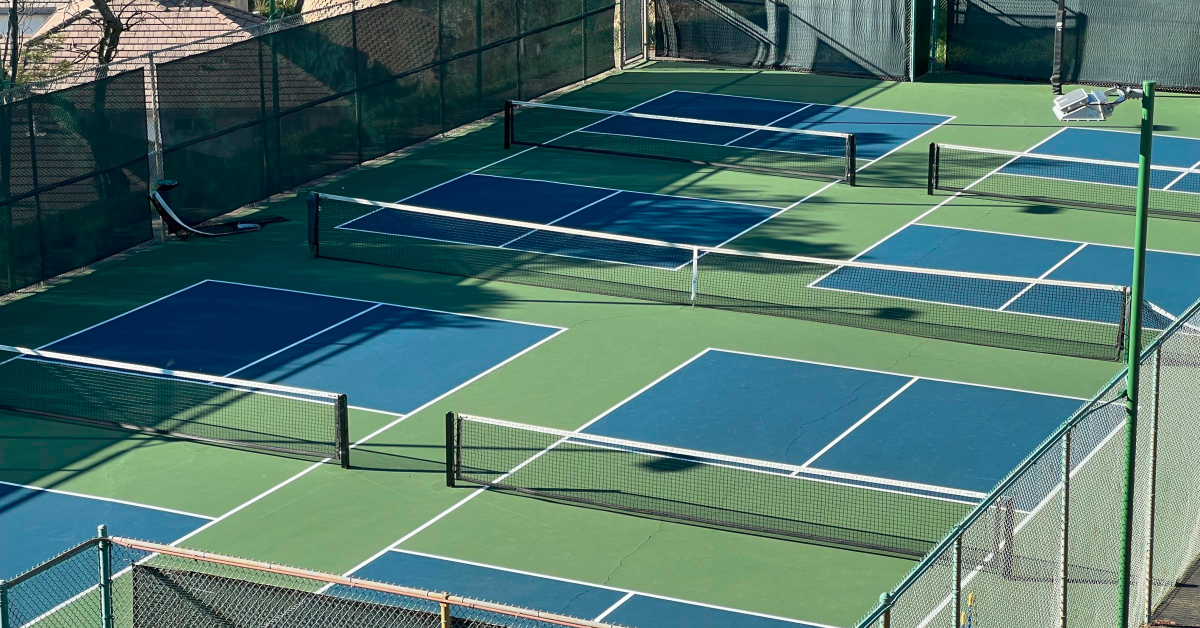
The conversation around pickleball court height clearance is most common with indoor facilities, but it’s relevant for outdoor courts, too. Each environment presents its own unique set of challenges that players and builders need to consider.
For indoor courts, the challenges are obvious. You have to contend with ceilings, support beams, HVAC ductwork, hanging scoreboards, and light fixtures. When I assess an indoor court, I don't just look at the ceiling height in the center. I walk the entire playing area, because the lowest point above the court is what truly defines your clearance. A basketball hoop hanging over the baseline can be just as problematic as a low ceiling.
Outdoor courts seem to offer unlimited height, but that isn't always the case. I’ve played on courts where low-hanging tree branches became an unofficial "third team," swatting down perfectly good shots. Other potential obstructions include utility lines that cross over the court or the overhang from an adjacent building. Before setting up an outdoor court, always look up and scan the entire area for anything that could interfere with the arc of a high lob.

The Hidden Costs of Ignoring Height Clearance
Cutting corners on pickleball court height clearance might seem like a way to save money or fit a court into an existing space, but it comes with significant hidden costs. These consequences can affect everything from player enjoyment to safety and the facility's reputation.
First and foremost is player frustration. A court with inadequate clearance effectively removes the lob from the game. This fundamentally changes pickleball strategy, favoring hard-driving players and penalizing those who rely on a softer, more tactical game. It leads to predictable, one-dimensional points and ultimately makes the game less engaging.
Beyond frustration, there are real safety hazards. When players are constantly worried about hitting the ceiling, their focus is split. I’ve seen players look up after hitting a lob and stumble because they weren't watching their footing. Furthermore, repeatedly hitting fixtures can cause damage to lights or sprinklers, creating a maintenance headache and a potential danger for everyone on the court. For facility owners, a court with substandard pickleball court height clearance is simply bad for business, as it will be unsuitable for leagues or tournaments.

How to Properly Measure and Plan for Your Court
Whether you're building a new court or converting an existing space, measuring the pickleball court height clearance correctly is a critical first step. A simple tape measure won’t cut it; you need to be thorough to avoid any unpleasant surprises down the road.
Here’s a simple process to follow for an accurate assessment:
- Use a Laser Measure: A laser distance measurer is your best friend here. It provides quick and accurate readings without needing a ladder.
- Measure the Entire Playing Area: Don't just measure the center of the court. Take measurements at the net, along both baselines, and at the four corners of the court. The "total playing area," including the space behind the baseline and on the sides, should be clear.
- Identify the Lowest Point: Scan the ceiling for any and all obstructions. This includes lights, fans, vents, pipes, or structural beams. Your official clearance is the distance from the floor to the bottom of the lowest-hanging object.
- Plan for Fixtures: If you are building new, plan your lighting and other overhead installations from the start. Choose low-profile LED fixtures and position them strategically to maximize the vertical playing space. Ensuring you meet the recommended pickleball court height clearance from the beginning will save you from costly renovations later.
Frequently Asked Questions of pickleball court height clearance
What is the absolute minimum height for a casual pickleball court?
For very casual play focused on dinking and drives, you might get by with 16 feet. However, this will severely limit lobs and is not recommended for a genuine gameplay experience.
Do I need to worry about height clearance for an outdoor court?
Yes, you should always check an outdoor space for obstructions before playing. Overhanging tree branches, power lines, and building eaves can all interfere with high-arcing shots.
How does lighting affect the required pickleball court height clearance?
Lighting fixtures are often the lowest point over a court, so the clearance should be measured from the floor to the bottom of the lights. Modern, low-profile LED lighting can help maximize your available vertical space.
Can I play pickleball in a standard garage?
A standard residential garage with a 9-10 foot ceiling is far too low for a real pickleball game. It can be a useful space for practicing very low dinks, but it won’t allow for any type of lob or full swing.
Is there a maximum height for a pickleball court?
There is no official maximum height, and generally, higher is better. Taller ceilings in indoor facilities create a more open, airy feel and completely remove any chance of overhead interference.
Conclusion
Understanding the importance of pickleball court height clearance is fundamental to creating a space where the game can be played as it was intended. The 18-to-20-foot recommendation is more than a guideline; it's the foundation for fair, safe, and enjoyable play. It ensures every player can use every shot in their toolkit, from a powerful drive to a sky-high defensive lob.
Before you build a court or book your next game, take a moment to look up. By ensuring the vertical space is as clear as the court itself, you are setting the stage for a fantastic pickleball experience. Now that you're armed with this knowledge, what are your experiences with great (or not-so-great) court heights? Share your stories in the comments below