
A standard pickleball court is 20 feet by 44 feet with a 34-inch center net.
If you want smooth games, safe movement, and rules that match official play, you need to understand the standard pickleball court size. I’ve built, measured, and played on many courts, and I’ll help you get it right the first time. This guide covers exact dimensions, layout tips, space planning, and common mistakes, so your court feels pro-level from day one.
What is the standard pickleball court size?
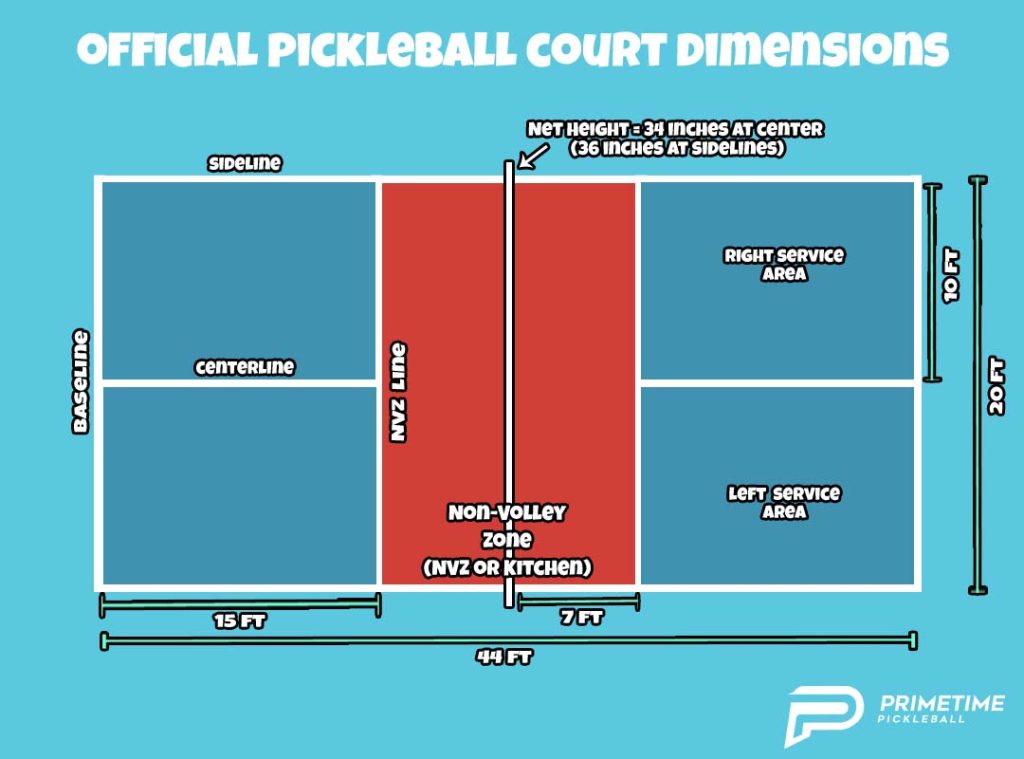
The standard pickleball court size is 20 feet wide by 44 feet long for doubles and singles. The non-volley zone is 7 feet on each side of the net. Service courts are split into 10-foot by 15-foot rectangles. The net stands 36 inches high at the sidelines and 34 inches in the middle.
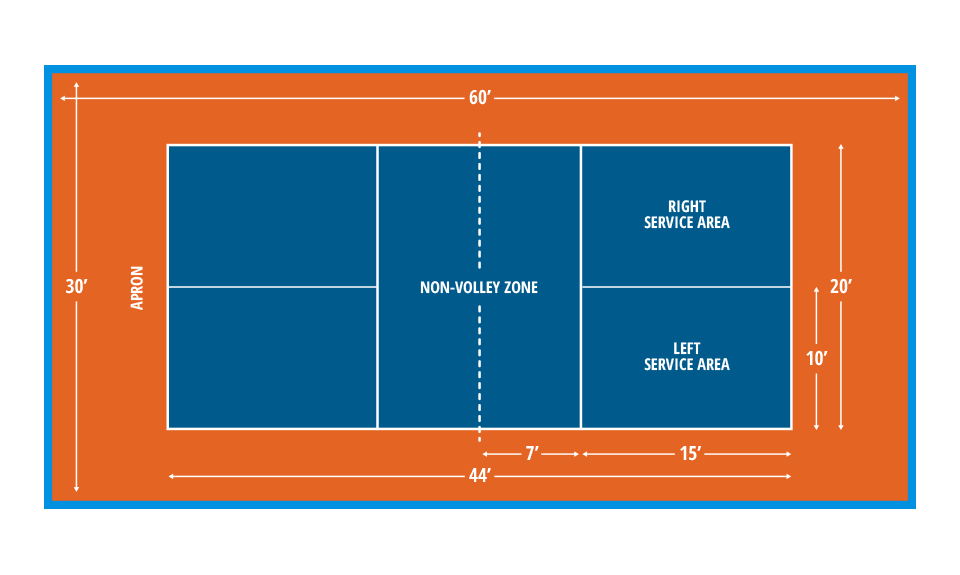
For safe play, plan for a total court area of at least 30 feet by 60 feet. This adds space behind baselines and along sidelines. Many facilities prefer 34 feet by 64 feet for better run-off.
Key specs at a glance
- Playing lines area: 20 by 44 feet
- Ideal total space: 30 by 60 feet (minimum), 34 by 64 feet (preferred)
- Non-volley zone: 7 feet from the net on each side
- Service boxes: 10 by 15 feet each
- Net height: 36 inches at posts, 34 inches at center
- Line width: 2 inches, part of the court
Why the standard pickleball court size matters
Court size affects safety, fairness, and fun. If your run-off space is tight, you will hesitate on lobs. If lines are off by an inch, serves feel unfair. When your space meets the standard pickleball court size, players move with confidence, and rallies feel right.
I once played on a court with short baselines. Every deep return felt awkward. When we resized to the standard pickleball court size with proper run-off, long rallies returned, and players stopped tripping.

Benefits of correct sizing
- Better safety with room to brake and turn
- True bounces and honest lines
- Consistent play from court to court
- Smoother tournaments and leagues
Court layout explained
The standard pickleball court size packs a lot into a small footprint. Understanding each zone helps you paint lines and teach new players.

Main zones
- Baselines: The back boundary lines on each end of the 44-foot length.
- Sidelines: The side boundaries across the 20-foot width.
- Non-volley zone: 7 feet from the net on each side. You cannot volley while touching this area.
- Centerline: Splits the service courts into left and right boxes.
- Service courts: Each is 10 feet wide by 15 feet long, from the non-volley line to the baseline.
Net details
- Height: 36 inches at sidelines, 34 inches at center dip.
- Length: Net spans the 20-foot court with posts placed just outside the sidelines.
- Tension: Keep tight enough to hold height but not bow the posts.
Line tips from the field
- Use 2-inch tape or paint for clarity.
- Measure twice at corners and diagonals to keep squares true.
- Mark the non-volley zone boundary clearly. It is the most used line after the baseline.
Indoor vs outdoor sizing and space
The standard pickleball court size stays the same indoors and outdoors. What changes is how much space you add for walls, fences, and safety.

Indoor notes
- Leave 3 to 5 feet from the sideline to the wall or divider.
- Aim for 7 to 10 feet behind baselines if you can.
- Watch ceiling height for lobs. Higher is better.
Outdoor notes
- Fences should be a few feet beyond the recommended 30 by 60 feet area.
- Wind can push lobs deep. Extra baseline space helps.
- Use UV-stable paint or tape for lines.
Setting up a court at home
You can set up the standard pickleball court size in a driveway, cul-de-sac, or backyard. It is easier than most think, as long as you measure well.

Quick setup steps
- Measure and mark a 20 by 44 feet rectangle.
- Add run-off to reach at least 30 by 60 feet.
- Snap chalk lines. Paint or tape 2-inch lines.
- Place a portable net and adjust to 36/34 inches.
- Test with a few serves and dinks before final paint.
Converting a tennis court
- One tennis court can host up to four pickleball courts.
- Use the singles sidelines as guides.
- Add temporary nets and removable lines to protect the tennis surface.
Common home mistakes
- Short baseline run-off causes stumbles on deep balls.
- Sloped driveways create odd bounces. Test first.
- Cheap tape lifts in heat. Invest in outdoor line tape or paint.
Surface, net, and equipment standards
A good court feels fast but fair. The standard pickleball court size is only part of the puzzle. Surface and net quality matter just as much.

Surface
- Asphalt or post-tension concrete offers the best balance of speed and cushion.
- Outdoor acrylic coatings improve grip and visibility.
- For temporary setups, sport tiles work well.
Net and posts
- Choose a regulation portable net with a stable base.
- Check 36 inches at the sides and 34 inches at center before each play day.
- Replace frayed center straps early to keep height true.
Balls and paddles
- Outdoor balls are harder with smaller holes.
- Indoor balls are softer with larger holes.
- Match ball type to the setting for better control and fewer cracks.
Common sizing mistakes and fixes
Even seasoned players mis-measure the standard pickleball court size. The good news is that most fixes are simple.

Mistakes I see often
- Non-volley zone too short or too long by a foot.
- Crooked centerlines, which skew serves.
- Net too high at center, causing unfair net cords.
Quick fixes
- Re-measure from the net plane, not the tape edge, for the 7-foot kitchen.
- Use a chalk line reel to snap straight centerlines.
- Keep a small level or measuring stick to check 34 inches at center.
Space planning for clubs and events
If you manage a gym or park, plan beyond the standard pickleball court size. Think flow, seating, and storage.
Planning tips
- Leave walking lanes behind baselines to avoid player traffic jams.
- Add benches 3 to 5 feet off the sideline for safety.
- Keep a gear corner for nets, balls, and bins to reduce clutter.
Tournament layout
- Use 34 by 64 feet when space allows to reduce let calls.
- Add clear signage for court numbers and brackets.
- Provide warm-up areas to limit delays between matches.
Cost and budget basics
Building to the standard pickleball court size can be budget-friendly. Costs scale with surface type and extras.
Typical ranges
- Temporary tape and a portable net: Low cost for a driveway setup.
- Acrylic-coated asphalt with permanent posts: Moderate cost for parks.
- Post-tension concrete, pro coating, fencing, and lights: Higher cost for clubs.
Save smart
- Start with one lined court and add more later.
- Use shared fencing around multiple courts.
- Buy a quality net once; it pays off in durability.
Frequently Asked Questions of standard pickleball court size
What are the exact dimensions of a standard pickleball court?
The playing area is 20 feet by 44 feet. The preferred total space is 34 feet by 64 feet, with 30 feet by 60 feet as the minimum.
How high is the net on a standard pickleball court?
It is 36 inches high at the sidelines and 34 inches at the center. Check with a tape before play to keep it consistent.
How big is the non-volley zone on a standard pickleball court?
The non-volley zone is 7 feet from the net on each side. The line itself counts as part of the zone.
Can I fit a standard pickleball court size in my driveway?
If you have at least 30 by 60 feet, yes. If not, you can still practice, but play may feel tight near the baselines.
Is the standard pickleball court size the same for singles and doubles?
Yes, singles and doubles share the same 20 by 44 feet court. Only the number of players changes, not the lines.
What is the size of each service box on a standard pickleball court?
Each service court is 10 feet by 15 feet. They run from the non-volley line to the baseline and are split by the centerline.
How much space should I leave around the court for safety?
Aim for at least 5 feet on the sides and 7 to 10 feet behind baselines. More space is better for lobs and sprints.
Conclusion
Getting the standard pickleball court size right sets the stage for safe, fair, and fun play. Measure carefully, allow enough run-off, and keep your net at 36 and 34 inches. Small details, like a straight centerline and clear kitchen, make games feel great.
Use this guide to build or check your court this week. If you found this helpful, share it with your club, subscribe for more guides, or leave a comment with your setup questions.