
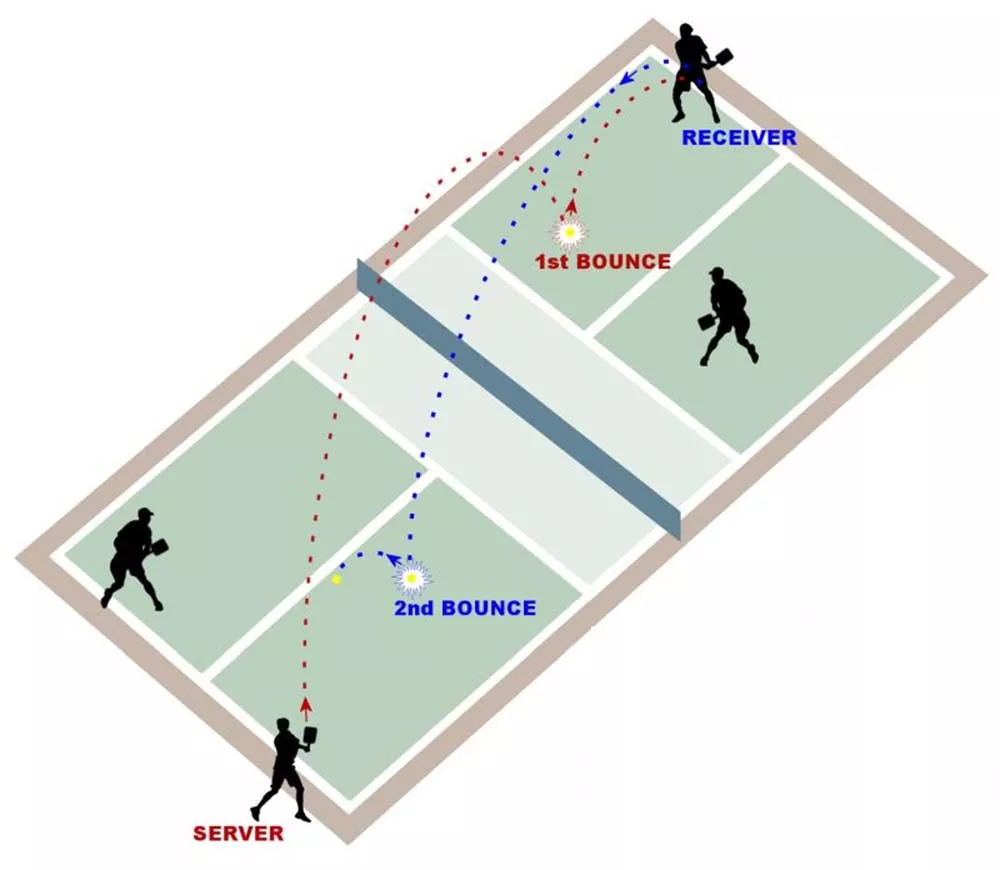
The double-bounce rule requires the ball to bounce once on each side after the serve before any volleys.
As a long-time pickleball player and coach, I've seen countless new players get tripped up by one specific, quirky rule. It's not the kitchen line or the scoring system that causes the most confusion; it's the rule that defines the very start of every point. Understanding the double-bounce rule in pickleball is the key to unlocking longer rallies, smarter strategies, and a much more enjoyable game. This guide will break down everything you need to know, from the basic mechanics to the advanced strategies that will help you master this fundamental aspect of the sport.

What Exactly is the Double-Bounce Rule in Pickleball?
At its core, the double-bounce rule is simple. It governs the first two shots of any rally: the serve and the return of serve. The official rule states that after the serve, the receiving team must let the ball bounce once before returning it. Then, the serving team must also let that return bounce once before hitting it.
Let's break that down step-by-step:
- Bounce 1: The Serve. The player serving hits the ball to the receiver's service court. The receiver must let this ball bounce before they can hit it. This part is pretty intuitive, just like in tennis.
- Bounce 2: The Return of Serve. After the receiver hits the ball back over the net, the serving team cannot hit it out of the air (a volley). They must let the returned ball bounce once on their side.
After these two bounces have occurred, the rule is no longer in effect for the rest of the rally. Players on both teams are now free to volley the ball or play it off the bounce. Think of it as a "two-bounce minimum" to start the point. This rule is why you often see players starting rallies from the baseline and then moving forward to the non-volley zone (or kitchen line).

The "Why" Behind the Rule: A Quick History Lesson
You might be wondering why this rule even exists. It feels a bit strange compared to other net sports, right? The double-bounce rule in pickleball was created by the game's founders to solve a specific problem: preventing the serving team from having an overwhelming advantage.
Without this rule, the serving team could simply serve the ball and immediately rush the net. The server's partner could then smash an easy volley on the return, ending the point almost instantly. This would create short, boring points dominated by power rather than strategy.
By forcing both teams to play the ball off the bounce at the start, the rule accomplishes several things:
- It extends rallies, making the game more fun and engaging.
- It levels the playing field, giving the receiving team a fair chance to get into the point.
- It emphasizes strategy, placement, and the "dink" game over pure power.
I remember playing a casual game with a friend who was new to pickleball. He had a strong tennis background and kept trying to serve and volley. After losing five straight points because he volleyed the return, he finally threw his hands up in frustration. I explained the purpose of the double-bounce rule, and a lightbulb went on. He realized it wasn't just an arbitrary restriction; it was the foundation of pickleball strategy.

Common Mistakes and Misconceptions
Despite its simple premise, the double-bounce rule in pickleball is the source of many common faults, especially for new players. The most frequent mistake is made by the serving team. After serving, they often forget they have to let the return bounce. Instinct takes over, and they step in to hit a volley, immediately losing the point.
Another common misconception is about when the rule ends. I've seen players hesitate to volley later in a rally, thinking the ball always has to bounce. Remember, once the serve has bounced and the return of serve has bounced, the double-bounce rule is done. From the third shot onward, all bets are off, and volleys are fair game for everyone.
A funny story from my own experience: during a tournament, my partner and I were the serving team. The return came back high and slow, a perfect put-away shot. My partner, forgetting the rule in the heat of the moment, smashed a winning volley. We celebrated for a second before our opponents calmly pointed out our fault. It was an embarrassing but valuable lesson—always remember the double-bounce rule in pickleball, no matter how juicy the shot looks.

Strategies to Master the Double-Bounce Rule
Instead of seeing the rule as a limitation, smart players use it to their advantage. Mastering the double-bounce rule in pickleball is about positioning and shot selection. Your goal is to hit shots that put your opponents in a difficult position after their required bounce.
Here are some strategies for both teams:
- For the Serving Team: After you serve, don't just stand there. The moment the receiver hits the ball, both you and your partner should be moving up toward the non-volley zone line. Your goal is to establish your position at the net by the time the return bounces, ready for the third shot.
- For the Receiving Team: Your primary goal on the return of serve is to hit a deep, controlled shot. This pushes the serving team back, making it harder for them to get to the net after their bounce. A deep return gives you more time to advance to your own kitchen line and take control of the point.
- The Third Shot Drop: This is perhaps the most critical shot related to the double-bounce rule. After the serving team lets the return bounce, they often hit a soft, arching shot that lands in the opponent's kitchen. This "third shot drop" is designed to be unattackable, allowing the serving team to safely advance to the net and neutralize the receiving team's advantage.
By focusing on deep returns and effective third shots, you can turn the double-bounce rule from a simple requirement into a powerful strategic weapon.

How the Double-Bounce Rule Impacts Gameplay
The double-bounce rule is the heart and soul of pickleball's unique rhythm. It creates a distinct flow that sets it apart from sports like tennis or badminton. The rule forces a more deliberate and strategic start to every point, preventing immediate, aggressive net play from dominating the game.
This deliberate start is what leads to the classic pickleball rally structure:
- Serve and return from the baseline.
- Both teams advance to the non-volley zone.
- A strategic "dink" rally begins, where players exchange soft shots until one team makes a mistake or creates an opening for an attack.
Without the double-bounce rule in pickleball, the game would be much faster and more reliant on power. The serving team would have a huge advantage, and the intricate dinking exchanges that make pickleball so compelling would rarely happen. It’s a simple rule, but it has a profound impact on every single point you play.
Frequently Asked Questions about the Double-Bounce Rule in Pickleball
h3 Does the double-bounce rule apply in singles pickleball?
Yes, the rule applies to both singles and doubles play. The server must let the return bounce, and the receiver must let the serve bounce before volleys are allowed.
h3 What happens if I volley the return of serve?
If you are on the serving team and you volley the return of serve, it is a fault. You immediately lose the rally, and the other team wins the point.
h3 Can the ball bounce twice on my side before I hit it?
No, that would be a fault. The ball can only bounce once on your side of the court before you must hit it. The double-bounce rule refers to one bounce on each side, not two bounces on one side.
h3 When is it okay to start volleying?
You can start volleying after the first two bounces have occurred. To be specific, the third shot of the rally (the one hit by the serving team after the return of serve bounces) can be the first volley of the point, provided the player is not in the non-volley zone.
h3 Is the double-bounce rule the same as the two-bounce rule?
Yes, the terms are used interchangeably. Both "double-bounce rule" and "two-bounce rule" refer to the same official rule in pickleball that governs the serve and return of serve.
Conclusion
The double-bounce rule in pickleball may seem unusual at first, but it is the cornerstone of the game's strategy and flow. It ensures fair, competitive points and encourages the soft-game finesse that makes the sport so addictive. By understanding not just what the rule is but why it exists, you can transform your approach from simply following a requirement to strategically using it to your advantage.
The next time you step on the court, pay close attention to the start of each rally. Practice your deep returns, work on your third shot drop, and focus on your court positioning. Mastering the double-bounce rule is a journey, but it's one that will make you a smarter, more effective, and more confident pickleball player.
Have a story about a time the double-bounce rule tripped you up? Share it in the comments below