The short answer
The three-player game most sources describe is cutthroat, also called Australian pickleball: one player serves alone against a pair, only the solo server scores, each player keeps their own score, and the players rotate when the server loses a rally. USA Pickleball’s rulebook covers singles and doubles, so three-player games run on house rules.
Every rule here comes from a named, dated source: USA Pickleball’s 2026 Official Rulebook (read November 5, 2026) for the official game, and two clubs and two pickleball publications for the three-player formats. Where they disagree, both versions are shown. More rules explainers sit in our Rules, Courts & Play guides.
What the Official Rulebook Covers
The rulebook says in Section 1: “Pickleball can be played as singles or doubles.” Part II adds: “Section 14 provides format variations to standard play.” Those are rally scoring (Rule 14.A) and mini-singles (Rule 14.B), a half-court form of singles. The tournament event categories in Rule 15.A are singles and doubles events. No section sets rules for three players.
Pickleland, an indoor pickleball club in Austin, says the same of its three-player games: “None of these is in the USA Pickleball rulebook, which covers singles, doubles and their official variations (rally scoring and mini-singles, Section 14).” It adds: “These are house formats, so agree on the details before the first serve.”
Cutthroat, Also Called Australian Pickleball
PlayPickleball.com (August 2, 2024) calls the format “also known as Cutthroat Pickleball or Australian Pickleball (similar to Canadian Doubles in tennis)”. Pickleland (first published December 2, 2024) calls cutthroat “The most popular 3-player game.” The rules below come from those two pages, The Dink, a pickleball publication (June 9, 2024), and the Pickleball Athletic Club (PAC), an indoor club in Thousand Oaks, California (August 20, 2025). PAC describes cutthroat as “accommodating three players on a standard court”; for the paddle each player needs, see the best pickleball paddles.
One player faces two
PlayPickleball.com: “To play pickleball with three people, you will have one player on one side of the net, and two players on the other side of the net.”
The solo player serves
“The single player always serves.” (PlayPickleball.com). PAC adds that the solo player “continues serving while winning points”.
The server’s own score sets the serving side
The Dink: “When the score of the player serving is even (0, 2, 4, 6, 8, 10), they serve from the right side. When it’s odd (1, 3, 5, 7, 9), they serve from the left.” Pickleland calls this serving “as in singles”; see how serving works in singles and doubles.
Only the server scores, and each player scores alone
PlayPickleball.com: “You can only score if you are the serving player.” and “Each player is scored individually. Keep track of your own points.”
When the pair wins a rally, the players rotate
The Dink: “The single player continues serving until they side out. When that happens, all the players rotate clockwise, and one of the players on the two-player side moves onto the one-player side for their serve.” Pickleland names the order (A, B, C) instead of court positions: “The next player in order (B) becomes the solo server, and A joins C as a pair.”
First to 11; PAC and Pickleland add win by 2
“The first person to 11 points wins the game.” (PlayPickleball.com); “Games are played to 11 and everyone keeps track of their scores.” (The Dink). PAC says “Play to 11 points, win by 2”, and Pickleland “First to 11, win by 2, wins.” Compare how standard pickleball scoring works.
Pickleland’s worked example, with A, B and C taking the solo role in that order:
| Rally | Solo server | Pair | Rally won by | Scores (A-B-C) |
|---|---|---|---|---|
| 1 | A | B + C | A | 1-0-0 |
| 2 | A | B + C | Pair | 1-0-0 |
| 3 | B | A + C | B | 1-1-0 |
| 4 | B | A + C | Pair | 1-1-0 |
| 5 | C | A + B | C | 1-1-1 |
Source: Pickleland’s rotation example.
Where the Ball Must Land: Sources Differ
PAC lists a “Standard pickleball court (20×44 feet)”, the size the rulebook sets (see our pickleball size guide). The pages differ on how much of it is in play.
| Source | Solo player’s end | Where the pair must hit | Where the solo player may hit |
|---|---|---|---|
| PlayPickleball.com | The half served from; the other half is out | Into the half the solo player served from | Not stated |
| The Dink | The half served from | Into that half | The entire court |
| PAC | The served half | The served half | Not stated |
| Pickleland | The whole width | Not stated; the solo player’s half in its “half court for the pair” variation | Not stated; anywhere in that variation |
PlayPickleball.com: “The single player will only play on the side/half of the court that they serve from.” The other half “is considered out of bounds during that rally”, and the pair’s returns must stay in the served half, bounded by “the imaginary extension of the center line through the kitchen zone to the net”. The serve is normal: “The serve is legal if it lands in the normal boundaries of the receiving side of the pickleball court.” The Dink: “The two-player side can only hit the ball into the half of the court that the single player serves from, while the solo player can hit it to the entire court.”
Pickleland’s caption reads “Cutthroat: the solo player covers the whole width, the pair splits it.” Its variation: “To even things out, the pair must hit into the solo player’s half and the solo player can hit anywhere. Or the reverse, if the solo player is the strongest.”
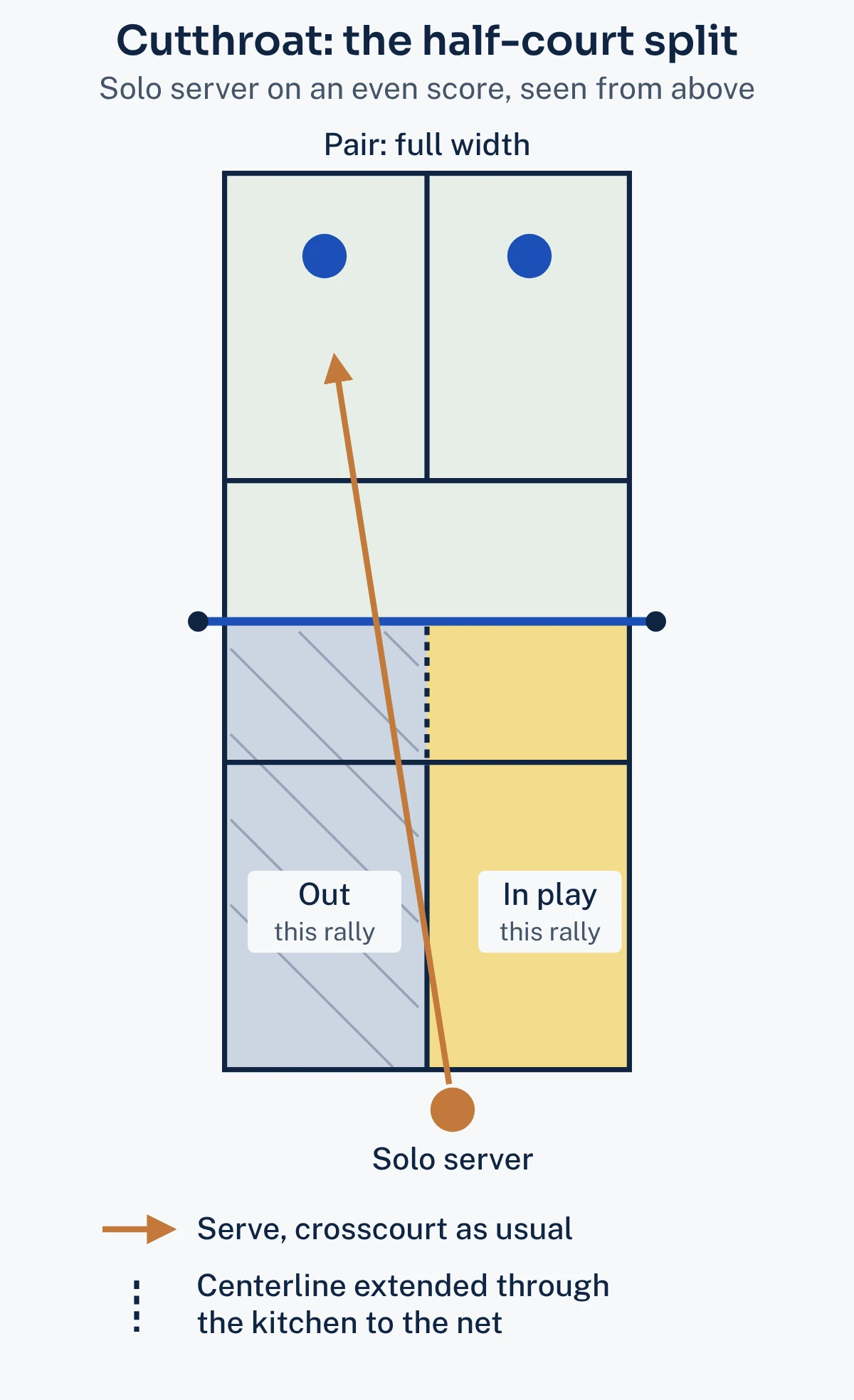
PAC lists “Kitchen rules remain standard”. Pickleland: “The standard two-bounce rule applies by default. Some groups let the solo player volley the return to make up for being outnumbered.” It also lists rally scoring: “Points on every rally, credited to whoever was serving or receiving alone.” The official option for singles and doubles is in our rally scoring guide.
Skinny Singles With a Third Player Waiting
The Dink: “Skinny singles is one of the most popular games to play with just two people (or three if you want to sub someone out after each game).” In its version, “every ball that’s hit must stay within the half of the court the player starts the point on.”
The rulebook’s own half-court game is mini-singles. Rule 14.B.1.a: “Only the right or left side on each player’s end of the court is in play during each rally based on each player’s respective score.” Rule 14.B.1.c: “An additional line must be provided that extends the centerline of the court through each non-volley zone.”
Pickleland’s version is winner-stays: “Two players play a short game on half the court, crosscourt or with the official mini-singles rules. The third waits at the side.” Games go to 5 or 7, win by 1, and “The winner stays on. The loser steps off and the waiting player steps in.” For equal court time it gives “A 9-game schedule if you’d rather everyone plays the same amount”:
| Games | On court | Sitting out |
|---|---|---|
| 1, 4, 7 | A vs B | C |
| 2, 5, 8 | B vs C | A |
| 3, 6, 9 | A vs C | B |
“Each player plays 6 of the 9 games and sits out 3.” For two players, see our guide to playing pickleball with two people.
Which 3-Player Format Fits Your Group
| Format | On court | Game length | Suits (source’s words) |
|---|---|---|---|
| Cutthroat | 3: one vs two | To 11; win by 2 for PAC and Pickleland | “A competitive game with friends” (Pickleland) |
| Skinny singles, third player rotates in | 2; third waits | To 11, sub out after each game (The Dink); 5 or 7, win by 1, winner stays (Pickleland) | “Even-level players who like singles” (Pickleland) |
| Skinny singles, set schedule | 2; third sits out | 9 games, 6 each (Pickleland) | When “everyone plays the same amount” (Pickleland) |
Pickleland names a third option, three-player drills, “if you’d rather practise than keep score”.
Quick check
Pickleland: “Agree on the rules before the first point.” Its list: “Two-bounce rule, scoring, game length, line calls.” For cutthroat, the sources also differ on which half is in play, and only PAC and Pickleland state win by 2.
Frequently Asked Questions
Q. What is 3-person pickleball called?
Cutthroat, or Australian pickleball. PlayPickleball.com likens it to Canadian Doubles in tennis.
Q. Is there an official rule for 3-person pickleball?
No. Pickleland’s answer: “The USA Pickleball rulebook covers singles and doubles, plus rally scoring and mini-singles. Three-player games are house rules, so agree on them before you start.”
Q. Can the pair score points in cutthroat?
Not in these versions. PAC: “Only the solo player can score points”.
Q. Does the two-bounce rule apply in cutthroat?
In Pickleland’s version it applies by default, and some groups relax it for the solo player.
Q. Is pickleball played best of 3?
In tournaments it can be: the rulebook’s standard scoring options include “Best 2-of-3 games to 11 points.” (Rule 15.C.1.a). The three-player sources describe single games.
Sources (5)
- USA Pickleball, 2026 Official Rulebook (PDF)
- PlayPickleball.com, 3-person pickleball rules: Australian/Cutthroat Pickleball (August 2, 2024)
- The Dink, Pickleball Games You Can Play with Less Than Four People (June 9, 2024)
- Pickleball Athletic Club, 3 Person Pickleball: Master Cutthroat’s Winning Rotations (August 20, 2025)
- Pickleland, 3-Person Pickleball Rules: Cutthroat, Winner-Stays Singles and 3-Player Drills (first published December 2, 2024; updated October 28, 2026)