The short answer
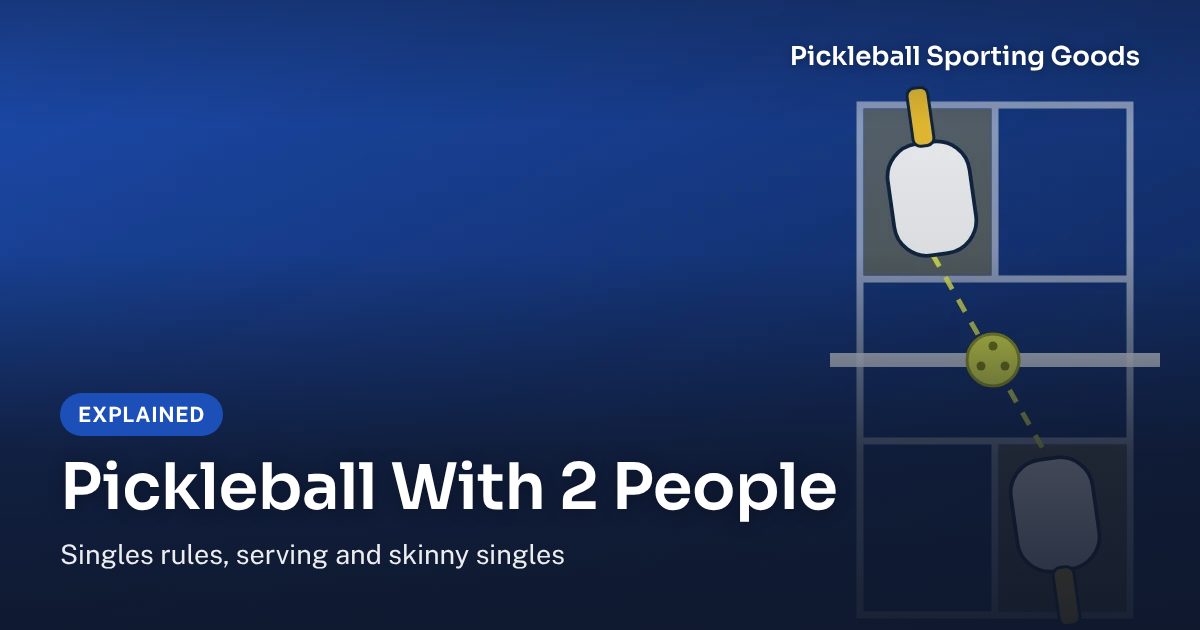
Yes. Two people play singles, one player on each end of the court. USA Pickleball’s 2026 Official Rulebook says in Section 1: “Pickleball can be played as singles or doubles.” Singles uses the same court, one server per side out and a two-number score. Skinny singles is a half-court version.
Every rule below is quoted from USA Pickleball’s 2026 Official Rulebook (read November 5, 2026) with its rule number. The skinny singles versions come from a pickleball publication and a pickleball retailer, named at each rule. More rules explainers sit in our Rules, Courts & Play guides.
What the Rulebook Says About Two Players
Singles is part of the standard game, not a house variation. The rulebook gives its purpose as “the rules necessary for standard play (recreational, social, organized league), and tournament play”, and adds: “Part I and Part II of this rulebook are applicable to all play, both standard play and tournament play.” The singles rules sit in those two parts, so a two-player game at a park and a sanctioned singles match start from the same rules.
The court does not change either. Rule 3.A.1 sets it at “20 feet (6.10 m) wide and 44 feet (13.41 m) long for both singles and doubles matches.” Our pickleball size guide quotes the rest of the court, net, ball and paddle figures. Paddles for the one-player game are compared in our singles pickleball paddles roundup.
In tournaments, singles is an event of its own. Rule 15.A lists Men’s, Women’s, Wheelchair and Adaptive Standing events as “Singles and Doubles”, while Mixed and Hybrid events are doubles.
Two players against one is a different game: the rulebook sets no three-player format, and our guide to 3 person pickleball sets out the house rules clubs use for it.
How Singles Serving Works, Rule by Rule
The server’s own score picks the side
Rule 5.A.1: “When the server’s score is zero or even, the serve must be made from the right serving area and be received in the opponent’s right service court. When the server’s score is odd, the serve must be made from the left serving area and be received in the opponent’s left service court.”
The serve crosses diagonally
Rule 7.E: “The server must serve to the service court diagonally opposite their correct position.” It goes on: “The served ball must clear the opponent’s non-volley zone, with or without touching the net, and land in the correct service court.”
The server keeps serving while winning rallies
Rule 5.A.2: “A player continues to serve, alternating right and left serving areas after each point won, until the player loses a rally.”
One lost rally ends the turn
Rule 5.A.3: “A side out occurs after the server loses a rally.” The serve then goes to the other player, whose own score sets their side. Our explainer on how many serves you get in pickleball covers serve faults and the doubles sequence.
Both bounces still apply
Rule 10.A: “The serve and the return of serve must each bounce before being returned.” The non-volley zone is the same too: Section 1 describes it as “the area of the court that extends 7 feet from the net on each end of the court”.
Calling the Score and Winning a Singles Game
Rule 6.B.1: “For singles play, the score must be called as two numbers: server’s score, then receiver’s score.” It adds: “To start each game, the score will be called as “zero – zero.””
Worked from rules 6.B.1 and 5.A.1: a server with 5 points facing a receiver with 3 calls “5 – 3” and, because 5 is odd, serves from the left serving area.
Section 1 explains the scoring method: “Standard pickleball uses a scoring method where points are scored only when the serving team wins the rally.” Rule 4.A: “A point is scored by serving the ball and winning the rally.” Section 1 also gives the usual target: “Typically, the first player or team scoring 11 points and leading by at least a 2-point margin wins the game.”
Tournaments set the match length. Rule 15.C says “All scoring options are win by two points, except win by one point is allowed for team play,” and the first standard option, 15.C.1.a, is “Best 2-of-3 games to 11 points.”
Singles vs Doubles: What Changes
| Rule | Singles | Doubles |
|---|---|---|
| Players | One per side | Two per side |
| Who serves before a side out | The server alone (5.A.3) | Both partners; at the start of each game, only the starting server (5.B) |
| Serving side set by | The server’s own score (5.A.1) | The team’s score (5.B.3) |
| Score call | Two numbers, starts “zero – zero” (6.B.1) | Three numbers, starts “zero – zero – two” (6.B.2) |
| Court, kitchen, two bounces | 20 x 44 ft; same rules (3.A.1, Section 1, 10.A) | Same |
Source: USA Pickleball 2026 Official Rulebook, rules as numbered.
The second server is a doubles idea. Rule 5.B reads: “Both players on a team will serve before a side out is declared, except at the start of each game when only the starting server will serve as a second server before a side out is declared.” The rulebook’s definitions label the term “(Doubles)”: “Second Server (Doubles). The first server’s partner. The second server serves after the first server loses serve.” A singles player has no partner, so one lost rally on serve is a side out (5.A.3). That is also why doubles adds a third number to the score call: rule 6.B.2 has “the server number” last.
Rally Scoring in Singles
Section 1 says “Rally scoring has been provisionally approved as an option (Rule 14.A)”. Rule 14.A reads: “Rally scoring may be used for singles and doubles.” The change for a singles game is who scores. Rule 14.A.2: “A point is scored by the singles player or doubles team that wins each rally.” Under rally scoring, doubles also has one server per side out: “Only one player on a team will serve before a side out is declared.” (14.A.5).
For tournaments, rule 15.C.2 lists rally scoring match formats as a provisional option, starting with 15.C.2.a: “One game to 11 points, 15 points, or 21 points.” Our rally scoring explainer covers serving, game point and where the format is allowed in 2026.
Skinny Singles: Two Players, Half the Court
Section 1 of the rulebook says: “Mini-singles (Rule 14.B) is a half-court variation of standard singles.” Pickleball Warehouse, a pickleball retailer, lists the names players use for it in its Learning Center (read November 5, 2026): “Some refer to it as ghost doubles, skinny singles, half-court singles or as the USAP officially designates it, “mini-singles.”” The Dink, a pickleball publication (June 9, 2024), says: “Skinny singles is one of the most popular games to play with just two people (or three if you want to sub someone out after each game).”
The rulebook’s version, rule by rule:
- Same rules, same court. “All standard singles rules apply to mini-singles except for the modifications included in this section.” (14.B) and “Mini-singles is played on a standard pickleball court.” (14.B.1)
- Half of each end is in play. “Only the right or left side on each player’s end of the court is in play during each rally based on each player’s respective score.” (14.B.1.a) The other half is out: “The opposite side of the court is out of bounds.” (14.B.1.b)
- One extra line. “An additional line must be provided that extends the centerline of the court through each non-volley zone.” (14.B.1.c)
- Each player’s own score sets their side. “The server’s and the receiver’s correct positions for a rally are determined by their individual scores.” (14.B.2)
- Every shot lands in the live half. “Each player’s served and returned balls must land in bounds of the opponent’s side of the court that is in play.” (14.B.3)
Casual skinny singles games do not all follow this. The two other sources describe their own versions:
| Version | Which half is in play | Game length |
|---|---|---|
| Rulebook mini-singles (14.B) | Set by “each player’s respective score” (14.B.1.a) | Standard singles rules apply (14.B) |
| The Dink | Start crosscourt; “every ball that’s hit must stay within the half of the court the player starts the point on”; “If the server scores a point, the server moves, but the returner stays.” | “Play games to 11, just as you regularly would.” |
| Pickleball Warehouse | “The traditional way is to play all of the points on the cross court”; option: “play goes straight across” | “Games to 11 or 15 are typical, but unless you are playing a USAP sanctioned event, there is no set limit.” |
Pickleball Warehouse also marks the extra line the rulebook requires: “extend the center court line up through the NVZ (kitchen) to the net on both sides of the court”. Its scoring line matches standard singles: “Scoring is side-out (same as usual). Players keep serving until they lose a point.”
Frequently Asked Questions
Q. Can you play 1v1 pickleball?
Yes. A one-on-one game is singles, which the rulebook names in Section 1 alongside doubles.
Q. Do you get two serves in singles pickleball?
No. The second server is a doubles term in the rulebook, and in singles a lost rally on serve is a side out (5.A.3).
Q. Do you use the whole court in singles?
Yes in standard singles: rule 3.A.1 sets one 20 by 44 foot court for both singles and doubles. Mini-singles (14.B) puts half of each end out of bounds.
Q. Are the singles rules different for casual games or beginners?
No. The rulebook says Parts I and II “are applicable to all play, both standard play and tournament play”, and its singles rules sit in those parts.
Q. Can two people play against one?
That is a three-player game, and the rulebook sets no three-player format. Our 3 person pickleball guide sets out the house formats clubs use, such as cutthroat.
Q. Is singles a tournament event?
Yes. Rule 15.A lists singles events for Men’s, Women’s, Wheelchair and Adaptive Standing play.
Sources (3)