
The main types of pickleball round robins include fixed partner, rotating partner, and ladder-style formats. As someone who has organized and played in countless pickleball events, I've seen firsthand how the right format can turn a good day of play into a great one. Choosing the best format can feel confusing, but it doesn't have to be. In this guide, we'll break down the different types of pickleball round robins, exploring how each one works so you can pick the perfect setup for your next game day, tournament, or social gathering.
Understanding the Basics: What is a Pickleball Round Robin?
Before we dive into the different variations, let's cover the basics. A pickleball round robin is a tournament format where every team plays against every other team in their group at least once. Think of it as a friendly but organized way to get a lot of games in with a variety of opponents. Unlike a single-elimination tournament where one loss means you're out, a round robin guarantees everyone plenty of court time.
This format is incredibly popular in pickleball for social events, club play, and even competitive tournaments. The winner is typically determined by the number of matches won. If there's a tie, the winner is often decided by point differential, which is the total points scored minus the total points allowed. This structure ensures that every single point matters, keeping the games exciting from start to finish.

The Fixed Partner Round Robin: A Competitive Classic
The fixed partner round robin is likely the format you're most familiar with, especially if you've played in traditional tournaments. In this setup, you and your partner sign up as a team and stay together for the entire event. You’ll play against all the other pairs in your designated pool or division. This is the go-to format for serious competition.
From my experience, this is the best way to test a partnership's chemistry and strategy. It really shows you how well you and your partner communicate and adapt under pressure. The biggest advantage is that it rewards teamwork and consistent play. However, the downside is that if you're paired with someone whose skill level is very different from yours, it can lead to a long and frustrating day. Choosing the right partner is absolutely key for these types of pickleball round robins.
The Rotating Partner Round Robin: The Ultimate Social Mixer
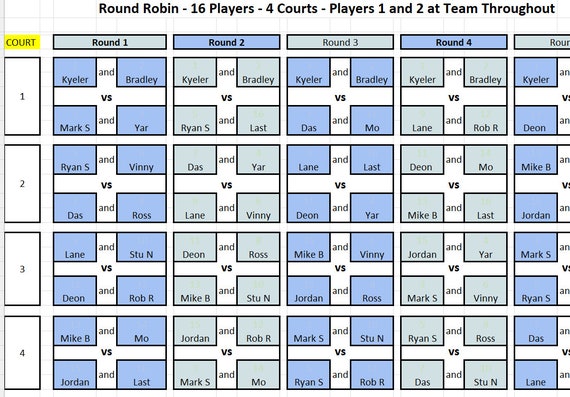
Often called a "scramble" or a "mixer," the rotating partner round robin is all about fun and meeting new people. In this format, you sign up as an individual, and your partners change for every game or every round. The goal is less about which team wins and more about individual performance. Your personal score is tracked, and the player with the most wins or highest point total at the end is the champion.
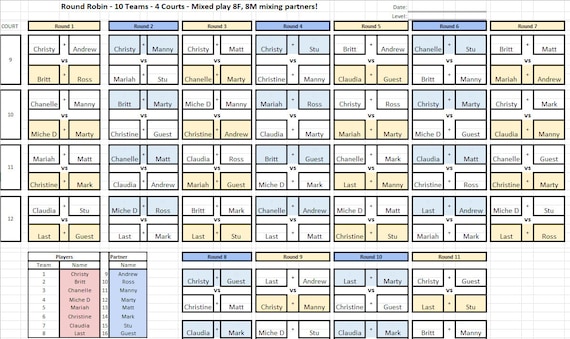
I love running these events for our local club because they break down cliques and encourage players to mingle. It’s a fantastic way to balance out the skill levels across the courts. A beginner might get paired with an advanced player, creating a great learning opportunity. The challenge here is organization. You need a clear system for rotating players to ensure everyone gets a fair mix of partners. While less formally competitive, this is one of the most popular types of pickleball round robins for social play.

The Ladder League: A Dynamic and Continuous Format
A ladder league is a type of continuous round robin that is perfect for clubs or groups that play together regularly. Players are arranged on a "ladder" according to their rank. Players challenge others who are ranked closely to them, typically one or two spots above. If the lower-ranked player wins, they take the higher-ranked player's spot on the ladder.
This format is excellent for fostering ongoing competition and tracking individual progress over a season. It allows players to find competitive matches at their skill level consistently. The beauty of the ladder is its flexibility; players can participate as their schedules allow. It’s less of a single-day event and more of an evolving competition. Setting one up requires a good manager to track results, but it’s one of the most engaging types of pickleball round robins for dedicated players.
How to Choose the Right Round Robin Format for Your Event
Deciding between the different types of pickleball round robins comes down to the goal of your event. Are you hosting a highly competitive tournament or a laid-back weekend social? Answering this question is the first step. Here are a few things to consider to help you make the right choice.
- Goal of the Event: For competitive play where strategy and teamwork are paramount, the fixed partner format is the best choice. For a social event focused on fun and community, the rotating partner scramble is unbeatable.
- Player Skill Levels: If you have a wide range of skill levels, a rotating partner format helps balance the courts and prevents lopsided games. If your players are all at a similar level, a fixed partner event can create some intense and exciting matches.
- Time and Court Availability: A simple round robin with a small group can be done in a few hours. Larger groups or more complex rotating formats will require more time and courts. A ladder league is a long-term format that doesn't require everyone to be present at once.
- Number of Players: The number of participants heavily influences the best format. For example, running a rotating partner event with an odd number of players requires a system for "byes," where one player sits out each round.
Ultimately, understanding the different types of pickleball round robins allows you to tailor the experience to your group. Don't be afraid to try different formats to see what your players enjoy the most.
Frequently Asked Questions of types of pickleball round robins
How do you score a pickleball round robin?
In a round robin, scoring is usually based on the number of matches won. The team or player with the most wins is the champion. If there is a tie in wins, the tiebreaker is typically the total point differential (points for minus points against).
What is a "bye" in a round robin?
A "bye" occurs when there is an odd number of teams or players in a group. In each round of play, one team or player must sit out. This ensures that everyone else has an opponent to play against.
How long does a pickleball round robin take?
The duration depends on the number of players, the number of courts, and the format of the games (e.g., one game to 11 or 15). A small round robin with 8 players on two courts could take about 2-3 hours.
Which round robin is best for beginners?
A rotating partner round robin, or scramble, is excellent for beginners. It provides a low-pressure environment, allows them to play with more experienced players, and focuses on fun rather than intense competition.
Can you run a round robin with different skill levels?
Yes, absolutely. A rotating partner format is ideal for mixing skill levels, as it balances the talent across all courts. For a fixed partner event, it is best to create separate divisions or pools based on skill ratings to ensure fair and competitive matches.
Conclusion
Mastering the various types of pickleball round robins can elevate your playing experience, whether you're organizing a casual get-together or a competitive tournament. From the strategic depth of a fixed partner event to the social fun of a scramble and the ongoing challenge of a ladder league, there is a format for every occasion. The key is to match the format to the goals and skill levels of your players.
Now that you're equipped with this knowledge, I encourage you to organize your own round robin. Start small, communicate the rules clearly, and focus on creating a positive experience for everyone involved. What are your favorite types of pickleball round robins to play in? Share your experiences in the comments below