The short answer
On durability, Selkirk and Pickleball Effect lean yes. Selkirk says foam-filled cores “significantly reduce the risk of core crushing”, and Pickleball Effect found positive long-term reports outnumbered significant failure reports by roughly 3 to 1 in a Reddit discussion. The catches: Pickleheads says foam paddles “usually cost a little more”, owners still report disbonding, and some pros prefer honeycomb.
Selkirk, CRBN, JOOLA, Paddletek, Onix and Brick House Paddles make and sell paddles, so their lines below are makers’ claims. For the face sheets, edge guard and grip, see our guide to what pickleball paddles are made of.
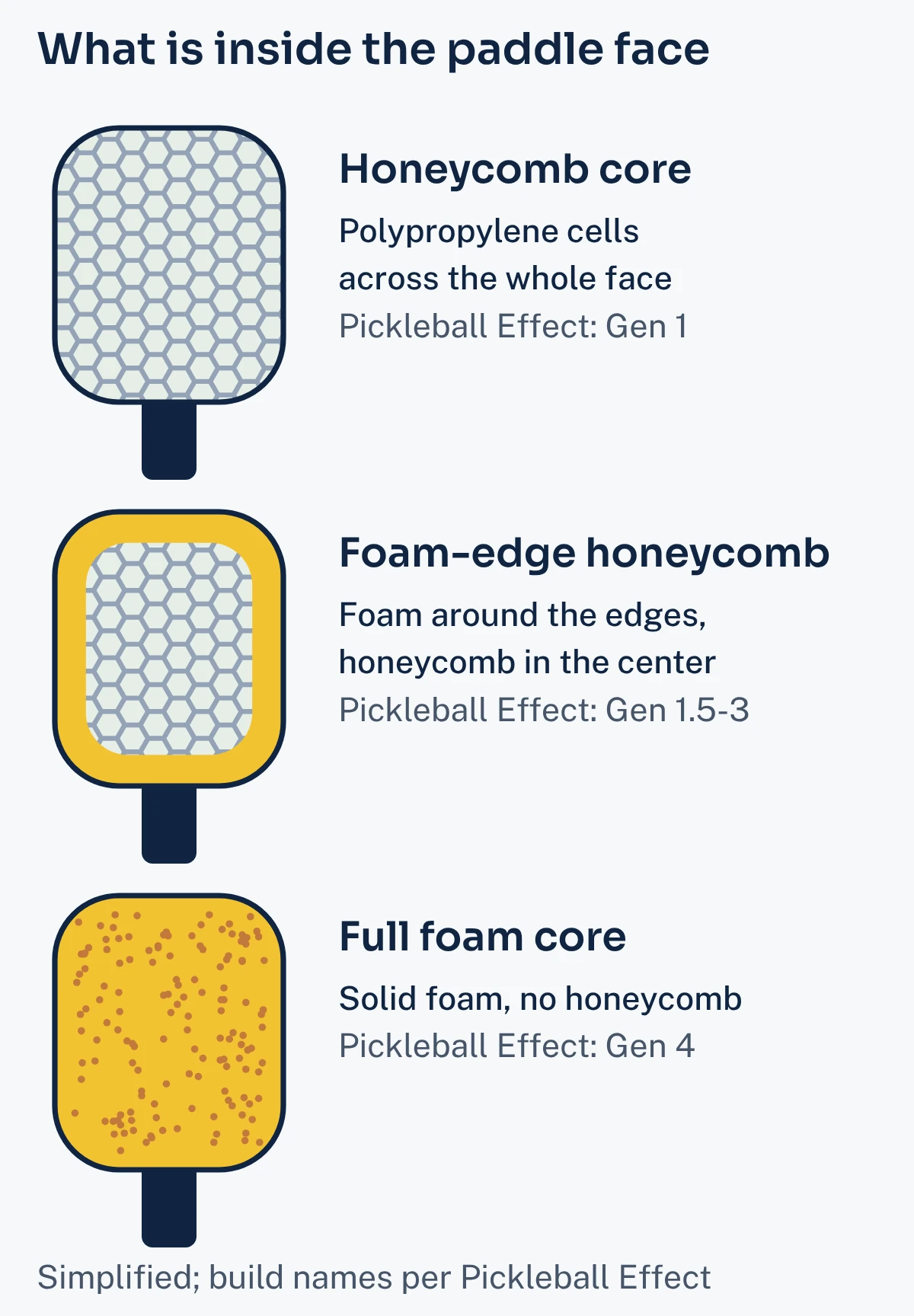
Full foam or foam around a honeycomb: what the label covers
Onix, a paddle maker, explains where the core sits in its foam vs honeycomb article (August 18, 2026, per the page’s metadata): “The core sits between the paddle’s face layers and helps determine how the paddle feels, responds, and performs.” Pickleheads’ paddle cost guide (August 13, 2026) describes what that core used to be: “For most of the last decade, nearly every paddle used the same build: a polypropylene honeycomb core.”
“Foam paddle” can mean two builds. Pickleball Effect, a paddle-testing site that publishes its own measurements, draws the line in its core guide (Nate Ting, May 9, 2026): “Fully foam core paddles replace that honeycomb structure entirely.” It adds: “It’s important to distinguish these from earlier foam-enhanced polymer paddles. In those designs, foam was primarily used around the perimeter while the center remained a traditional honeycomb polymer core.”
Pickleball Effect’s paddle buyer’s guide (Braydon Unsicker, published March 1, 2025, updated April 7, 2026, per the page’s metadata) names the builds as generations, “since they were adopted in that order”:
| Build (Pickleball Effect’s name) | What is inside, in its words | Introduced, per the guide |
|---|---|---|
| Cold Pressed (Gen 1) | “the paddle’s facing layers are adhered to the polymer core, and then an edge guard is wrapped around it” | not given |
| Light Thermoforming (Gen 1.5) | “expanding foam injected around the perimeter” | 2023 |
| Full Thermoforming (Gen 2) | “They often have foam injected around the edges” | 2023 |
| Widened Foam Edge (Gen 3) | “incorporate additional foam around the perimeter, creating a dual foam wall” | 2024 |
| Full Foam Core (Gen 4) | “utilize a full foam core, a departure from the polypropylene cores used in previous generations” | 2025 |
Of the newest build, the guide says: “As this technology is still new to the industry, it continues to be evaluated and developed.”
Makers describe their full-foam cores in their own words:
- CRBN (TruFoam page, undated): “These 4th Gen paddles feature a 100% foam core built for durability and high performance.”
- Selkirk (Boomstik article, published October 24, 2025, updated August 19, 2026, per the page’s metadata): “The system comprises a pure foam (EPP) core wrapped in an EVA foam “Power Ring” at the perimeter.”
- JOOLA (POWER FX post, October 5, 2026): “JOOLA’s first foam paddle pairs EPP foam material with our patented Propulsion Core technology”.
- Paddletek (Honeyfoam ESQ page, undated): “Engineered with a three-foam architecture, Honeyfoam™ begins with a low-density EPP core”.
The foam itself varies. Pickleball Effect separates EPP and MPP foam (“Expanded Polypropylene vs. Microcellular Polypropylene”), and its core guide says the Selkirk Boomstik and the CRBN Waves, both foam core paddles, are “two paddles that play almost nothing alike”.
Why makers moved off honeycomb: core crushing
Selkirk’s core crushing guide (published August 4, 2025, updated February 11, 2026, per the page’s metadata) defines the problem: “Core crushing refers to the collapse or breakdown of the core inside a pickleball paddle.” It names the material most affected: “Traditional polypropylene honeycomb cores are cost-effective and lightweight, but they’re the most prone to core crushing over time.”
Pickleball Effect’s core guide explains the mechanism: “The chief downside is durability. Polymer cores fail through a process called core crushing.” It goes on: “During manufacturing, thermoformed paddles are exposed to significant heat and pressure, which can weaken the paddle’s small (10–12mm) honeycomb cells over time.” Then: “With repeated ball impact, those cells can begin to buckle or collapse internally, changing how the paddle responds.” It puts a time on it: “Depending on playing frequency and intensity, a paddle may last less than six months.”
On foam, the two point the same way. Selkirk: “Newer paddles often use foam-filled cores, which significantly reduce the risk of core crushing. Some hybrid paddles use partial foam inserts to support a honeycomb core, but are still susceptible to crushing at high-stress impact points.” Pickleball Effect says foam core paddles “use a solid foam structure that is generally more resistant to the heat, pressure, and manufacturing inconsistencies that can contribute to core crushing.”
Makers of full-foam paddles make claims for their own paddles. CRBN’s TruFoam page lists “No Core Crush”, and Selkirk’s Boomstik article says “The BoomCore promises no break-in period and resistance to the common “core crush” issue found in many high-power paddles.” Owners disagree on the break-in part, as the next section shows. For how paddles wear in general, see our guide to how long a pickleball paddle lasts.
What owners report after 100 to 500+ hours
Pickleball Effect collected owner reports from a Reddit discussion in “What Players Are Saying About Foam Paddle Durability” (Matt Reny, June 3, 2026). Its summary: “players with anywhere from 100 to 500+ hours on their paddles are reporting similar experiences around stable cores, predictable performance, and fewer durability concerns than many expected.” It gives the balance: “positive long-term durability experiences outnumbered significant failure reports by roughly 3:1 in the Reddit discussion.”
- The face wears first. “The surface wears out before the core does.” Pickleball Effect calls this “the most agreed-upon finding in the entire discussion”.
- Disbonding. “The most commonly reported structural issue was disbonding, where the facesheet separates from the foam core.” It adds: “Several players mentioned experiencing it”.
- Softening. “A smaller number of players reported dead spots, softened feel, or a noticeable loss of power after months of heavy use.”
- Edge guards. “Edge guard failures also appeared across multiple brands”.
Pickleheads’ foam paddle guide (published August 15, 2025, updated August 24, 2026, per the page’s metadata) recalls one disbonding case: “The Vatic Pro V-Core, one of the early budget foam paddles, had to be pulled after widespread reports of disbonding.” Its reviewer adds, “I haven’t heard of disbonding issues from other foam builds”. Pickleball Effect’s June 2026 owner reports differ: disbonding was the most common structural issue there.
Break-in is where makers and owners disagree. CRBN lists “No ‘break-in’ period” and Selkirk says the BoomCore “promises no break-in period”. Pickleball Effect’s owner reports say: “Foam paddles have a more noticeable break-in period than most players expected.” The usual pattern it describes is “a slight settling in feel, a touch less pop than out of the box”. Its advice: “If something feels genuinely off after 30 to 50 hours, it’s worth contacting the manufacturer.”
The type of foam may matter less than the build. Pickleball Effect writes that “EPP paddles appear to have the more consistently positive durability track record so far,” and that “The most dramatic failures discussed in the thread involved MPP-based paddles”. It does not call a winner: “The takeaway isn’t that one material is definitively better than the other. If anything, the reports suggest construction quality and brand support may matter more than the foam type itself.” Its core guide notes of MPP that “Long-term data is still limited”.
Not every source agrees that foam lasts. Brick House Paddles, a Canadian maker whose foam or honeycomb page (published April 27, 2025, updated January 28, 2026, per the page’s metadata) recommends honeycomb and lists its own paddles below the comparison, writes: “Foam can compress and lose rebound over time, often referred to as pack out.” Pickleball Effect’s owner-report piece ends the other way: “If durability has been your hesitation around foam, the evidence coming back from real players says it probably shouldn’t be.”
What testers and makers say about power and feel
Pickleheads’ foam guide says that “early foam paddles felt soft and underpowered, the latest ones are a different story.” Its reviewer wrote: “When I tested the original CRBN TruFoam Genesis paddles, which helped to kickstart the foam craze, they were not at the level of a true power paddle like the JOOLA Perseus Pro IV”. The same guide now says: “Fast forward to 2026 and our best pickleball paddles guide is overwhelmingly made up of foam paddles.” It describes “a whole new type of power that’s more dwell-based than simply poppy.”
A maker’s figure is a different kind of evidence. Selkirk’s Boomstik article says “According to lab tests, this construction delivers up to 12% more ball velocity than a traditional Gen 3 carbon/honeycomb paddle.” It does not say whose lab ran the test, and it describes one paddle, not foam paddles in general.
Pickleball Effect’s core guide reports how common foam has become in its Main Paddle Monitor survey: “51.4% of players now report using a fully foam core paddle”. It notes the survey “skews toward more dedicated paddle enthusiasts rather than the general pickleball population”. On why players switched, it says “most players cited one of three reasons: durability, power, or value.”
What foam costs, in the sources’ words
- Pickleball Effect opens its owner-report piece with the price question: “at $180–$250 a paddle and no real long-term track record, players had reasonable questions.”
- Pickleheads’ foam guide says “most foam models are priced well over $150”.
- Pickleheads’ cost guide adds: “Foam, whether injected around the perimeter, layered with honeycomb, or filling the whole paddle, is now standard in the flagship lineup of almost every major brand, and it’s largely what you’re paying for once you’re north of $200.”
- At the low end, Pickleheads credits the Vatic Pro V-SOL Pro with “bringing foam tech into the budget paddle price range”. Our budget paddle roundup includes two Gen 4 foam picks, the Enhance MPP Turbo and the Vatic Pro V-Sol Pro V7, alongside honeycomb builds.
For the other reasons paddle prices climb, see our explainer on why pickleball paddles are so expensive.
Three foam paddles built for different jobs
Our roundups include foam paddles aimed at different players:
- CRBN TruFoam Genesis 1. Our main paddle roundup lists it as “14 mm, 100% foam (TruFoam)”. Citing Pickleball Effect’s lab numbers, it says “its power came in at the 32nd percentile, so this is a spin and feel paddle rather than a power paddle out of the box”.
- JOOLA Perseus Power FX 16mm. This is JOOLA’s first foam paddle, quoted above. Our power paddle roundup says “We found no independent test of this paddle”, and quotes The Kitchen Pickle (October 12, 2026), a retailer: “the pop off the face is what stands out the most.”
- Paddletek Honeyfoam ESQ 16mm. Our control paddle roundup lists it as a multi-foam control pick; Paddletek says its three-foam core is designed for “increasing dwell time for greater control”.
| # | Preview | Product | Price | Link |
|---|---|---|---|---|
| 1 |  | CRBN Pickleball, TruFoam Genesis, Carbon Fiber Pickleball…All-Foam Spin and Feel | $199.99 | Check on Amazon |
| 2 |  | JOOLA Perseus Power FX Foam Pickleball Paddle, High-Grit…Full-Foam Power | $179.95 Prime | Check on Amazon |
| 3 |  | Paddletek Honeyfoam ESQ 16mm Pickleball Paddle – Multi-Foam…Multi-Foam Control | Check on Amazon |
When the sources point to honeycomb instead
- For polymer feel. Pickleball Effect quotes Ben Johns, whom it calls world number one, on the Joola Pro V Perseus they play: “Polymer core paddles give me an unmatched feel of connection from paddle to ball.” It adds: “Some pros still prefer the feel and performance of polymer cores, while others have embraced foam for its durability and evolving performance characteristics.”
- For a proven, responsive build. Onix: “Polypropylene honeycomb is a great option if you want a proven, responsive construction with a balance of power and control.”
- For mid-range and budget shoppers. Pickleheads’ cost guide: “Honeycomb still holds its own in the mid-range and budget tiers”, “so it’s not that one core beats the other.”
- For consistency over pop. Brick House Paddles: “Choose Honeycomb if you want a paddle that gives you confidence, consistency, and proven performance.” On foam, its next line is: “Choose Foam if you want maximum pop with minimal effort and don’t mind being part of the “experimental” side of paddle design.”
Pickleball Effect’s buyer’s guide adds two cautions about build labels. It says “a newer construction method isn’t necessarily superior to an older one.” And not every honeycomb wears the same way: “Generation 1 and 1.5 paddles are generally more durable and do not degrade as quickly as Generation 2 or 3 paddles. Generation 4 paddles show promise as a more durable material, and we will continue to monitor their development.”
| If you… | What the source says | Source |
|---|---|---|
| Have had a honeycomb core crush | Foam-filled cores “significantly reduce the risk of core crushing” | Selkirk, 2025 (updated 2026) |
| Are looking at a hybrid with foam inserts | Hybrids “are still susceptible to crushing at high-stress impact points” | Selkirk, 2025 (updated 2026) |
| Prefer the polymer feel some pros keep | “an unmatched feel of connection from paddle to ball” | Ben Johns, quoted by Pickleball Effect, 2026 |
| Shop the mid-range or budget tier | Honeycomb “still holds its own” there | Pickleheads, 2026 |
| Want pop for little effort | “Choose Foam if you want maximum pop with minimal effort and don’t mind being part of the “experimental” side” | Brick House Paddles (maker), 2025 (updated 2026) |
| Care most about spin lasting | “The surface wears out before the core does.” | Pickleball Effect owner reports, 2026 |
Ready to buy?
Our roundup of the best pickleball paddles and our power paddle roundup both include full-foam picks, with each pick’s core and the testers’ notes. For foam paddles only, see our roundup of foam core pickleball paddles.
Frequently Asked Questions
Q. Do any pickleball pros use foam paddles?
Some do. Pickleball Effect says “At the professional level, the landscape is more split and often depends on which brands sponsor the players”, with some pros keeping polymer cores and others moving to foam.
Q. Are foam pickleball paddles better than honeycomb?
The sources disagree. Brick House Paddles, a maker, says “honeycomb cores remain the gold standard for players at every level”, while Pickleheads’ foam guide says “Foam paddles aren’t just hype – they’re solving real problems.” For every core and face material, see our paddle materials guide.
Q. How long does a foam core pickleball paddle last?
None of the sources here gives a set lifespan. Pickleball Effect’s owner reports cover paddles with 100 to 500+ hours and say “the surface often wears down before the foam core does.”
Q. Can a foam paddle core crush?
Selkirk says foam-filled cores “significantly reduce the risk”, CRBN claims “No Core Crush” for TruFoam, and Selkirk claims “resistance” to it for the Boomstik. Owners in Pickleball Effect’s roundup still reported dead spots or softening on a smaller number of paddles.
Q. Is a foam paddle better than a carbon fiber one?
They are different layers, and many paddles use both: Onix’s Theory “pairs its foam core with a raw carbon fiber face”. Onix says spin “is primarily influenced by the interaction between the paddle face and the ball, along with your swing and technique.”
Q. Do foam paddles need a break-in period?
Makers and owners disagree. CRBN says its TruFoam paddles need none and Selkirk says the Boomstik’s BoomCore “promises no break-in period”, while Pickleball Effect’s owner reports describe a settling period under the heading “What to Expect in the First 20–100 Hours”.
Sources (12)
- Pickleball Effect (paddle-testing site), Foam vs Polymer Pickleball Paddles: How We Got Here and Why Foam Is Taking Over
- Pickleball Effect, What Players Are Saying About Foam Paddle Durability
- Pickleball Effect, Pickleball paddle buyer’s guide
- Pickleheads (publication), A Quick Guide to Foam Pickleball Paddles
- Pickleheads, How much does a pickleball paddle cost?
- Selkirk (maker), What is core crushing in pickleball? Everything you need to know
- Selkirk (maker), Why the Selkirk LABS Project Boomstik is the pickleball paddle of the year
- CRBN (maker), TruFoam by CRBN
- JOOLA (maker), Breaking Down JOOLA’s First Foam Pickleball Paddle
- Paddletek (maker), Honeyfoam ESQ
- Onix (maker), Pickleball Paddle Cores Explained: Foam vs. Honeycomb
- Brick House Paddles (maker), Which is better, foam core or honeycomb?
Product prices and availability are accurate as of the date/time indicated and are subject to change. Any price and availability information displayed on Amazon.com at the time of purchase will apply to the purchase of this product.