The short answer
Outdoors, the eyewear makers and sellers cited here point to warm contrast tints: rose, copper, brown, amber, red or orange. Indoors, they point to clear lenses, or yellow or light orange under bright lights. Gray darkens with less contrast than warm tints, and four of the five eyewear makers, sellers and sites here that cover polarized lenses advise against them.
A lens tint does two jobs at once: it sets how much light gets through, and it changes which colors stand out against the court. This guide takes the two apart, using the light-transmission figures Tifosi publishes for its lenses and the tint advice of the lens makers RIA, Rudy Project, Dink, Solaro and CRBN, the online optician SportRx, the pickleball site Pickleheads and players on Reddit. Most of these sources sell eyewear, so their lines are their own claims; where they disagree, both sides are shown.
For the glasses themselves, our pickleball glasses roundup compares eight pairs by their lens sets and published figures. Our other court accessories are in the bags and accessories section.
Two things a lens color decides: how dark, and which colors stand out
How dark. Makers measure darkness as light transmission, often written VLT (visible light transmission). Tifosi’s lens color page defines it plainly: “The light transmission is the percentage of light that reaches your eye. The lower the light transmission, the darker the tint.” Tifosi prints a figure for each lens on its charts and adds that “Light transmission percentages may vary by +/- 2%.”
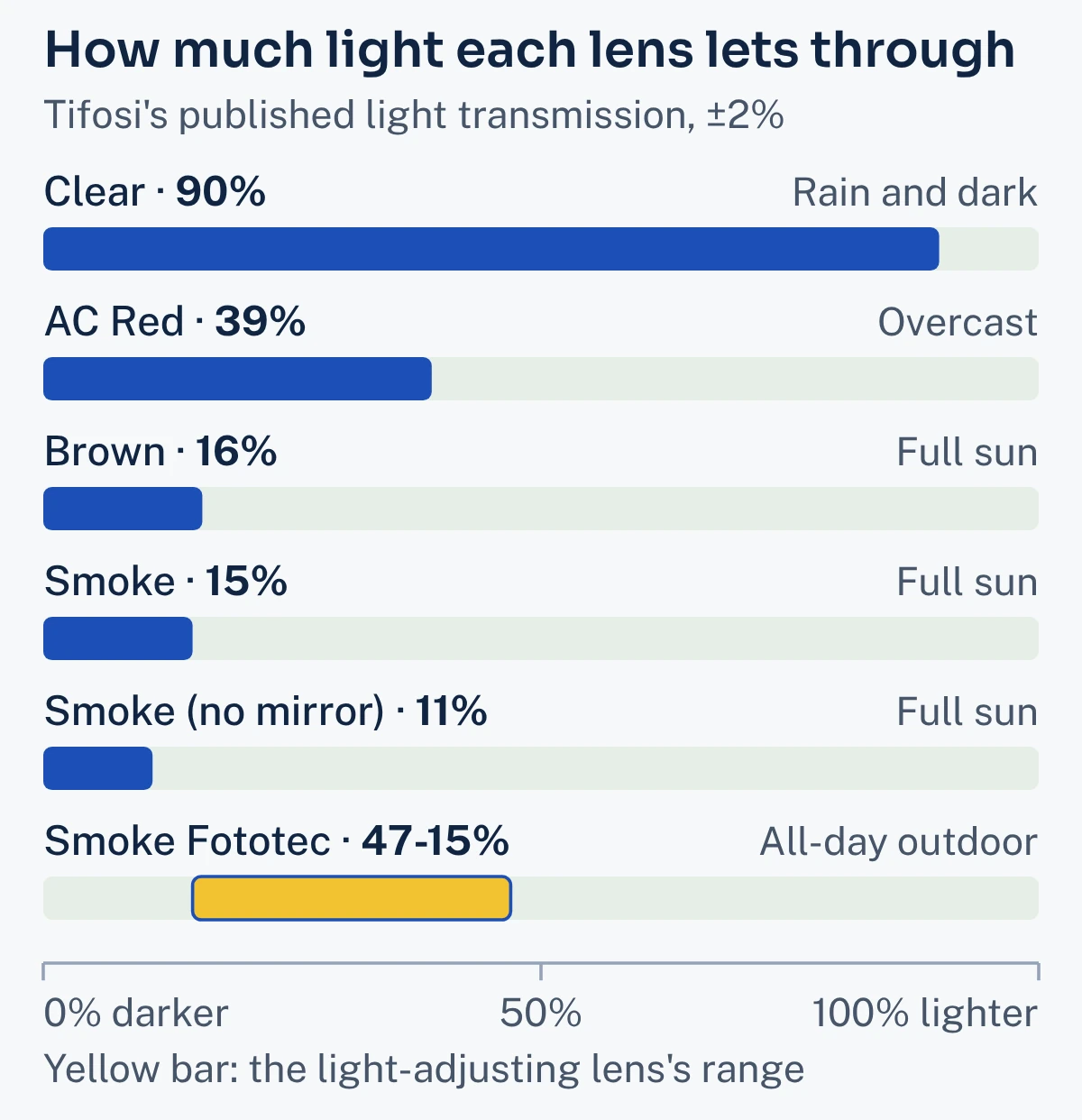
Two lenses of the same color can differ in darkness: Tifosi rates its smoke lens at 15% and its smoke lens without a mirror at 11%. The conditions on the charts follow the figures. The 90% clear lens is rated for rain and dark conditions, the 39% AC Red for overcast conditions, and the 16% brown and both smoke lenses for full sun.
Which colors stand out. RIA, a pickleball eyewear maker, describes the second job in its buying guide: “Some shades can enhance the colors you see while others simply darken the environment without changing color perception.” Tifosi’s chart calls its AC Red lens a “tint for improving contrast” and its smoke lens a “good all-around grey tint”. The warm tints in the next section are the ones the sources credit with contrast; gray is the neutral case.
Outdoor courts: warm, contrast-boosting tints
The sources agree on warm tints outdoors, but each leads with a different one.
- Rose or copper (SportRx). SportRx’s pickleball lens guide says “the best lens color for pickleball is a rose or copper tint that maximizes color contrast in your field of view”, and “Brown, bronze, or amber-toned tints will also do the trick.” Of the rosy copper tint it adds: “It even works well for cloudy or overcast days.” Its rose picks include Oakley’s PRIZM Dark Golf and PRIZM Field lenses; its brown picks include Oakley’s PRIZM Tungsten.
- Brown or amber (RIA). RIA’s lens color article says “Brown, amber, and copper-tinted lenses are widely regarded as the best option for outdoor pickleball because they enhance contrast and depth perception, helping players track the ball more easily.” Its buying guide adds that “A tint in the brown-amber family provides the best contrast of yellow”.
- Purple or red (Rudy Project). Rudy Project’s pickleball glasses guide: “Purple or Red lenses provide the best contrast of the light green or yellow pickleball against the dark blue or green court and blue sky.”
- Orange mirror (CRBN). CRBN, a pickleball brand, calls the orange mirrored lens in its Pivot kit “Perfect for sunlight. Designed to enhance ball contrast allowing you to focus in on what matters.” Its Drift page adds: “The orange mirrored lens enhances focus by muting surrounding colors, making the yellow pickleball stand out.”
Players land in the same warm range. The poster of a Reddit r/Pickleball thread on lens colors wrote that “the consensus seems to be red/rose/sunset AND brown/amber, are the two colors that help make a pickleball stand out a little more”. One reply put it in order: “Rose followed by amber are the best tints for PB play.”
Sun versus cloud
Color sets the contrast; the light-transmission figure sets how the lens copes when clouds roll in. RIA warns about “gray, green, and blue lenses, which typically become too dark if the sun ducks behind the clouds”. Tifosi rates its 39% AC Red lens for overcast conditions and its 15-16% brown and smoke lenses for full sun. Solaro, a sunglasses maker, lists rose and vermilion tints as “Best For: Overcast or mixed-light conditions”, and CRBN sells its amber lens for “low/mid light or challenging weather”. A player in the same Reddit thread asked the question in light-transmission terms: “Deciding between Prizm Field (VLT 15) versus the Prizm Trail Torch (VLT 35) for outdoor Pickleball in Chicago where it can be very bright or overcast.”
Match the tint to the ball color
Dink Eyewear’s tint guide argues the right lens should “depend on your ball color and your lighting”. It pairs “Green (Indoor/Outdoor Green): Best for green/yellow balls.” with “Violet: Best for red, orange, and pink balls.” Dink is the only source here that changes its tint advice with the ball’s color, and it sells those tints. Our guide to pickleball ball types covers the balls themselves.
Indoor courts: clear first, then yellow or light orange
Indoors, the sources start from clear. SportRx says “the best lens color for indoor pickleball is actually a clear lens”, and advises to “add a quality anti-reflective (AR) coating to guard against distracting glare and ghost images from artificial lighting”. RIA’s buying guide agrees: “In most cases, the best lens color for indoor pickleball is a clear lens.” Tifosi’s clear lens lets through 90% of the light.
Where they part is on tinted lenses under gym lights:
- Light orange or yellow, for bright lights. RIA: “If you’re playing underneath particularly bright or harsh lights, a light orange tint such as our Hybrid Orange HD+ lenses will help soften the glow and provide a subtle contrast boost.” SportRx: “Yellow lenses can also be used for indoor pickleball if you want a little less light transmission.” It warns that if you have not worn yellow before, “it might take some getting used to”.
- Yellow or a light neutral tint, for low light. Solaro lists yellow and gold tints as “Best For: Low light, cloudy days, or indoor courts”. Dink’s guide offers “Natural: Best universal choice in low or artificial light.”
- Clear or amber. Pickleheads, a pickleball news and gear site, writes that “Indoor glasses tend to have a clear or amber lens, while outdoor glasses will have a polarized lens.”
Gray and smoke lenses: darker, not sharper
Three sources say gray does less for contrast than other tints. Solaro’s tinted lens article says “Gray lenses are neutral, meaning they don’t distort colors.” but “they don’t boost contrast as well as other tints”. SportRx goes further: “grey lenses provide no real benefits for ball sports, including pickleball”, because “Gray neutralizes color rather than makes it stand out”. Rudy Project says gray lenses “don’t provide the high-contrast, clear vision that red, amber/orange, and brown lenses do”.
Tifosi still rates both its smoke lenses for full sun, at 15% and 11%. None of the sources here credits gray with extra contrast.
Polarized lenses: where the sources disagree
Tifosi describes its polarized lenses as “Tints that reduce glare by polarizing light. Great for snow and water sports.” The question for pickleball is whether that glare cut is worth having on a court.
Against. SportRx: “Polarization is excellent for cutting glare, but also affects depth perception in the process.” It adds that “Pickleball courts don’t usually have glaring surfaces either”. RIA: “The mechanism in polarized filters that blocks horizontal glare also flattens the image you see, cutting down on depth perception”, and it says “all our current court lenses are non-polarized”. Rudy Project: “the polarized treatment tends to make your vision flatter”. Dink’s polarized article says “polarization can actually make the game harder” and “For indoor play, non-polarized lenses prevent distortion from LED lighting.”
Yes, for bright sun. Pickleheads’ buying guide says “A clear lens suits indoor play, and a tinted or polarized lens suits bright sun.” Its lens list adds that polarized lenses are “Not great for indoor play as the tint can affect your visibility when tracking the ball.”
Two of the four against make their own court lenses non-polarized: RIA’s line is quoted above, and Dink says “Dink Eyewear uses non-polarized ColorBoost lenses”.
Photochromic and interchangeable lenses for mixed light
Photochromic lenses (also sold as transition lenses) “darken with UV exposure”, in SportRx’s words. CRBN gives a range for its Pivot lens: “Visible light transmission (VLT) range is 15-83% and darkens to UV400 based on the amount of UV light exposure.” Tifosi calls its Fototec lenses “Variable tints that become darker as the day grows brighter”, and its chart gives the Smoke Fototec lens 47-15%.
The makers differ on speed: RIA doubts the lenses darken fast enough, while Rudy Project says they turn clear quickly. RIA: “While convenient, photochromic lenses may not darken quickly enough for fast-paced pickleball matches, making them better suited for casual players.” Rudy Project tells indoor-and-outdoor players to “consider photochromic lenses, which quickly turn from dark to clear in the absence of sunlight”.
Interchangeable lenses take the other route: one frame and several tints you swap by hand. SportRx suggests them for players who switch between sports or play at all hours of the day.
Which tint for which court
| Court light | Tints the sources name | Example figure | Who says so |
|---|---|---|---|
| Full sun, outdoors | Rose, copper, brown, amber, purple, red, orange mirror | Tifosi brown 16%, smoke 15% | SportRx, RIA, Rudy Project, CRBN |
| Overcast or mixed | Rose, AC Red, amber; light-adjusting lenses | Tifosi AC Red 39%; Smoke Fototec 47-15% | SportRx, Solaro, Tifosi, CRBN |
| Indoor, usual lights | Clear, with an anti-reflective coating (SportRx) | Tifosi clear 90% | SportRx, RIA, Pickleheads |
| Indoor, bright lights | Light orange or yellow | None given | RIA, SportRx |
| Low light | Yellow, gold, Dink “Natural”, clear | Tifosi clear 90% | Solaro, Dink, Tifosi |
| Polarized? | Skip; or outdoors in bright sun only | Not a tint figure | Against: SportRx, RIA, Rudy Project, Dink; for bright sun: Pickleheads |
Three lens sets from our glasses roundup
Three pairs from our pickleball glasses roundup show these choices in real lens sets:
- Tifosi Rivet Interchange: three lenses on the ladder above, smoke 15%, AC Red 39% and clear 90%.
- CRBN Pivot: a photochromic lens with CRBN’s 15-83% range plus an amber lens in the Amazon listing; CRBN’s own site lists an orange mirrored lens as well.
- Tifosi Swick Clear: one clear lens at 90%.
Lens color and impact rating are separate lines on a spec sheet. CRBN states that the Pivot “Meets or exceeds ANSI Z87.1 (Drop Ball) and Z80.3 (Impact Resistance) standards”; the roundup records no named impact standard for the Rivet’s or the Swick’s lenses.
| # | Preview | Product | Price | Link |
|---|---|---|---|---|
| 1 |  | Tifosi Optics Rivet Sunglasses (Blackout (Smoke/AC…Smoke, AC Red and clear lenses | $79.95 | Check on Amazon |
| 2 |  | CRBN Pickleball, Pivot Pickleball Glasses for Men & Women…Photochromic and amber lenses | Check on Amazon | |
| 3 |  | Tifosi Swick Lifestyle Sunglasses – Cycling, Golf & Hiking…Clear lens for indoor courts | $29.95 | Check on Amazon |
Ready to buy?
Our pickleball glasses roundup compares eight pairs by lens set, each maker’s light-transmission figure where one is published, and the impact standard each maker names.
Frequently Asked Questions
Q. Do mirrored lenses change the color you see?
A little. SportRx says of mirror coatings: “While they’re mostly cosmetic, they can also add a slight darkening effect or influence the base tint on your lenses.”
Q. Are gradient lenses a good idea for pickleball?
Asked in the comments about lenses that run from dark at the top to light at the bottom, SportRx’s Eyeglass Tyler replied: “A gradient tint would be okay, but I can’t think of a beneficial functional reason to do that. I’d be worried that it could be distracting, personally. If it’s sunny out, gradient tints, to me, feel like they don’t cut enough light.”
Q. Are blue lenses good for pickleball?
None of the sources here puts blue first. RIA groups blue with the tints that turn too dark under cloud, and a player in the Reddit thread said of a blue pair: “the blue ones I have, I’ve found, aren’t really for sunny outdoor conditions”.
Q. Do photochromic lenses work indoors?
Pickleheads says yes for the CRBN Pivot’s lens: “It darkens in the sun and turns clear in the shade or indoors.” CRBN ties the darkening to the amount of UV light and gives 83% as the lens’s lightest figure.
Q. Can you get these tints in prescription lenses?
SportRx says of its rose lens picks: “All of them are available in prescription”. Our glasses roundup lists each pair’s prescription route.
Q. Is the best lens color different for men and women?
None of the sources here splits lens color by gender; their advice turns on court light. For the rest of the outfit, see our guide on what to wear for pickleball.
Sources (12)
- Tifosi Optics, Lens Collection (light transmission charts)
- SportRx, Pickleball Lens Guide
- RIA Eyewear, Best Color Lenses for Pickleball Glasses
- RIA Eyewear, How Do I Choose Pickleball Glasses? A Buyer’s Guide
- Rudy Project North America, How to Choose Pickleball Glasses
- Dink Eyewear, What Lens Tint Is Best for Pickleball? A Simple Guide
- Dink Eyewear, Polarized vs. Non-Polarized Sunglasses for Pickleball
- Solaro Shades, The Color of Victory: How Tinted Lenses Can Help Your Pickleball Game
- CRBN, Pivot Pickleball Glasses
- CRBN, Drift Pickleball Glasses
- Pickleheads, Best Pickleball Glasses
- Reddit r/Pickleball, Best Sunglasses For Pickleball (non-polarized & lens color options)
Product prices and availability are accurate as of the date/time indicated and are subject to change. Any price and availability information displayed on Amazon.com at the time of purchase will apply to the purchase of this product.