The short answer
It depends on the ball and who is hitting it. In Pickleball Science’s tests, outdoor balls lasted from about 7 to more than 30 games before cracking or losing a tenth of their stiffness. Makers’ and sellers’ estimates run from 3 to 40 games. CORE’s signs to replace one: a crack, a dead or soft feel, a lower bounce.
The figures disagree, and the sources do not count the same thing. Pickleball Science ends a ball at a crack or a measured loss of stiffness; the makers’ and sellers’ ranges come without a published method, and one maker’s table rates its own balls against its rivals. Pickleball Science adds its own caution: “Results may vary according to your level of play and how hard you hit the balls.”
Below, the figures sit side by side, followed by how to check a ball, when to replace it, what the rulebook says about a damaged ball and how to store balls between games. How indoor and outdoor balls are built is covered in our guide to the types of pickleball balls.
Related guide: How to Clean Pickleball Balls: Wipe, Wash or Replace
What testers, makers and players report
| Source | Who they are | Ball and conditions | Games per ball |
|---|---|---|---|
| Pickleball Science | testing site | six outdoor balls, 3.5-level players, concrete, warm Florida | about 7 (Franklin X-40) to more than 30 (Pro Penn 40) |
| Pickleheads | review publication | its reviewer’s sessions | X-40 20 to 30, LT Pro 48 about 20 to 25, Vulcan 10 to 20 |
| CORE | ball and paddle maker | outdoor and indoor balls in general | outdoor 5 to 12, indoor 20 to 40 |
| Joysent | paddle maker and seller | outdoor and indoor balls in general | outdoor 10 to 20, indoor 20 to 40 |
| MyPickleballGear | retailer | outdoor and indoor balls in general | outdoor 3 to 6, indoor 6 to 10 |
Pickleball Science measured its balls. In its first test, of the Franklin X-40 only, it pressed the balls on a force gauge after each hour of “highly competitive games with 3.5 level players (“bangers”)” and reported, for the X-40, “a reduction of ball stiffness of about 10% for each hour of play!” Each hour, it notes, “represented about four games.” Its later reviews call a ball finished “when it cracks or when it loses more than 10% of its stiffness or when it has been played for at most 30 games.” By that test the Franklin X-40 was “degrading by 10% in about seven games”, the Core Impact “loses 10% of its stiffness in about 17 games”, the Selkirk SLK Competition “loses 10% of its stiffness by about 15 games”, the DuraFast 40 “developed cracks at around 24 games”, and the Pro Penn 40, “Even after 30 games, the ball loses only 5% of its initial stiffness!” The games were played “by intermediate-level players (level 3.5) on outdoor concrete courts at warm Florida temperatures.”
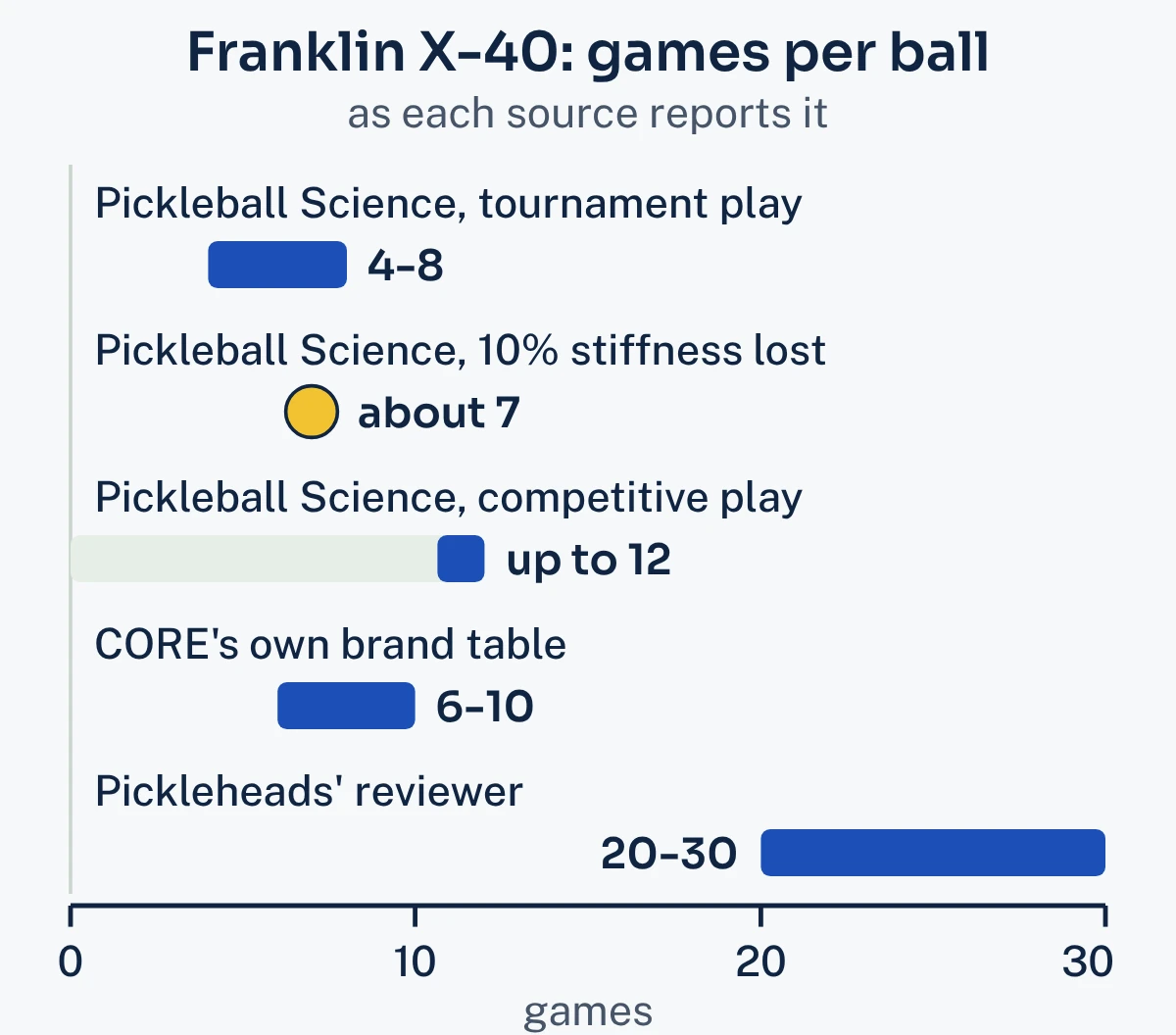
The Franklin X-40 shows how far apart the answers are. Pickleball Science says its usable life “would be no more than 4-8 games for “tournament” play and up to 12 games for “competitive” play”, and that its test ball “was subsequently used for at least a dozen more “recreational” or “social” games before it cracked.” Pickleheads’ reviewer says the X-40 “lasts longer than most others (20 to 30 games in my experience).” CORE’s brand table, which it says is “based on player feedback and lab testing”, gives the X-40 6 to 10 games and lists its failure mode as softening and a “Mushy” feel.
Related guide: How Long Do Pickleball Shoes Last, and How to Make a Pair Go Further
The Dura Fast 40 splits the sources the other way. Pickleball Science saw cracks at around 24 games. CORE’s table gives it 3 to 6 games, with “Cracking (High Brittleness)” as the failure mode, and puts CORE’s own balls at 12 to 18. An r/Pickleball owner whose group keeps Duras in a drill bag counts “10 cracks for every 1 an x40 has.”
Selkirk’s own trial favours its ball. It reports a one-week trial at the Grand Pickleball Club: “players used 180 of their old balls and broke 112. In contrast, of the 100 Selkirk balls used, only one broke.”
Owners on r/Pickleball report the same spread. In a 2026 thread about Life Time balls, one player keeps “6-10 in rotation and they usually all crack within 6ish weeks at 5.0 rec play / drilling,” another has “some X40’s that have lasted well past a year,” and a reply says “A X40 rarely lasts an hour for powerful players.” In a 2025 thread, a player who writes “I don’t swing too hard” reports “easily getting at least ten games per ball.”
Indoor and outdoor balls wear out differently
Two makers describe the same split: outdoor balls crack, indoor balls go soft. Paddletek, a paddle maker, puts it this way: “Indoor balls deform before they crack, which means they lose their shape gradually rather than splitting mid-rally.” CORE says indoor balls played on gym floors or smooth surfaces “rarely crack,” while outdoor balls in the cold suffer “structural cracks”.
The indoor figures disagree by a wide margin. CORE puts indoor balls at 20 to 40 games, “Avg. 3–4 weeks of play”, and Joysent gives the same 20 to 40. MyPickleballGear, a retailer, gives indoor balls 6 to 10 games. One owner who moved to an indoor club reports “DuraFast and Selkirk balls now can last at least 6 hours of play, compared to 4 hours when I was playing outdoor in 100F heat.”
Paddletek also warns that “Indoor balls on rough concrete wear out fast and bounce unpredictably.” Our comparison of indoor and outdoor pickleball balls covers which ball suits which floor.
Foam quiet balls are a different material, and none of these sources gives a game count for them. For the quieter plastic Selkirk Q1, our roundup of quiet pickleball balls reports that The Adventurous Boomer’s balls “show no signs of cracking or going out of round” after using them “for more than a month”.
What wears a ball out faster
Selkirk’s blog lists five factors:
- Length of play: “Longer playing sessions naturally lead to quicker wear and tear.”
- Frequency of play: “Regular players will go through balls faster than occasional players.”
- Climate: “Extreme temperatures and humidity can affect the ball’s material.”
- Court conditions: “Some players regularly play on harder court material or courts that have cracks or other imperfections.”
- Playing style: “Aggressive players, or “bangers,” will likely wear out balls faster than “dinkers,” or players who prefer finesse.”
Pickleball Science agrees on the hitter: “More casual players would expect their pickleballs to last much longer than intermediate or advanced players.”
On temperature, the sources give their own lines:
- CORE: “In temperatures below 50°F, the plastic becomes brittle, leading to structural cracks.”
- Pickleball.com’s help centre: “Playing in temperatures below roughly 50°F (10°C) dramatically increases cracking risk, even with otherwise normal play.”
- Pickleheads, for one ball: the Selkirk Pro S1 “can withstand 30º sessions without any issues.”
- Pickleball Effect, on heat: its reviewer finds the X-40 softens and writes, “I don’t recommend it when it’s over 90 degrees outside.” The same reviewer cracked one Life Time ball in six months, “during a very cold early-morning session”.
How to check, retire and store a ball
Run these checks between games. They need nothing but a new ball to compare against.
Look for cracks around the holes
Pickleball.com’s help centre says cracks “almost always begin as small hairline fractures around one or more holes.” CORE’s advice is to “always retire cracked balls immediately.”
Squeeze it for soft spots
CORE’s squeeze test: “Press your thumbs into the poles of the ball (where there are no holes).” A ball that feels mushy or stays dented has failed by CORE’s account. Pickleball Science found that its worn X-40 “had soft spots where it could be indented by finger pressure.”
Roll it on a flat floor
CORE says to “roll it across a flat kitchen floor; if it doesn’t roll in a perfectly straight line, it’s dead.” Out of round is not the same as cracked: the Selkirk Pro S1’s no-crack warranty excludes it (see below).
Bounce it beside a new ball
CORE’s check: “Hold a new ball and your used ball at eye level (approx. 3 feet). Drop them simultaneously. If the used ball bounces more than 2-3 inches lower than the new one, the plastic has lost its elasticity”. This is a comparison, not the official test. CORE’s page describes that test as a drop “from a height of 36 inches onto concrete”, but USA Pickleball’s Equipment Standards Manual (January 2025), section 2.D.5, reads in full: “Bounce. The ball shall have a bounce of 30 to 34 inches (76.2 to 86.4 cm) to the top of the ball when dropped from a height of 78 inches (198.1 cm) onto a granite surface plate that is a minimum of 12 inches (30.5 cm) by 12 inches (30.5 cm) by 4 inches (10.2 cm). The test is to be performed at an ambient temperature of 70 degrees F plus or minus 5 degrees F.”
Listen to it
A ball can sound wrong before you see a crack. One r/Pickleball player’s rule: “when a ball bounces weird/sounds weird on the bounce, you inspect it and see a crack.”
Count games and rotate
For the X-40, Pickleball Science says to “monitor their usage, inspect them for soft spots, and replace them early and often, especially if have played more than 12 games with them.” CORE suggests you “mark balls with a small dot and rotate practice balls” and keep league balls apart from drill balls. Keep indoor balls off rough concrete, where Paddletek says they “wear out fast”.
Store the keepers at room temperature
CORE says to “Keep balls at room temperature (65°F–75°F) until you reach the court” and to “Never leave your equipment bag in a frozen or sweltering car.”
How often to replace pickleball balls
CORE’s rule of thumb is by session: “Recreational players should replace balls every 3–10 sessions, while competitive players often require fresh balls every 1–3 sessions to ensure consistency.” Its second page puts outdoor balls at “Avg. 1 week of daily play”, and Joysent says “Daily use can wear out balls in just 1–2 weeks. Casual players may get several months of use.”
Players split on whether to wait for a crack. In an r/Pickleball thread on the question, one reply says “If you wait until they are cracked, you’ve waited FAR too long,” while another says “Yep, play it until it cracks or is deformed.” Pickleball Science’s advice for the X-40 (step 6) sides with replacing early.
During a game, the rulebook decides. USA Pickleball’s 2026 Official Rulebook, rule 10.G, reads in full: “Damaged Ball. When a ball is or becomes broken, cracked, soft or degraded, play must continue until the end of the rally. The ball will be replaced if all players agree.” Rule 10.G.1: “Replay – Broken or Cracked Ball. When all players agree that a broken or cracked ball affected the outcome of the rally, the rally must be replayed. If all players do not agree that a broken or cracked ball affected the outcome of the rally, the result of the rally stands.” Rule 10.G.2: “No Replay – Soft or Degraded Ball. When a ball is or becomes degraded or soft, the result of the prior rally stands.”
In refereed matches, rule 20.F modifies rule 10.G: “Damaged Ball. A player may appeal to the referee to determine whether a ball is degraded, soft, broken, or cracked. A potentially soft or degraded ball will not be replaced unless all players agree. If the referee determines that the ball is broken or cracked, it will be replaced. (Modifies Rule 10.G)” Rule 20.F.1: “Replay – Broken or Cracked Ball. When the referee determines that the broken or cracked ball affected the outcome of the rally, the rally must be replayed with a replacement ball. (Modifies Rule 10.G.1)”
What not to do
Each of these also sits in the steps above:
- Don’t leave balls in a hot or frozen car (step 7). Owners disagree on how much heat storage matters: one found a new can of X-40s left in a car “were trash as soon as I opened it,” while another keeps “a hundred in the garage that gets up to 140 in the summer and they are fine when I pull them out for whatever reason once weather gets cool again.”
- Don’t play indoor balls on rough concrete (step 6).
- Don’t play one ball all session; CORE’s tip is to rotate marked balls (step 6).
- Don’t keep a cracked ball in play: CORE’s advice is to “always retire cracked balls immediately” (step 1). In a game, rules 10.G and 20.F, quoted in full above, decide when a damaged ball is replaced.
Warranties and the maker’s word
The maker’s terms for your ball are the final word on what it covers. Selkirk’s one-year no-crack warranty for its Pro S1 ball shows what the small print can hold. Selkirk’s warranty page says:
- “Warranty applies only to retail end users who must currently reside in the United States and must have originally purchased Pro S1 Pickleball Balls at selkirk.com or from a United States Selkirk authorized retailer.”
- “At least 4 defective balls and a receipt are required to submit a warranty claim.”
- “Warranty does not apply to balls purchased for Events, Clubs, Programs (Advocates & Players), or Facilities. The warranty does not cover any ball purchased at a discount.”
- “The Pro S1 Pickleball Ball 1-Year No-Crack Warranty does not apply to pickleballs that have gone “out of round”.”
- “Normal wear and tear are also not covered under this warranty.”
- “Warranty claims can ONLY be processed through selkirk.com.” The page adds that each valid claim carries “a flat processing fee”.
For any other ball, check its maker’s own terms.
Two of the three balls in the box below have lifespan figures from more than one source: the Franklin X-40 (the four answers above) and the Dura Fast 40 (where Pickleball Science and CORE’s table disagree). The Vulcan VPRO Flight’s figure comes from Pickleheads alone, whose reviewer calls it “not as durable as the Franklin, Life Time, or Selkirk balls, with each of my Vulcans usually lasting 10 to 20 games.” All three are compared in our pickleball balls roundup.
| # | Preview | Product | Price | Link |
|---|---|---|---|---|
| 1 |  | Franklin Sports x-40 Performance Outdoor Pickleballs…Four lifespan answers | Check on Amazon | |
| 2 |  | Dura Fast 40 Pickleballs | Outdoor pickleball balls…Sources disagree | $21.99 | Check on Amazon |
| 3 |  | Vulcan VPRO Flight Outdoor Pickleball Balls – USA…Pickleheads: 10 to 20 games | $19.75 | Check on Amazon |
Ready to buy?
Our roundup of pickleball balls compares eleven balls, with separate guides to outdoor pickleball balls for hard courts and indoor pickleball balls for gym floors.
Frequently Asked Questions
Q. How long do Life Time (LT Pro 48) balls last?
Pickleheads’ reviewer puts it at “around 20 to 25 games on average in my experience.” One r/Pickleball owner says “after about 50 games they start to feel softer,” and our roundup found the ball was not on USA Pickleball’s approved list when it checked on 21 October 2026.
Q. Can you keep playing with a cracked pickleball?
CORE says no: “Even a hairline fracture changes the compression of the ball.” One owner found that a ball with a couple of small cracks “still played pretty well, but had to be retired as folks noticed the cracks.”
Q. Can you repair a cracked pickleball?
Pickleball.com’s help centre says “there’s no practical or recommended way to repair a cracked pickleball.”
Q. Can you recycle old pickleballs?
Check before you bin them. Earth911 says recycling centres that take rigid plastics “may not accept pickleballs because they are small and could jam sorting machinery,” and P3 Cares, a recycling programme that places collection bins at courts, says the plastic in injection-molded balls “is not able to be recycled by typical recycling centers.” BounceBack also collects cracked balls in bins at member facilities.
Q. Do unused pickleballs go bad in storage?
Srikel Sport, a paddle and net seller, writes that “Polymers degrade even without use, especially if exposed to heat or light during storage.” Owners’ accounts of balls stored in heat differ (see “What not to do”).
Q. How long do pickleball paddles last?
Paddles wear in other ways; our guide to how long a pickleball paddle lasts covers it.
Sources (23)
- Pickleball Science, How Many Games Will a Pickleball Last?
- Pickleball Science, Pickleball Reviews
- Pickleheads, Best pickleball balls (2026)
- Pickleball Effect, Best Pickleball Balls (2026 Tested and Ranked)
- CORE Athletics, When Should You Replace Your Pickleballs?
- CORE Athletics, How Long Do Pickleball Balls Last?
- Selkirk, How long do pickleballs last?
- Selkirk, Pro S1 Pickleball warranty
- Paddletek, Indoor vs outdoor pickleballs
- Joysent, Do Pickleball Balls Really Expire? When to Replace Them
- MyPickleballGear (retailer), How Long Do Pickleballs Last?
- Pickleball.com help centre, Why do pickleball balls crack?
- USA Pickleball, 2026 Official Rulebook (PDF)
- USA Pickleball, Equipment Standards Manual, January 2025 (PDF)
- Earth911, Recycling Mystery: Pickleballs
- P3 Cares, What we do
- BounceBack Pickle
- Srikel Sport, Think Your Pickleballs Don’t Last Long Enough?
- The Adventurous Boomer, Review of quiet pickleballs
- r/Pickleball (forum), How often to replace balls?
- r/Pickleball (forum), Lifetime ball lifespan?
- r/Pickleball (forum), Have pickleballs always been this fragile?
- r/Pickleball (forum), Which is the best ball and why?
Product prices and availability are accurate as of the date/time indicated and are subject to change. Any price and availability information displayed on Amazon.com at the time of purchase will apply to the purchase of this product.