The short answer
Clean and dry the edge, then peel back a few inches of backing at a time. Center the tape on the rim from your pack’s start point, often the top center or the throat, and smooth it onto both faces as you go. Ease it round corners, trim and seal the ends, and let it set for a day.
The steps below put together the application instructions of seven tape and paddle makers (Selkirk, JOOLA, CRBN, Bodhi, Helios, Warping Point and AMA SPORT), two pickleball shops and one r/Pickleball thread. Where they agree, a step says so. Where they differ, on where to start and how hard to pull, it names who says what.
Edge tape is the replaceable layer. The edge guard is the band the paddle maker fitted around the rim, and a loose or worn guard is a different job: it starts with the paddle’s warranty, covered in its own section further down.
What you need
- Edge tape sized to your paddle’s thickness. Several makers size their tape by paddle thickness. JOOLA’s Pro IV tape page lists it as “available in 30mm x 800mm (designed for 16mm) or 28mm x 800mm (designed for 14mm)”. Selkirk recommends its 15 mm tape for “10mm-14m edgeless paddles, or paddles with edge guards thinner than 10mm” (Selkirk’s wording). CRBN sells its tape in a 12-14 mm size and a 16 mm size. Check your paddle’s thickness on its maker’s page before you buy.
- A cloth, and water or rubbing alcohol. Selkirk uses a damp cloth. Get2Eleven, Spinwave and Helios use rubbing (isopropyl) alcohol; Helios keeps it off the paddle face.
- Small scissors. Selkirk, Bodhi and Get2Eleven all trim with scissors.
- A credit card (optional). Helios uses “a credit card or application tool” to push out air bubbles.
- A hair dryer (optional). Two sources use one, for corners, cold days and lifting old tape, as the steps explain.
| # | Preview | Product | Price | Link |
|---|---|---|---|---|
| 1 |  | Selkirk Sport Pickleball Edge Guard Tape | 15mm x 350mm…15 mm, for thin edgeless paddles | $7.99 | Check on Amazon |
| 2 |  | Franklin Sports Pickleball Paddle Edge Guard Tape – 12-14mm…23 mm, for 12-14 mm cores | $10.31 Prime | Check on Amazon |
| 3 |  | AMA SPORT Pickleball Paddle Edge Guard Tape 3 Pack 3K…26 mm, for 16 mm paddles | $9.49 | Check on Amazon |
The three tapes above show how makers size by thickness, from 15 mm tape for thin edgeless paddles to 26 mm tape for 16 mm paddles. Each is compared, with its maker’s or listing figures and its evidence, in our edge guard tape roundup.
Where to start, and how tight to pull
The sources disagree on two things: where the first inch of tape goes and how much tension to use. Bodhi and JOOLA both point to the pack first: Bodhi says to “Check the edge tape packaging before installation”, and JOOLA tells buyers of its Pro V tape to “Simply follow the easy instructions on the back of the Edge Guard Tape pack”. Where the pack is silent, this is what each source says.
| Source | Where to start | Tension |
|---|---|---|
| JOOLA (maker) | “at the top of the paddle’s edge guard” | “Pull tape tightly” |
| Bodhi (maker) | Top center if the pack shows a “TOP” logo; otherwise near the bottom, at the throat | Stretch at the corners |
| Warping Point (maker) | “align it with the top of the paddle” | Not stated |
| CRBN (maker) | A “pre-cut alignment line” on the strip | Not stated |
| Selkirk (maker) | One end of the paddle, or the middle with the paddle upright | Stretch the tape first |
| Helios (maker) | The bottom edge (handle end) | No pulling or stretching |
| AMA SPORT (maker) | “the bottom center of the paddle edge” | Not stated |
| Spinwave (shop) | Near the throat, just above the handle | “slightly taut” |
| Get2Eleven (retailer) | The bottom of the paddle | Not stated; “firm, consistent pressure” |
Spinwave gives a reason for starting low: the throat “keeps the overlap seam in a less visible and less impacted area.” A tape printed with a logo or artwork across the top is the other case: Bodhi starts that kind of tape at the top center so the design lines up.
How to put edge tape on, step by step
Take off the old tape
Bodhi says to lift a corner near the bottom of the paddle and “Pull the tape back slowly at a low angle rather than pulling straight away from the paddle.” Helios warms it first instead: “Heat old tape slightly with a hairdryer on low setting for 15-30 seconds, then peel slowly at a 45-degree angle.”
Clean the edge and let it dry
Selkirk says: “Clean the edge of the paddle with a damp cloth to remove any dirt or debris.” For leftover glue, Helios uses “isopropyl alcohol with a microfiber cloth, avoiding paddle face surfaces and allowing complete drying before applying new tape.” Get2Eleven, a retailer, warns: “Avoid using harsh solvents that can damage the paddle face.” Our guide on how to clean a pickleball paddle has each paddle maker’s own instructions for the face and edge guard.
Find your start mark
Check the pack for a start mark or printed instructions, then pick your start point from the table above. To center the tape across the rim, one r/Pickleball owner suggests: “Mark the top center of the tape and the center of the top of the paddle if you can’t do that by eye.”
Peel a little backing at a time
Spinwave says: “Peel the backing a few inches at a time.” Helios exposes “approximately 2 inches of adhesive” to start.
Press the middle down, then smooth it onto both faces
Spinwave says: “Press the middle of the tape down first, then smooth outward toward the edges.” Another r/Pickleball owner in the same thread rubs from the rim toward the faces to push the bubbles out, and adds: “Most important: do not progress further along the paddle edge until it’s completely smoothed out on both faces.” Helios presses out bubbles with a credit card.
Work the corners
Notched or sawtooth tape is cut to fold round curves: JOOLA says its sawtooth pattern “helps reduce air bubbles during application”, and CRBN says its “Innovative sawtooth corner design conforms seamlessly to paddle edges and eliminates wrinkling.” On plain tape, Helios says: “For corners, create small relief cuts in the tape to allow smooth wrapping”. Bodhi instead stretches its own tape: “Stretch the tape around corners to allow the tape to mold to the corners.” On heat, the two sources that use it differ. Spinwave warms the tape as it goes: “Use medium heat for a few seconds at a time, then press the tape down firmly.” Helios warms it only on cold days, before it goes on: “In cold conditions, lightly warming the tape with a hairdryer before application can enhance adhesive performance.”
Meet the ends, trim and seal
Selkirk says: “Once the edge tape is in place, use a small pair of scissors to trim any unwanted excess tape.” The sources differ on overlap: Get2Eleven adds “about half an inch of overlap”, Helios overlaps “approximately 5mm”. Spinwave says to seal the overlap carefully, because “That seam is usually the first place tape starts peeling if the install is rushed.”
Press the whole length and let it set
Bodhi says to “Firmly press along the entire length of the tape, especially around curves and edges”. Get2Eleven says: “Give the tape 24 hours after application before heavy play.” Helios agrees: “Whenever possible, apply tape at least 24 hours before your next playing session.”
How far the tape may reach onto the face
USA Pickleball’s 2026 Official Rulebook allows edge tape. Rule 3.D.6 reads: “Allowable Alterations. Altered paddles must meet all specifications. The only allowable alterations or additions by a player to a commercially produced paddle as certified are:” Its first item, 3.D.6.a, reads: “Addition or replacement of edge guard tape (see Rule 3.D.7).”
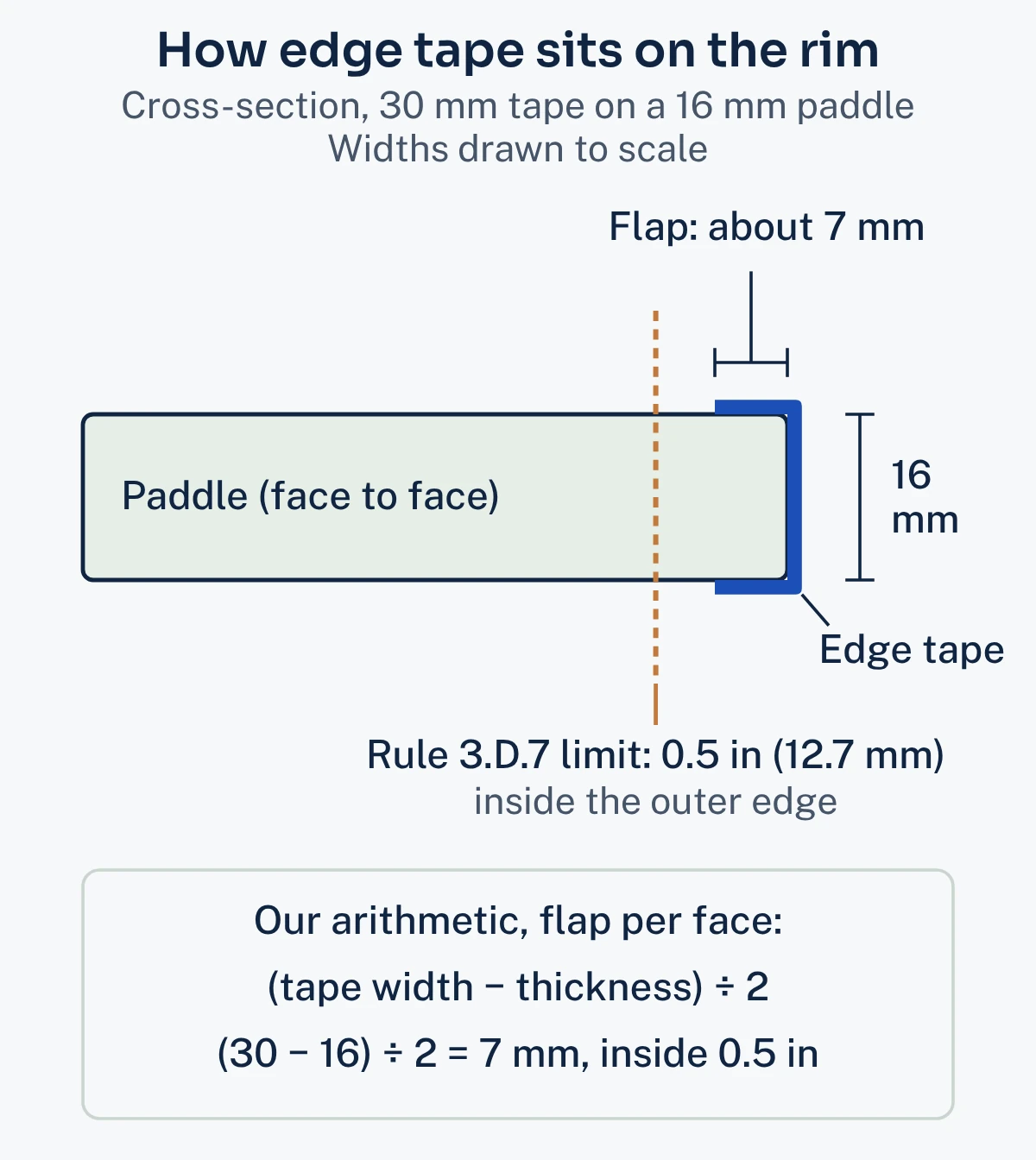
Rule 3.D.7 sets the limit for how far onto the face any tape may reach: “Decals and Tape. Decals and tape on the paddle face must not extend more than 1.0 inch (2.54 cm) above the top of the grip nor more than 0.5 inch (1.27 cm) inside the outer edge of the paddle or, if an edge guard is in place, 0.5 inch (1.27 cm) inside the edge guard.”
Edge tape wraps the rim, so its width covers the paddle’s thickness and the rest folds onto the two faces. By our arithmetic (not a USA Pickleball figure), the flap on each face is about half the difference between tape width and paddle thickness: JOOLA’s 30 mm tape on the 16 mm paddle it is designed for leaves about 7 mm (0.28 inch) per face, inside the rule’s 0.5 inch (12.7 mm). The same sum gives 7 mm for JOOLA’s 28 mm tape on a 14 mm paddle. On a paddle with an edge guard, the rule measures from the inside of the guard, and the guard itself uses up some of the tape’s width.
Fixing wrinkles, bubbles and lifting
| Problem | What the sources say to do |
|---|---|
| Wrinkles at the corners | Cut small slits across the bend (Helios; an r/Pickleball owner), or use notched or sawtooth tape (JOOLA, CRBN) |
| Wrinkles along the sides | One r/Pickleball owner says “Those wrinkles form because the tape wasn’t stretched enough (excess) and/or air bubbles.” and smooths each section onto both faces before moving on. Helios, by contrast, advises against stretching |
| Air bubbles | JOOLA: “Pull tape tightly when applying to edge guard to reduce air bubbles and wrinkles.” Helios: press them out with a card |
| Tape lifting at the throat | Get2Eleven: the throat “is the spot where tape lifts first if it is not pressed down firmly during application” |
| Ends peeling at the seam | Seal the overlap (Spinwave); AMA SPORT says to “press the end firmly onto the starting point” |
| Sticky residue after removal | Bodhi: keep the paddle out of a hot car and the sun, where the adhesive heats up and leaves residue. Peel slowly and low (Bodhi); clean with alcohol on a cloth, off the face (Helios) |
Replacing or regluing a factory edge guard
A factory edge guard that is coming loose is a question for the paddle’s maker before it is a repair. Paddle Tailor, a shop that sells custom paddles and printed edge tape, puts it plainly: “If your paddle’s factory edge guard is coming loose, contact the manufacturer before gluing it or covering the separation with tape.” Warranties differ:
- Selkirk’s warranty says: “Normal wear and tear, damage caused by abuse, negligence/user modification, chips to the top or sides of edgeless paddles, and the natural breakdown or fading of graphics or textures over extended use are not covered.”
- Six Zero says: “Minor edge guard lifting, separation, dents, buckling or other wear that develops through normal play, court contact or accidental paddle strikes is considered normal wear and tear and is not covered under warranty.”
- CRBN says: “Adding edge guard weights, overgrips, and edge guard tape is completely fine and won’t affect your warranty. However, any modifications to the paddle’s structure or face will void the warranty.”
Rule 3.D.6’s list of allowable alterations, quoted above, names edge guard tape but does not name the factory edge guard itself. On the rulebook and the Equipment Standards Manual, Paddle Tailor writes: “That language does not explicitly authorize every adhesive repair or factory-guard replacement. There is also a wording difference worth preserving. The Equipment Standards Manual, Revision 3.0 dated January 2025, uses broader wording referring to edge-guard tape/replacements. It should not be used to turn a particular home repair into a universal legality claim.” Its advice, pointing to USA Pickleball’s rulebook and Equipment Standards Manual: “If organized play matters to you, consult those resources and seek clarification about your specific repair before relying on the paddle at an event.”
Related guide: Are Pickleball Paddle Edge Guards Worth It? It Depends on the Edge
Brick House Paddles, a paddle maker, publishes the method it uses on its own paddles, saying “We designed our edge guard so it is replaceable”. It is one maker’s method for its own guard, and Paddle Tailor says glue and preparation “should come from instructions applicable to that paddle”, so ask your paddle’s maker first:
Choose the glue
Brick House prefers “CA (instant glue, gel type or thick)”, and offers construction adhesive as an option that “will take longer to dry”. It lists “Glues you probably shouldn’t use; white glue, carpenters glue, contact cement, or anything silicone based.” Follow the glue’s label for drying time.
Wear gloves
Brick House says to “wear disposable gloves” when working with CA glue.
Glue only the loose part
Brick House: “In many cases a little glue in the loose area will fix the issue and trim replacement is not required.”
Dry-fit a new guard before gluing
For a full replacement, Brick House says to “do a couple of dry runs fitting it to the paddle before you apply the glue and go for it.”
Or send it back
Brick House adds: “You are also welcome to send the paddle back to us for the repair.”
Edgeless paddles have no guard to replace. Selkirk “highly recommends using edge tape on edgeless paddles because their edges cannot be repaired or replaced”, and Six Zero recommends its tape on its edgeless Infinity paddles, where “Edge damage on edgeless infinity paddles is not covered.” Our edgeless paddle roundup covers what testers found on those edges.
When to put on new tape
Get2Eleven lists the signs, among them “Tape lifting at the corners or starting to peel away from the frame” and “Visible chips or dings showing through the tape itself”. How often that happens is where sources part: Get2Eleven says “Most players replace edge guard tape every 2 to 4 months under regular play”; Helios says “Most quality edge guard tapes maintain optimal protection for 2-3 months with twice-weekly play”; Spinwave says aggressive players who scrape the court often may need new tape every few weeks, and casual players only a few times a year. Get2Eleven’s own advice is: “Replace based on condition, not the calendar.”
Selkirk is clear about the limits: edge tape is “not armor and won’t prevent all types of damage.”
Ready to buy?
Our edge guard tape roundup compares eight tapes by width, the paddle thickness each is sized for where its maker says, and the evidence behind each.
Frequently Asked Questions
Q. What does edge tape do on a pickleball paddle?
Selkirk says its primary purpose is “to protect your paddle’s edges from scrapes, scuffs, scratches, and other types of damage that can occur during gameplay.” Selkirk also notes it is “not armor”.
Q. Is it okay to put edge tape on a pickleball paddle?
Yes. USA Pickleball’s rule 3.D.6.a allows “Addition or replacement of edge guard tape”, within the 0.5 inch face limit of rule 3.D.7 above. CRBN’s warranty says edge guard tape “won’t affect your warranty”; check your own maker’s warranty.
Q. Can I put edge tape over lead tape?
Warping Point sells its edge tape partly for that job: it says the tape “Keeps pickleball paddle lead tape in place & covered.” Our guide on how to add weight to a pickleball paddle covers where the weight goes, and our lead tape roundup compares the tapes.
Q. How much weight does edge tape add?
CRBN lists its tape as “Weight: ~10g each”. For the other seven tapes in our roundup, their makers publish no weight figure.
Q. How do you install JOOLA edge tape?
JOOLA says to start “at the top of the paddle’s edge guard” and to “Pull tape tightly when applying to edge guard to reduce air bubbles and wrinkles.” The steps above cover cleaning, corners and trimming.
Q. How do I put an overgrip on at the same time?
The grip is a separate job from the edge. Our guide on how to wrap a pickleball paddle handle covers overgrips and replacement grips.
Sources (19)
- USA Pickleball, 2026 Official Rulebook (PDF), rules 3.D.6 and 3.D.7
- Selkirk, How to apply edge tape to your pickleball paddles
- Selkirk, Protective Edge Guard Tape
- Selkirk, paddle warranty
- JOOLA, Clear Edge Guard Tape
- JOOLA, Pro IV Edge Guard Tape
- JOOLA, Pro V Protective Edge Guard Tape
- CRBN, Protective Edge Guard Tape
- CRBN, warranty
- Six Zero, warranty and return policy
- Bodhi, Premium Edge Tape (application and removal steps)
- Helios Pickleball, How to protect your paddle with edge guard tape
- Warping Point, Clear Paddle Protection Tape
- AMA SPORT, step-by-step guide to installing paddle edge protection tape
- Brick House Paddles, edge guard repair and replacement
- Paddle Tailor (shop), loose edge guard: tape, repair or manufacturer support
- Get2Eleven (retailer), edge guard tape: when to replace and how to apply
- Spinwave Pickleball (shop), edge guard tape guide
- r/Pickleball, “Applying edge tape” (owner forum thread)
Product prices and availability are accurate as of the date/time indicated and are subject to change. Any price and availability information displayed on Amazon.com at the time of purchase will apply to the purchase of this product.