The short answer
Start at the butt cap with the grip’s tapered end and make one full turn. Spiral up with tension, overlapping each turn (Pickleheads and Olaben say about 1/8 inch; Selkirk and Gamma say slightly). Trim the excess and secure it with finishing tape. A replacement grip goes on the bare handle, so the old grip comes off first.
The steps below put together the wrapping instructions of five makers (Onix, Selkirk, Gamma, Recess Pickleball and Olaben), Tourna’s product pages, Pickleheads (a gear review site) and two shops. Where they agree, each step says so; where they differ, it gives each source’s figure.
Related guide: How to Stop Sweaty Hands Slipping in Pickleball: Towels, Overgrips and Wristbands
There are two kinds of wrap. An overgrip is a thin layer over the grip already on the paddle; a replacement grip swaps out that grip. The method is the same from the butt cap up; the difference is what you do before you start.
What you need
- The grip. An overgrip or a replacement grip. Our overgrip roundup compares eight overgrips by thickness and feel, and our replacement grip roundup compares eight replacement grips.
- Scissors. Pickleball Warehouse, a retailer, lists scissors for trimming the end. To take off an old grip, Selkirk says to “Use a utility knife or scissors to cut along the length of the grip and carefully peel it off the handle.”
- Finishing tape. Pickleball Warehouse lists “Finishing tape (included with grip/overgrip)”, and Tourna’s pickleball overgrip pack “Includes finishing tape.” A grip band does the same job: Pickleball NVZ, a shop, says to “finish with finishing tape or a grip band at the top,” and Selkirk names “finishing tape or a rubber collar.”
- A pen (optional). Pickleball Warehouse uses one to mark a clean cut line (step 8).
- For a replacement grip: a damp cloth for the bare handle (Selkirk). For an old grip that will not let go, Recess Pickleball, a paddle brand, suggests: “Try wedging a flathead screwdriver underneath it and pulling up, or using pliers – but be gentle!”
Overgrip or replacement grip: what changes
| Overgrip | Replacement grip | |
|---|---|---|
| Goes on | Over the grip already there (Tourna: “meant to wrap over the original grip on a Pickle ball paddle”) | The bare handle (Tourna: “Simply remove your old grip and place this grip on the bare handle”) |
| Adhesive | Often a small strip at the tapered start (Onix: “the adhesive strip at the bottom”; Pickleball Warehouse: “It may have a small piece of adhesive”) | The back (Gamma: “Most grips have an adhesive backing”), under a protective strip (Selkirk: “Peel off the protective strip to reveal the adhesive”) |
| Thickness (Pickleball NVZ) | “typically 0.4-0.6 mm” | “1.5-1.8 mm”; Tourna also sells a “Pickleball Cushion Replacement Grip – 3.8mm” |
| Before you wrap | Take off the plastic and find the tapered end | Remove the old grip and its adhesive, then clean the handle |
| Steps below | 3 to 9 | 1 to 9 |
Onix describes the overgrip’s start as “the adhesive strip at the bottom that will hold your overgrip in place as you’re starting.” For a replacement grip, Selkirk says to “Peel off the protective strip to reveal the adhesive,” and Tourna’s 1.75 mm replacement grip is “Backed with adhesive so the grip stays put.”
How to wrap the handle, step by step
Steps 1 and 2 are for a replacement grip only. For an overgrip, start at step 3.
Cut off the old grip (replacement grip only)
Selkirk cuts along its length with a utility knife or scissors and peels it off; Gamma and Recess Pickleball also peel the old grip off, Recess after scoring it with scissors. Selkirk warns that an old grip can be hard to shift: “It might take some effort and patience to peel it off without damaging the handle. Take your time and use caution during this step.”
Clear the residue and clean the handle (replacement grip only)
Selkirk: “Be sure to remove any chunks of adhesive residue left behind, as they may interfere with applying the new grip.” Gamma also says to remove any residue. Then Selkirk wipes the handle “clean with a damp cloth.”
Unroll the new grip and find the tapered end
Take off the plastic (Pickleball Warehouse, Selkirk) and, in Selkirk’s words, “Roll it out on a flat surface to ensure it’s not twisted or creased.” The tapered end is where you start, say Onix, Selkirk, Pickleball Warehouse and Pickleheads. Onix and Gamma set the finishing tape aside now so it is ready at the end.
Peel the backing at the start
On an overgrip, Pickleheads says to “Peel the backing off the tapered end of the overgrip and anchor it at the bottom of your paddle handle”; Onix calls it the protective film at the tab. On a replacement grip, peel off the protective strip that covers the adhesive (Selkirk, Gamma).
Anchor it at the butt cap and make one full turn
Onix says to “align the bottom of your overgrip at the butt cap and make one complete turn”; Pickleball Warehouse also wraps fully around once before climbing, starting “by placing the tail on a bevel.” Which way you pull depends on your playing hand. Selkirk: “The wrapping direction is determined by your dominant hand: looking down at the butt cap, right-handed players pull the grip to the right, while left-handed players pull to the left.” Recess Pickleball gives the same rule, right for right-handers and left for left-handers. Pickleball Warehouse’s note for left-handers is that the “starting point would be opposite, in which the original grip is wrapped”. Olaben gives a rule by clockwise and counterclockwise instead, with no viewpoint named, so we do not use it.
Spiral up the handle with tension
Angle the grip slightly down as you go: Pickleball Warehouse says “about 30 to 45 degrees,” and Selkirk and Pickleheads say only “slightly.” Olaben says “Angle the grip upward at approximately 30-45 degrees”, the opposite word for the same angle range, so check the instructions in your grip’s pack. Selkirk, Pickleheads and Pickleball Warehouse ask for tension, in different words: Selkirk says “roughly 70 to 80 percent” without naming the scale, Pickleheads “firm but not too tight,” and Pickleball Warehouse “a slight amount of tension” so the grip “doesn’t wrinkle during application.”
Overlap each turn on the one below
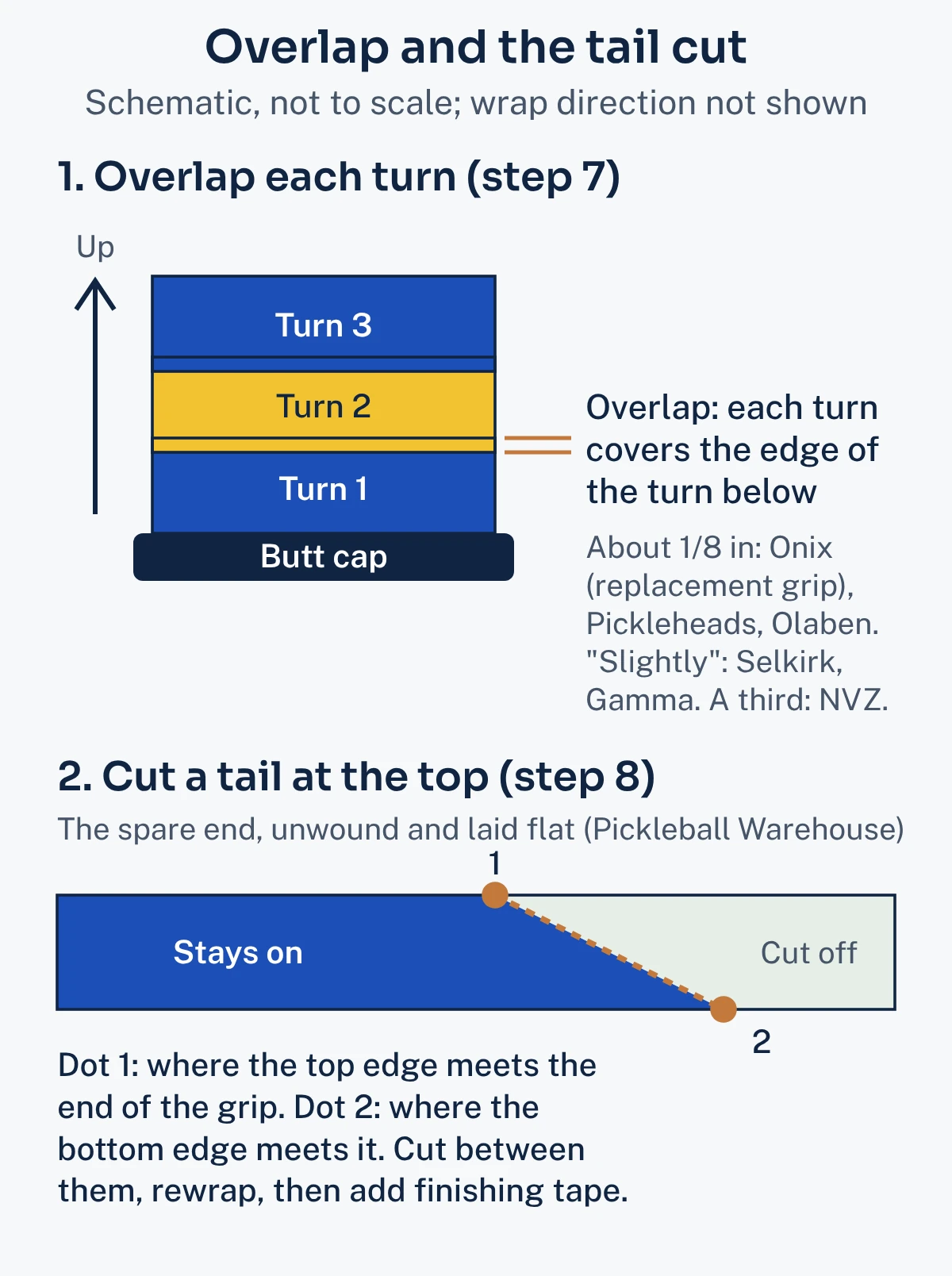
The sources differ on how much. Onix says “about an eighth of an inch” for its replacement grip, and for its overgrip says only “As we near the top of the paddle, you will want to manage the overlap distance to utilize the entire grip.” Pickleheads gives about 1/8 inch for an overgrip, and Olaben says “Maintain slight overlap between each layer (about 1/8 inch).” Selkirk says to “overlap each layer slightly” and Gamma “Overlap slightly.” Pickleball NVZ says to “overlap each wrap by about a third”, and Pickleball Warehouse says “The amount of overlap is personal preference and varies by player.” Olaben, a paddle brand, notes that “Using more overlap creates a thicker handle.” If the spiral drifts, unwind and redo it: Onix says “if we get off track, we can always go back and correct.”
Trim the end at the top of the handle
Pickleball Warehouse warns against winding the spare length round and round, which “may leave a bulge at the top of the grip,” and cuts a tapered tail instead. Mark a dot where the top edge of the wrap meets the end of the handle’s grip, wrap on until the bottom edge meets it and mark a second dot, then “Unravel the grip and draw a straight line between these two dots. Cut along this line with the scissors.” Onix cuts its replacement grip with “a perpendicular line” but gives its overgrip no cut. Selkirk says to “trim any excess from the top and bottom of the handle”, and Recess Pickleball says “trim it with scissors in a straight line.” Tourna cuts its pickleball overgrip to length, “so there is no need to cut or waste.”
Secure the end with finishing tape
Every wrapping guide we read finishes this way; Pickleheads says to “use the finishing tape that came with the grip to secure it in place.” Rewrap the trimmed tail, then wind the tape around the top of the grip. A grip band slid over the top can replace or cover the tape (Pickleball NVZ, Selkirk); Recess Pickleball uses both.
Ready to buy?
Our overgrip roundup compares eight overgrips by pack, thickness and feel, as each maker words them, and notes which packs include finishing tape. Covers for the paddle itself are compared in our paddle cover roundup.
Common mistakes and how to fix them
- Wrinkles in the wrap. Pickleball Warehouse applies “a slight amount of tension” so the grip does not wrinkle; keep it even all the way up.
- A crooked or uneven spiral. Selkirk: “If you make a mistake, don’t be afraid to pull back the grip and redo a previous section.”
- A lump at the top. Winding the spare length over itself can leave a bulge (Pickleball Warehouse); cut the tail instead (step 8).
- A replacement grip that will not sit flat. Old adhesive left on the handle “may interfere with applying the new grip” (Selkirk); clear it before you start.
- A handle that now feels too thick. More overlap makes a thicker handle (Olaben); wrap again with less overlap, or see the next section.
- Damage under the old grip. If the handle itself is cracked or the paddle has other damage, a new wrap will not fix it; our guide to when to replace a pickleball paddle covers the checks.
Building the handle up with a second layer
Players who want a thicker handle wrap an overgrip over the base grip, or add a second one. Selkirk says: “You can always ADD an over-grip (or two) to your paddle to increase the circumference.” The sources differ on how much one layer adds. Pickleball Warehouse says “A typical overgrip will increase a grip by 1/16 inch,” while Pickleball NVZ says an overgrip “adds tackiness and absorbs sweat without significantly changing the grip size.” Our paddle size guide covers grip sizes and how to measure, and our roundup of the best pickleball paddles gives the handle length and circumference its makers state for each pick. For more on what an overgrip does, see our guide to why players put an overgrip on a pickleball paddle.
Related guide: Are Pickleball Paddle Covers Worth It? What Makers and Owners Say
Related guide: Are Pickleball Paddle Edge Guards Worth It? It Depends on the Edge
Frequently Asked Questions
Q. Do you wrap a pickleball paddle from the top or the bottom?
From the bottom. Every wrapping guide we read starts at the butt cap and works up toward the paddle face, finishing with tape at the top of the handle.
Q. Should I take off the stock grip before I wrap?
Only for a replacement grip, which goes on the bare handle. An overgrip goes over the stock grip, which Tourna describes as wrapping “over the original grip.”
Q. Can you use a tennis overgrip on a pickleball paddle?
Players do. Tourna sells a pickleball overgrip “Cut specifically for the size of a Pickle ball paddle,” so a tennis grip may need trimming at step 8, and one r/Pickleball owner notes that the tapered start is often missing: “Some grips don’t have this, especially if you’re using tennis overgrips.”
Q. How often should you rewrap a pickleball paddle?
Recess Pickleball, a paddle brand, says to “replace the grip tape on your pickleball paddle after 12 hours of play, or when it feels silky instead of tacky – whichever comes first.” Pickleball NVZ says “Most players replace overgrip every 5-15 sessions depending on how much they sweat,” and Pickleball Warehouse recommends “changing your overgrip once traction is lost.” NVZ’s check: “A simple test: press your thumb into the grip. Fresh overgrip rebounds slightly and feels tacky. Worn overgrip feels flat, slick, or slightly shiny.”
Q. Is a grip wrap allowed in tournament play?
Yes. USA Pickleball’s Equipment Standards Manual (Revision 3, January 2025) says in rule 2.E.5 that “Altered paddles must meet all specifications,” and rule 2.E.5.a reads in full: “Player alterations or additions to a commercially produced paddle as certified, may include such items as edge guard tape/replacements, weighted tape, weights for an Original Equipment Manufacturer (OEM) integrated weight system, changes to the grip size via inserts, grip wraps, OEM interchangeable grips, OEM replacement paddle faces, and name decals and/or other identification markings on the paddle face.” Rule 2.E.5.b adds, in full: “Decals and tape can extend no farther than 1.0 inch (2.54 cm) above the top of the grip nor more than 0.5 inch (1.27 cm) inside the outer edge of a paddle or, if an edge guard is in place, 0.5 inch inside the edge guard.” We read the January 2025 manual; the 2026 rulebook did not open for us and was not checked.
Q. Can you rewrap a paddle without tools?
Nearly. Pickleball Warehouse lists finishing tape as included with the grip, and Tourna’s pickleball overgrip is cut to length, “so there is no need to cut or waste.” Other grips need scissors for the trim (step 8).
Sources (16)
- Onix, Apply Replacement Grip and Overgrip to Pickleball Paddle
- Selkirk, How to overgrip your pickleball paddle for maximum performance
- Selkirk, How to replace the grip on a pickleball paddle
- Selkirk, How do I find my pickleball paddle grip size?
- Gamma, The Ultimate Guide to Replacing Your Pickleball Grip
- Tourna, Pickleball Tourna Grip
- Tourna, Pickleball Replacement Grip – 1.75mm
- Tourna, Pickleball Cushion Replacement Grip – 3.8mm
- Recess Pickleball (Club Recess), How to Re-Grip a Pickleball Paddle
- Olaben, Regrip Your Pickleball Paddle in Minutes
- Pickleheads, When to use an overgrip in pickleball
- Pickleball Warehouse (retailer), How to Apply a Pickleball Overgrip in 6 Easy Steps
- Pickleball Warehouse (retailer), How to Choose a Pickleball Paddle
- Pickleball NVZ (shop), Best Pickleball Overgrip
- r/Pickleball (forum), Step by step tutorial on how to overgrip your paddle
- USA Pickleball, Equipment Standards Manual, Revision 3 (January 2025)