The short answer
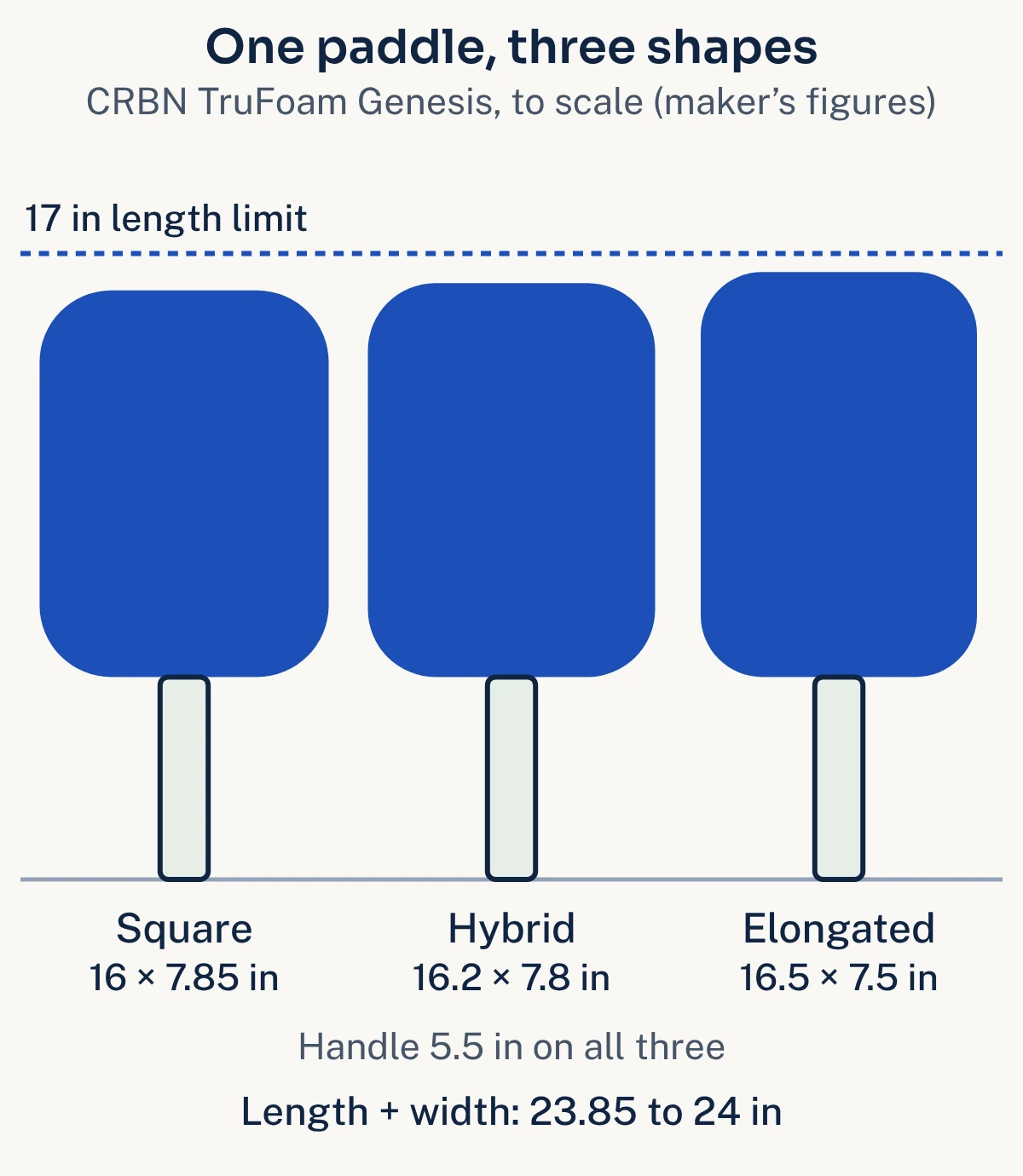
USA Pickleball caps a paddle at 17 inches long and at 24 inches for length plus width, edge guard and butt cap included; thickness and weight have no limit. The adult paddles in our chart total 23.6 to 24 inches: about 16 by 8 inches for standard and wide-body shapes, 16.5 by 7.5 for elongated ones.
A paddle’s size is really five numbers: length, width, handle length, grip circumference and core thickness. Only length and width have a limit. This guide starts with that limit, then lines up the sizes makers actually list for each shape, then covers the two numbers you choose from your own hand and game.
For ball, court and net measurements, see our overview of pickleball ball, paddle, court and net sizes. For ball dimensions, see our guide to pickleball ball size. Padel rackets have their own limits, which our article on how a pickleball paddle compares with a padel racket sets beside these.
The size limits in USA Pickleball’s equipment manual
USA Pickleball’s Equipment Standards Manual (Revision 3.0, January 2025) sets paddle size in rule 2.E.3:
Note
“The combined length and width, including any edge guard and butt cap, shall not exceed 24 inches (60.96 cm). The paddle length cannot exceed 17 inches (43.18 cm). There is no restriction on paddle thickness.”
Rule 2.E.4 adds: “There is no restriction on paddle weight.”
Two more rules in the manual matter when you change a paddle’s size. Rule 2.E.5 says “Altered paddles must meet all specifications.” Rule 2.E.5.a lists what players may change: “Player alterations or additions to a commercially produced paddle as certified, may include such items as edge guard tape/replacements, weighted tape, weights for an Original Equipment Manufacturer (OEM) integrated weight system, changes to the grip size via inserts, grip wraps, OEM interchangeable grips, OEM replacement paddle faces, and name decals and/or other identification markings on the paddle face.”
For tournament play, rule 2.F.3 makes the model check the player’s job: “Players are responsible for confirming that the paddle they are using for match play is listed as Pass on the USA Pickleball Approved Paddle List. The lists of approved equipment may be posted on the USA Pickleball website: USAPickleball.org.”
Good to know
This guide quotes the manual as posted on USA Pickleball’s equipment site on October 21, 2026. USA Pickleball’s 2026 Official Rulebook could not be opened for this guide (its site served a verification page instead of the file), so the 2026 rulebook’s wording was not checked here.
Paddle size chart by shape
Selkirk, a paddle maker, says “most paddles are around 8 inches wide and 16 inches long” and that “Manufacturers adjust paddle lengths and widths within these parameters to deliver desired outcomes.” The chart shows how three makers do it. Each row is copied from the maker’s own product or specification page (read October 21, 2026), under the shape name that maker uses. The last column is worked out here by adding length and width.
| Shape (maker’s word) | Paddle | Length × width | Handle | Length + width |
|---|---|---|---|---|
| Standard (junior) | Onix Z Junior | 14.5 × 7.625 in | 4.5 in | 22.1 in |
| Wide body | Onix Graphite Z5 | 15.5 × 8.125 in | 5 in | 23.6 in |
| Standard | JOOLA Scorpeus Pro IV | 16 × 8 in | 5.25 in | 24 in |
| Square | CRBN TruFoam Genesis | 16 × 7.85 in | 5.5 in | 23.85 in |
| Hybrid | CRBN TruFoam Genesis | 16.2 × 7.8 in | 5.5 in | 24 in |
| Elongated | JOOLA Perseus Pro IV | 16.5 × 7.5 in | 5.5 in | 24 in |
| Elongated | CRBN TruFoam Genesis | 16.5 × 7.5 in | 5.5 in | 24 in |
| Elongated, long handle | CRBN TruFoam Genesis | 16.5 × 7.35 in | 5.75 in | 23.85 in |
Worked from the chart: every adult paddle adds up to between 23.6 and 24 inches, and the longest is 16.5 inches, half an inch under the 17-inch cap. The junior paddle totals 22.1 inches.
The shape names overlap between brands. JOOLA’s product page calls the Scorpeus “standard,” while JOOLA’s own blog describes that class as “A traditional wide-body paddle shape,” typically 16 inches long by 8 inches wide. CRBN calls its 16 by 7.85-inch version “Square.” That is why the chart gives the numbers beside each maker’s word.
What the makers say the trade buys you, in their words:
- Selkirk: “Longer paddles = more reach and potential power.” and “Wider paddles = larger sweet spot and more forgiveness.”
- JOOLA: “The elongated paddle shape benefits players by offering added reach while the standard shape provides greater forgiveness.”
Three of the chart’s paddles are also picks in our roundups, one wide-body, one elongated and one elongated with a long handle:
| # | Preview | Product | Price | Link |
|---|---|---|---|---|
| 1 |  | Onix Graphite MOD Z5 Carbon Fiber Pickleball Paddle with…Widebody: Onix Graphite Z5 | $63.00 Prime | Check on Amazon |
| 2 |  | JOOLA Ben Johns Perseus Pro IV 16mm Pickleball Paddle…Elongated: JOOLA Perseus Pro IV | Check on Amazon | |
| 3 |  | CRBN Pickleball, TruFoam Genesis, Carbon Fiber Pickleball…Elongated, long handle: CRBN Genesis 1 | $199.99 | Check on Amazon |
The Onix Graphite Z5 is compared in our roundup of beginner pickleball paddles; the JOOLA Perseus Pro IV and the CRBN TruFoam Genesis 1 are compared in our roundup of the best pickleball paddles.
How to measure a paddle
Measure the length from the bottom of the butt cap to the top of the edge guard
The manual’s 24-inch total names both parts, and the length on its own must be 17 inches or less.
Measure the width across the face, edge guard included
The manual’s 24-inch total includes the edge guard here too.
Add length and width
The total must not exceed 24 inches. Maker pages list both figures, as in the chart above, so you can do the same sum before you buy.
Measure the handle the way the maker does
CRBN, for one, says “Handle length is measured from the very bottom to the top of the rubber band.”
For tournaments, look the model up
Search the approved paddle list USA Pickleball posts (the manual names USAPickleball.org); rule 2.F.3 above puts that check on the player.
Handle length for one- and two-handed players
The handle is part of the paddle’s length. Dick’s Sporting Goods, a retailer, explains the trade: because length plus width cannot exceed 24 inches, “every inch added to the handle length takes away surface area of the paddle face.”
Two sources tie a longer handle to two-handed shots:
- Dick’s: a player using two hands needs a handle of at least 5 1/2 inches.
- Selkirk: “handles are usually around 4.5 inches long, with a maximum of 6 inches for those who like to play some shots two-handed.” That 6-inch figure is Selkirk’s, not a USA Pickleball limit.
The adult handles in the chart run from 5 inches (Onix Graphite Z5) to 5.75 inches (the long-handle CRBN Genesis), longer than Selkirk’s “usually around 4.5 inches.” Some models come in both handle lengths. Vatic Pro lists its Prism handles as “Long Handle (5.75in) Standard (5.3in).” On some the footprint changes with the handle: Vatic Pro gives the Flash as 16.2 by 7.7 inches and the long-handle Flash LH as 16.375 by 7.625 inches, and CRBN’s elongated Genesis is 7.5 inches wide with the standard handle and 7.35 with the long one. Vatic lists its V7 and V7 LH at the same 16.5 by 7.5 inches.
Grip circumference: size it from your hand
Grip circumference is the distance around the handle. Selkirk says “Pickleball paddle grips start at 4 inches and go up to 5 inches in circumference,” while Dick’s says most grips run from 3 5/8 inches to 4.5 inches and up. In the chart, Onix lists 4 inches for the Graphite Z5 and JOOLA 4.25 inches for the Perseus Pro IV and Scorpeus Pro IV. Our pickleball grip size guide looks at grip size on its own.
Selkirk and Dick’s give the same ruler test:
Hold your playing hand palm up with the fingers extended
Selkirk’s words: “Open your dominant hand face up, with your fingers extended.”
Find the middle of the three creases across your palm
Dick’s: “Notice your palm has three major creases.”
Measure from that crease to the tip of your ring finger
Selkirk: “Measure the distance from the bottom lateral crease (the middle of the three), up to the tip of your ring finger. This measurement will be somewhere between 4 and 5 inches, and should be the perfect circumference for your pickleball grip.”
Match the number to the grip circumference on the paddle’s page
Makers list it in inches, as Onix and JOOLA do for the paddles above.
If you fall between two sizes, take the smaller one
Dick’s says “If you are unsure between two sizes, choose the smaller size.” Selkirk adds “You can always ADD an over-grip (or two) to your paddle to increase the circumference,” and USA Pickleball’s rule 2.E.5.a, quoted above, lists grip wraps among the changes players may make.
Without a ruler, height is the fallback. Selkirk publishes a height chart but says it is “less accurate than the ruler test.” Selkirk’s height chart (Dick’s gives the same three bands):
| Your height | Grip circumference |
|---|---|
| Below 5 ft 3 in (160 cm) | 4 in (10.2 cm) |
| 5 ft 3 in to 5 ft 8 in (160-173 cm) | 4.25 in (10.8 cm) |
| Above 5 ft 8 in (173 cm) | 4.5 in (11.4 cm) |
The centimetre figures are Selkirk’s.
You may also meet the index-finger test, borrowed from tennis. Dick’s lists it as a third method; Selkirk rejects it: “While this idea may work for tennis players, it is not the same for pickleball grip sizing.” The ruler test is the one both give.
Thickness and weight: no limit, so read the maker’s figure
USA Pickleball sets no limit on thickness or weight (rules 2.E.3 and 2.E.4 above), so both figures are the maker’s choice. Pickleball Central, a retailer, says “Paddles come in a variety of thicknesses ranging from 8-20mm.” Holbrook, a paddle maker, offers several: “Holbrook Pickleball offers a range of paddles in different sizes, including 12mm, 14mm, and 16mm.”
For weight, Selkirk sorts paddles into three bands: “Lightweight (<7.2 oz),” “Midweight (7.3–8.4 oz)” and “Heavyweight (8.5+ oz).” Our pickleball paddle weight guide looks at weight on its own.
If this is your first paddle, our guide to what to look for in a beginner pickleball paddle covers core, weight and grip for new players.
Ready to buy?
Our roundup of the best pickleball paddles compares picks across widebody, hybrid and elongated shapes, and our elongated pickleball paddle roundup compares the long shapes on their own.
Frequently Asked Questions
Q. What is a standard pickleball paddle size?
There is no single standard size, only the limits. Selkirk says most paddles are around 8 inches wide and 16 inches long, and JOOLA describes its standard class as typically 16 inches long and 8 inches wide.
Q. What is a pickleball paddle’s size in centimetres?
The manual gives its own metric limits: 43.18 cm for length and 60.96 cm for length plus width. Converted here at 2.54 cm per inch, a 16 by 8-inch paddle is about 40.6 by 20.3 cm, and a 16.5 by 7.5-inch elongated paddle about 41.9 by 19.1 cm.
Q. Is a 14mm or 16mm paddle better?
The rules allow either, since thickness is not limited. JOOLA, writing about the Scorpeus Pro V it sells in both, says the 14 mm is “Typically favored by aggressive, offense-first players who want extra pop and faster ball speed” and the 16 mm is “Often preferred by players who prioritize control and feel.”
Q. Is 8.7 oz too heavy for a pickleball paddle?
USA Pickleball sets no weight limit. On Selkirk’s bands, 8.7 ounces (about 247 g, converted here) falls in the heavyweight band, which starts at 8.5 ounces.
Q. What size paddle does a child need?
USA Pickleball’s equipment manual sets no separate junior size; the same limits apply. Onix sells the Z Junior as “A reduced length paddle perfect for young players,” listing it at 14.5 inches long, 7.625 inches wide, with a 4.5-inch handle and a 4-inch grip.
Q. Is a longer or wider pickleball paddle better?
The makers describe a trade, not a winner: Selkirk links longer paddles with reach and wider ones with a larger sweet spot. Within the 24-inch total, a paddle already at the limit can gain length only by losing width, as the chart rows show.
Sources (15)
- USA Pickleball (governing body), Equipment Standards Manual, Revision 3.0, January 2025
- CRBN (paddle maker), TruFoam Genesis product page
- JOOLA (paddle maker), Pickleball Paddle Specifications
- JOOLA (paddle maker), Perseus Pro IV 16mm product page
- JOOLA (paddle maker), How to choose a pickleball paddle
- JOOLA (paddle maker), Scorpeus Pro IV 16mm product page
- JOOLA (paddle maker), Scorpeus: Shape Matters
- Onix (paddle maker), Graphite Z5 product page
- Onix (paddle maker), Z Junior product page
- Vatic Pro (paddle maker), Prism product page
- Selkirk (paddle maker), How do I find my pickleball paddle grip size?
- Selkirk (paddle maker), How to choose your perfect pickleball paddle: 10 key factors
- Dick’s Sporting Goods (retailer), Pickleball Paddle Buying Guide
- Pickleball Central (retailer), How to Choose a Pickleball Paddle
- Holbrook Pickleball (paddle maker), Pickleball Paddle Sizes Explained: 12mm, 14mm, and 16mm
Product prices and availability are accurate as of the date/time indicated and are subject to change. Any price and availability information displayed on Amazon.com at the time of purchase will apply to the purchase of this product.