The short answer
Look for a forgiving sweet spot and not too much pop. The makers and reviewers cited below point beginners to a wide or hybrid shape, a 16 mm polymer core, a midweight body (Selkirk’s midweight band is 7.3 to 8.4 ounces) and a grip circumference measured from your own hand, at a mid-range price rather than the top tier.
Paddle pages throw a dozen specs at a new player: core, face, swing weight, twist weight. Pickleball Effect, an independent paddle review site, says why they can wait: most beginners are trying to “optimize for things they haven’t earned enough court experience to understand yet.”
This guide keeps to what a first paddle needs, in the order you will meet it: the minimum kit, the checks on the paddle, the first outing, the mistakes and the next step.
The minimum kit before you buy a paddle
The kit is short. In an r/Pickleball thread where a first-timer asked what to buy, the top answer was one line: “Court shoes. Tennis or Pickleball.” Putting the pieces in order:
- A paddle. The rest of this guide.
- Balls that suit the court. Indoor and outdoor balls differ in holes and plastic; our guide to indoor, outdoor and approved pickleball balls sorts out which to bring.
- Court shoes. PickleRage, an indoor pickleball club operator, says “Tennis or volleyball shoes provide lateral support for quick directional changes.” One owner in that thread adds: “Running shoes aren’t ideal as they don’t allow for side to side movement.”
You may not need to buy the paddle first. Selkirk, a paddle maker, notes that “Many local clubs, pro shops, and events offer demo programs.” An owner in the same r/Pickleball thread suggests another route: “ask someone if they’ve got a paddle they can loan you for the day.”
What to look for in the first paddle
Pickleheads, a pickleball site that reviews gear, boils it down: “brand-new pickleball players should look for two key things in a paddle: a forgiving sweet spot, and not too much pop.” Selkirk agrees on the first: “Beginner paddles usually have a larger sweet spot for more forgiveness on off-center hits.” The checks below are about those two aims.
Shape: wider is more forgiving
Selkirk lists the trade: “Longer paddles = more reach and potential power” and “Wider paddles = larger sweet spot and more forgiveness.” JOOLA, another maker, puts it in one line: “The elongated paddle shape benefits players by offering added reach while the standard shape provides greater forgiveness.”
| Shape | What the sources say it favors | Who points beginners there |
|---|---|---|
| Standard or widebody | A wider face and bigger sweet spot (Selkirk, JOOLA) | Pickleball Kitchen, a pickleball blog: “Typically, beginner paddles are widebody” |
| Hybrid | Pickleball Effect lists “Enough reach,” “Plenty of forgiveness” and “Faster hands than elongated paddles” | Pickleball Effect: “I recommend hybrid paddles for most beginners” |
| Elongated | Added reach (Selkirk, JOOLA) | Pickleball Kitchen says of long, narrow paddles: “These require a much greater degree of accuracy.” |
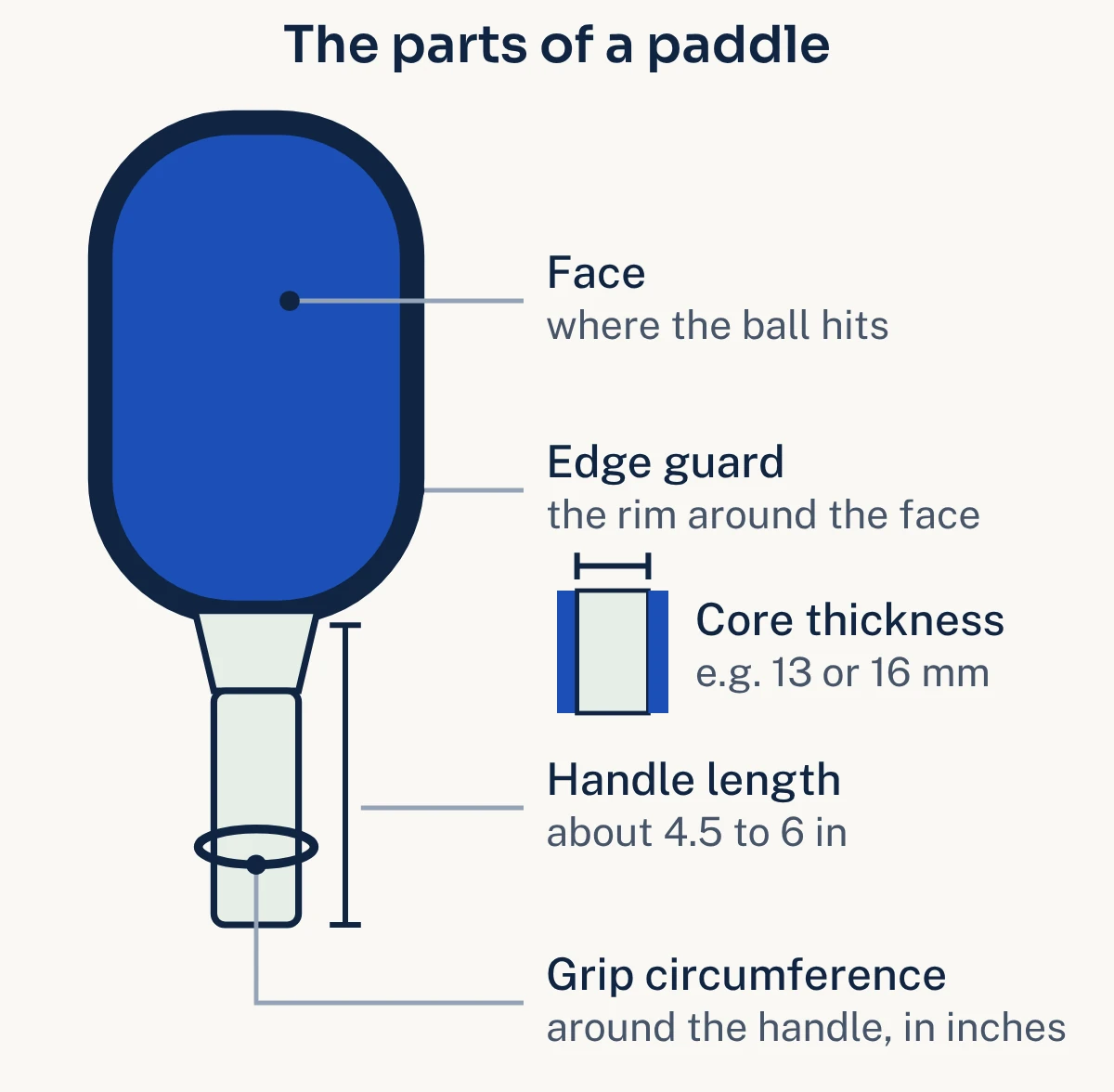
The two reviewers split. Pickleball Kitchen says beginner paddles are typically widebody; Pickleball Effect recommends a hybrid and calls hybrids “the middle ground.” Pickleball Kitchen also says to “Avoid long-board paddles.” Dick’s Sporting Goods, a retailer, adds a limit worth knowing: “every inch added to the handle length takes away surface area of the paddle face.” Both Selkirk and Dick’s give handle lengths of about 4.5 to 6 inches: Selkirk says “usually around 4.5 inches long, with a maximum of 6 inches for those who like to play some shots two-handed” (a Selkirk figure, not one of USA Pickleball’s limits below), and Dick’s gives the same 4.5 to 6 inch range.
Good to know
USA Pickleball’s Equipment Standards Manual sets the size limits as equipment specs: “The combined length and width, including any edge guard and butt cap, shall not exceed 24 inches (60.96 cm). The paddle length cannot exceed 17 inches (43.18 cm).” It adds “There is no restriction on paddle thickness” and “There is no restriction on paddle weight,” so those two choices are yours. Selkirk says most paddles are “around 8 inches wide and 16 inches long.”
Core thickness: the sources lean to 16 mm
Selkirk writes that “Thinner cores, around 13 mm, favor power, while thicker cores, around 16 mm, favor control.” JOOLA describes 16 mm as the one that “Offers control, precision, and stability” and 14 mm as “Ideal for players who prioritize power and faster gameplay.” Pickleball Effect says beginners are “better off with 16mm paddles because they offer bigger sweet spots than thinner 14mm builds.”
Makers do not all word it the same way. Holbrook, a paddle maker, says its 16 mm paddles “are designed for players who seek maximum power and stability,” and adds that they provide “a perfect blend of power and control.” For its 12 mm paddles Holbrook says they are “perfect for players who prioritize power, drive and pop,” and its summary offers “a light and fast 12mm paddle, a balanced 14mm, or a powerful 16mm paddle,” so Holbrook calls both ends power options in different ways. Read the page for the paddle you are considering rather than assuming a thickness means one thing everywhere.
Weight: start in the middle
Selkirk groups paddles into three weight bands and advises: “start with a midweight paddle and adjust” if you are unsure.
| Band | Weight | Selkirk’s description |
|---|---|---|
| Light | Lightweight (<7.2 oz) | “Quick maneuverability, best for net play and reaction shots.” |
| Middle | Midweight (7.3–8.4 oz) | “Balanced power and control” |
| Heavy | Heavyweight (8.5+ oz) | “Maximum power with less swing effort, but reduced finesse.” |
Pickleball Kitchen’s author goes further than the bands: “Avoid paddles that are over 8.5oz in weight” and, “Similarly, avoid paddles that are under 6oz in weight.” Pickleball Kitchen also calls 7.5 oz “midweight” and says “The #1 aspect to consider when choosing a pickleball paddle is weight.” The 7.3 to 8.4 oz band is Selkirk’s; Pickleball Kitchen’s own limits are the two above, under 6 oz and over 8.5 oz. Dick’s reminds readers that “the optimal weight is different for each athlete,” so treat the midweight band as a starting point, not a verdict.
Grip circumference: measure your hand
Grip circumference is the distance around the handle, and makers list it in inches. Selkirk and Dick’s both give the same ruler test:
Open your playing hand, palm up, fingers straight
Selkirk’s ruler test starts with “your dominant hand face up, with your fingers extended.”
Find the middle of the three creases on your palm
Selkirk calls it “the bottom lateral crease (the middle of the three).”
Measure from that crease to the tip of your ring finger
Use a ruler; Selkirk says the result “will be somewhere between 4 and 5 inches.”
Read that number as your grip circumference
Match it to the circumference on the paddle’s page.
If you fall between two sizes, pick the smaller and build up
Dick’s says “If you are unsure between two sizes, choose the smaller size.” Selkirk adds that “You can always ADD an over-grip (or two) to your paddle to increase the circumference,” and an r/Pickleball owner agrees: “While you can somewhat decrease grip size, increasing grip size is much easier.”
If you have no ruler, Selkirk and Dick’s both give the same height chart. Selkirk calls it “less accurate than the ruler test.”
| Your height | Grip circumference |
|---|---|
| Below 5’ 3” | 4 in |
| 5’ 3” to 5’ 8” | 4.25 in |
| Above 5’ 8” | 4.5 in |
The sources split on one test. Dick’s lists an index-finger test; Selkirk says of it: “While this idea may work for tennis players, it is not the same for pickleball grip sizing.” This guide uses the ruler test, which both give.
Face and core materials: the plain options
For the face, Selkirk says fiberglass is “Balanced power, control, and spin. A versatile choice for all-around play,” while carbon fiber is “Ultra-durable, lightweight, and control-focused, but it offers less raw power.” For the core, Selkirk calls polymer (polypropylene) “Most popular. Versatile balance of control, power, and spin — great for all skill levels” and says of Nomex: “suited for experienced players.” Pickleball Kitchen’s advice is blunter: “Avoid nomex and aluminum core paddles.” Dick’s disagrees on aluminum: it calls aluminum cores “a wise, standard choice in flexible maneuverability and control,” and as a face material says “Aluminum is best utilized for beginners, junior or recreational athletes searching for an inexpensive option to play and wanting a lightweight paddle.” Selkirk adds one pairing to avoid: “Avoid paddles that pair carbon fiber faces with aluminum cores as carbon can degrade aluminum over time.” The sources also split on carbon fiber: Selkirk calls it “control-focused, but it offers less raw power,” while Dick’s says it “provides massive power control on the ball for a large sweet spot.” Our guide to pickleball paddle materials goes deeper on each.
Price: three tiers, three opinions
No source sets one price for a beginner paddle, and they disagree. These are category ranges, each from the source named.
| Tier | Range or figure named | What the source says |
|---|---|---|
| Starter set | $35-40 for a two-paddle set (an r/Pickleball owner) | Pickleball Effect: “You should absolutely upgrade from a cheap Amazon starter set.” Pickleball Kitchen: “Unless you need the cheapest options, avoid paddles under $30.” |
| Mid-range | roughly $90–$180 (Pickleball Effect) | “The sweet spot for most beginners today” |
| Top tier | $250 (Pickleball Effect) | “you do not need to spend $250 to buy status.” |
Owners are split too. One r/Pickleball owner says a two-paddle set “took me through three seasons of league play”; another advises “Do NOT start with an expensive paddle.” Both fit the same idea: spend to match how much you expect to play. For prices at every level, see our guide to how much a pickleball paddle costs.
Your first outing with the new paddle
These steps cover the gear, not the game.
Pack the kit
Paddle, balls that suit the court surface and court shoes, as above. Court shoes were the top answer in the r/Pickleball thread above.
Hold the paddle and compare it with your ruler number
The circumference on the paddle’s page should match your measurement. If it is thinner, an overgrip adds circumference; Selkirk says you can add “an over-grip (or two).”
Judge the grip on court, not in the shop
Selkirk says “The best way to make sure a grip size is right for you is through actual court time.”
Try other players’ paddles when they offer
An owner advises: “ask people if you can try their paddles, find the type of paddle you like (longer handle? Thicker grip? Smaller core? Heavier?)”
Write down what you would change
A heavier or lighter paddle, a thicker or thinner grip, a bigger face. Pickleball Effect says “By the time you outgrow your first paddle, you’ll actually understand your preferences,” and your notes become the brief for the second one.
Mistakes to avoid
- Buying what the pros use. Pickleball Effect says “Most beginners would play worse with many pro paddles.”
- Starting with a power paddle. On whether beginners need one, Pickleball Effect answers: “For most beginners, the answer is no.” It adds that “It’s much easier to add power later than it is to take it away and try to learn touch shots.”
- Guessing the grip size. Selkirk says “your fingers need to comfortably wrap around the circumference” of the grip, and both it and Dick’s publish a ruler test.
- Paying for status, or for the cheapest set, without a plan. The price table shows the sources split on both ends, so decide how much you expect to play first.
- Chasing every spec. Pickleball Effect says beginners “do not need to spend hours researching” a list that opens with “Elongated vs hybrid vs widebody” and “14mm vs 16mm,” then runs through foam vs polymer cores, raw carbon vs fiberglass, swing weight, twist weight and balance point: “Those things absolutely matter later.” Its own answer is to start from a hybrid shape and a 16 mm paddle. Pickleball Kitchen ranks the choices differently and puts weight first (see the weight section).
What to do next
Your second paddle is the one to research more closely. Pickleball Effect says “your second paddle becomes far more personalized,” and by then you will have notes from step 5 above. Our paddle roundup, linked below, compares specific models by shape, thickness and weight.
Ready to buy?
See our roundup of the best pickleball paddles for picks across the shapes and thicknesses described here. For a first paddle in particular, see our guide to beginner pickleball paddles or our guide to budget pickleball paddles. Once you are ready to move up, see our guide to intermediate pickleball paddles. For younger players, see our guide to kids’ pickleball paddles.
For more on the choices in this guide, see our comparison of 14 mm and 16 mm pickleball paddles.
Frequently Asked Questions
Q. Is a 14 mm or 16 mm paddle better for beginners?
Pickleball Effect recommends 16 mm for the bigger sweet spot, and Selkirk and JOOLA both describe 16 mm as the control side. Holbrook says its 16 mm paddles “are designed for players who seek maximum power and stability” and provide “a perfect blend of power and control,” and its summary calls 16 mm “a powerful 16mm paddle,” so check the paddle’s page.
Q. How much should a beginner pickleball paddle weigh?
Selkirk’s midweight band is 7.3 to 8.4 ounces, and it suggests starting there if unsure. USA Pickleball’s manual sets no weight limit, so the choice is about fit.
Q. What size should a beginner pickleball paddle be?
Selkirk says most paddles are around 8 inches wide and 16 inches long, within USA Pickleball’s 24-inch length-plus-width limit. Choose the grip circumference by measuring your hand.
Q. Is there a difference between cheap and expensive paddles?
Selkirk says “higher-quality paddles tend to offer better materials, performance, and longevity.” Pickleball Effect says its roughly $90 to $180 range now gives access to “Strong spin” and “Better durability,” and that you do not need to spend $250.
Q. How can I tell if a paddle is good quality?
Selkirk lists “Trusted brands with proven construction quality” and “Warranty coverage” as two checks. For tournament play, USA Pickleball’s manual says equipment “must be named on the list of” approved equipment, which you can search on its equipment site.
Q. Do beginners need a paddle set?
Sources disagree. An r/Pickleball owner says “just stay away from wood” and that a $35 to $40 two-paddle set “should all work fine,” Pickleball Effect says to upgrade from one, and Pickleball Kitchen says “Unless you need the cheapest options,” avoid paddles under $30.
Sources (13)
- Selkirk (paddle maker), How to choose your perfect pickleball paddle: 10 key factors
- Selkirk (paddle maker), How do I find my pickleball paddle grip size?
- JOOLA (paddle maker), How to choose a pickleball paddle
- Holbrook (paddle maker), Pickleball paddle sizes explained: 12mm, 14mm and 16mm
- USA Pickleball (governing body), Equipment Standards Manual, January 2025
- Dick’s Sporting Goods (retailer), Pickleball paddle buying guide
- Pickleball Effect (independent paddle review site), Expert review: best pickleball paddles for beginners
- Pickleheads (pickleball site with gear reviews), Best beginner pickleball paddles
- Pickleball Kitchen (pickleball blog and coaching site), Top 5 best pickleball paddles for beginners
- PickleRage (indoor pickleball club operator), What do you need to play pickleball?
- r/Pickleball (forum), As a first-time Pickleball player, what equipment should I buy?
- r/Pickleball (forum), How to find your hand size and optimal grip size?
- r/Pickleball (forum), Best paddles for beginners?