The short answer
USA Pickleball sets no limit on paddle weight. The paddles Pickleball Effect has measured average about 8 ounces (8.01 oz, about 227 g). Light, midweight and heavy are each source’s own labels, and they disagree: an 8.3-ounce paddle is midweight on Selkirk’s chart and heavyweight on Pickleball Central’s.
A paddle’s weight comes as three numbers: static weight (what a scale reads), swing weight and twist weight. The three makers in the chart below list static weight or none; a few makers also publish swing and twist weight (Bread & Butter on its Loco page, Six Zero on its Coral page), and testers such as Pickleball Effect measure all three. This guide lines up the weight classes five sources use, sets makers’ listed weights beside measured ones, and covers adding weight within the rules.
Paddle length and width limits are in our guide to pickleball paddle size; ball, court and net sizes are in our overview of pickleball sizes.
No weight limit, but rules on adding weight
USA Pickleball’s Equipment Standards Manual (Revision 3.0, January 2025), in its paddle specifications, says in rule 2.E.4: “There is no restriction on paddle weight.”
The same section covers weight you add yourself. Rule 2.E.5 says “Altered paddles must meet all specifications.” Rule 2.E.5.a lists what players may add or change:
Note
“Player alterations or additions to a commercially produced paddle as certified, may include such items as edge guard tape/replacements, weighted tape, weights for an Original Equipment Manufacturer (OEM) integrated weight system, changes to the grip size via inserts, grip wraps, OEM interchangeable grips, OEM replacement paddle faces, and name decals and/or other identification markings on the paddle face.”
Rule 2.E.5.b then limits where tape may go: “Decals and tape can extend no farther than 1.0 inch (2.54 cm) above the top of the grip nor more than 0.5 inch (1.27 cm) inside the outer edge of a paddle or, if an edge guard is in place, 0.5 inch inside the edge guard.”
Good to know
This guide quotes the manual as posted on USA Pickleball’s equipment site on October 21, 2026. USA Pickleball’s 2026 Official Rulebook could not be opened for this guide (its site served a verification page instead of the file), so the 2026 rulebook’s wording was not checked here.
Weight classes: five sources, five sets of cut-offs
With no rule to set them, the light, mid and heavy labels come from makers and retailers. Each row below is copied from that source’s own guide (read October 21, 2026), in the source’s own class names.
| Source | Light | Middle | Heavy |
|---|---|---|---|
| Selkirk (maker) | Lightweight: under 7.2 oz | Midweight: 7.3 to 8.4 oz | Heavyweight: 8.5 oz and up |
| Paddletek (maker) | Lightweight: below 7.3 oz | Midweight: 7.3 to 8.3 oz | Heavy: above 8.3 oz |
| Eleven Zero (maker) | Lightweight: under 7.5 oz | Midweight: 7.5 to 8.2 oz | Heavyweight: 8.2 oz and up |
| Pickleball Warehouse (retailer) | Lightweight: 7.5 oz or less | Mid-range: 7.6 to 8.2 oz | Heavier side: above 8.2 oz |
| Pickleball Central (retailer) | Featherweight: 7.5 oz and under; Lightweight: 7.6 to 7.8 oz | Mid-weight: 7.9 to 8.2 oz | Heavyweight: 8.3 oz and over |
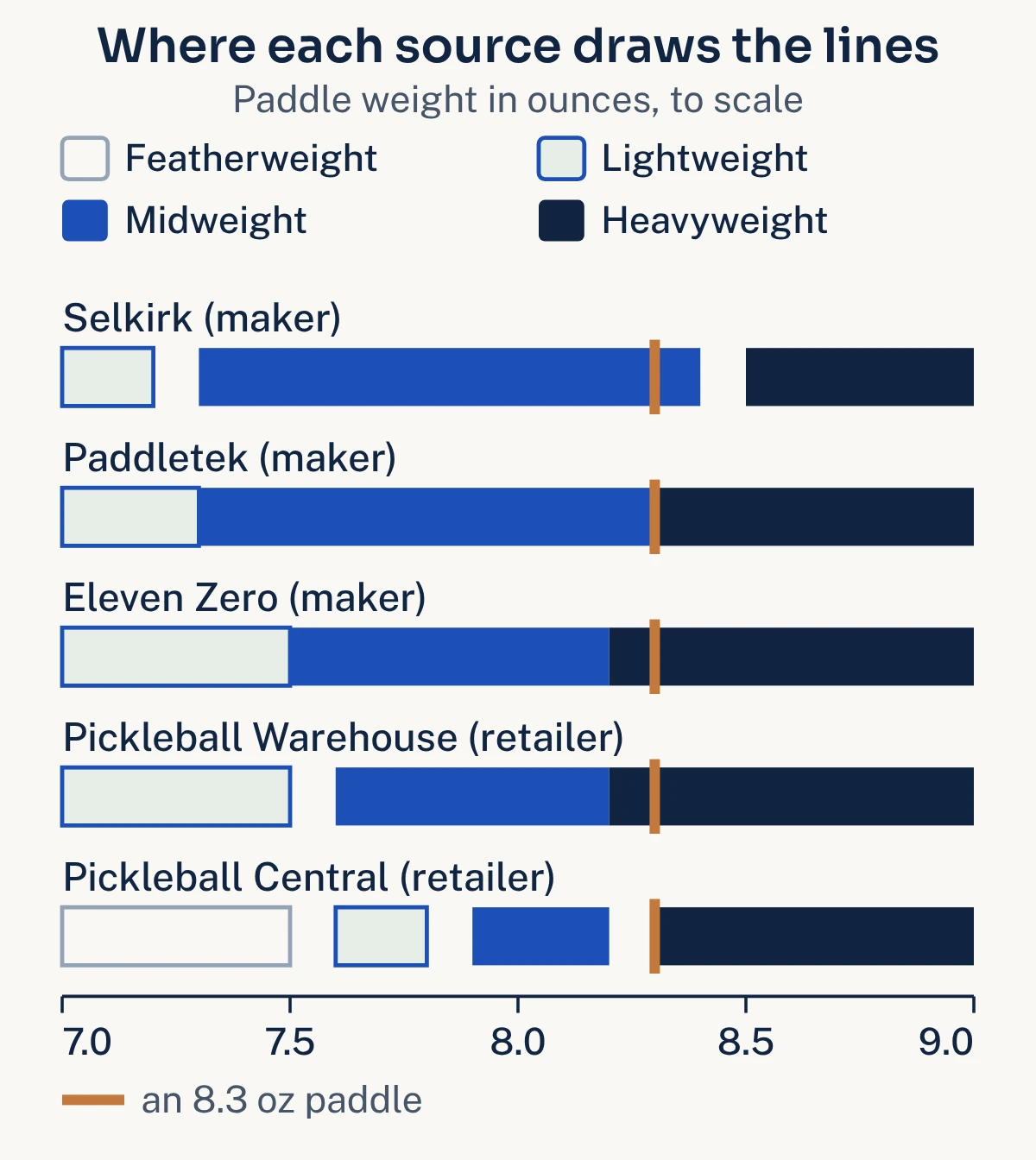
Worked from the table, the same paddle changes class with the chart you read:
- 8.0 oz is in the middle class on all five.
- 8.3 oz is midweight for Selkirk and heavy for Eleven Zero, Pickleball Warehouse and Pickleball Central. Paddletek’s page puts it on both sides: its summary says midweight runs “between 7.3 and 8.3 ounces” and heavier paddles are “8.3 ounces and up.”
- 7.3 oz is also in two classes on Paddletek’s page: lightweight paddles are “7.3 ounces and lighter” and midweight ones are “between 7.3 and 8.3 ounces.”
- 7.5 oz is midweight for Selkirk, Paddletek and Eleven Zero, lightweight for Pickleball Warehouse and featherweight for Pickleball Central.
- 8.5 oz and up is in the heaviest class on all five.
Paddletek writes: “You may find other weights aligned to each class, but in terms of how major retailers classify paddle weights, they most often follow the same weights referenced above. If there is any variance, it will typically be within .1oz.” The two retailer guides read here match it at the heavy end (above 8.2 at Pickleball Warehouse; 8.3 and over at Pickleball Central) but not at the light end: their middle class starts at 7.6 (Pickleball Warehouse) and 7.9 ounces (Pickleball Central), against Paddletek’s 7.3.
Maker labels add to the spread. Onix lists its Graphite Z5 at “Weight: 7.5-8.2 oz” and calls it a “medium-weight graphite pickleball paddle.” On Selkirk’s chart that whole range is midweight; on Pickleball Central’s it runs from featherweight (7.5) to mid-weight (8.2). Eleven Zero says two of its own paddles, the H13 Pro Origin and the EZ Speed E14, are “both 7.8 oz” and “sit right in this zone,” its midweight band.
Paddle weight chart: what makers list and what a tester measured
Makers list weight in different ways: a range, an average with a tolerance, or not at all. Selkirk explains why one exact figure is rare: “It’s nearly impossible to make paddles to a very specific weight every time.” The chart sets three makers’ listings beside the figures Pickleball Effect, an independent tester, measured on its own units. Maker figures are from their product pages, read October 21, 2026; Pickleball Effect’s are from its own pages, dated below.
| Paddle | Maker lists | Measured by Pickleball Effect | Swing weight | Twist weight |
|---|---|---|---|---|
| Onix Graphite Z5 (wide body) | 7.5 to 8.2 oz, “approximate” | Not found in Pickleball Effect’s database | – | – |
| CRBN TruFoam Genesis 1 (elongated, long handle) | 8.0 oz ± 0.2 | 7.9 oz | 118 | 5.51 |
| Vatic Pro Prism Flash, 16 mm | No weight given | 7.91 oz | 114 | 6.40 |
Onix’s page says “Approximate measurements and weights only.” CRBN’s ± 0.2 ounce works out to 7.8 to 8.2 ounces, and Pickleball Effect’s Genesis 1 at 7.9 ounces sits inside it. Vatic Pro gives no weight on the Prism page; of custom weight requests it says “exact weights are not guaranteed.” The Genesis 1 figures are from Pickleball Effect’s paddle page (read October 21, 2026), the Prism Flash figures from its best control paddles list (updated August 14, 2026). Its paddle pages add: “Measurements are from our test unit and may vary.”
The three are picks in our roundups, one for each way the weight is listed:
| # | Preview | Product | Price | Link |
|---|---|---|---|---|
| 1 |  | Onix Graphite MOD Z5 Carbon Fiber Pickleball Paddle with…Wide body, weight listed as a range | $63.00 Prime | Check on Amazon |
| 2 |  | CRBN Pickleball, TruFoam Genesis, Carbon Fiber Pickleball…Elongated, weight listed as average ± 0.2 oz | $199.99 | Check on Amazon |
| 3 |  | Vatic Pro Prism Flash Carbon Fiber 16mm – Foam Injected…16 mm, no weight on the maker page | $99.99 | Check on Amazon |
The Onix Graphite Z5 is compared in our roundup of beginner pickleball paddles, the CRBN TruFoam Genesis 1 in our roundup of the best pickleball paddles and the Vatic Pro Prism Flash in our roundup of budget pickleball paddles.
Swing weight and twist weight: what the scale misses
Pickleball Effect puts it bluntly: “Static weight tells you very little on its own. These are the numbers that do.” Its first number, swing weight, is “How heavy a paddle is to swing.” Its second, twist weight, is “A paddle’s resistance to twisting on off-center contact.” Our explainer on what swing weight is goes into the number on its own.
In Pickleball Effect’s data, shape moves both numbers while the scale barely changes. Its averages across the paddles it has measured, as shown on its paddle pages on October 21, 2026:
| Shape | Average static weight | Average swing weight | Average twist weight |
|---|---|---|---|
| Widebody | 8.00 oz | 109.2 | 6.85 |
| Hybrid | 8.01 oz | 112.9 | 6.45 |
| Elongated | 8.00 oz | 117.6 | 6.11 |
| All paddles in the database | 8.01 oz | 114.2 | 6.39 |
Worked from the table: the three shapes average within 0.01 ounce of each other on the scale, yet the elongated average swing weight is 8.4 points above the widebody one, and the widebody average twist weight is 0.74 higher than the elongated one.
One example from the same tester: “At 8.16 oz static the Widebody reads mid-heavy on paper, but the 108 swing weight (11th percentile) and 232mm balance point make it play light, quick, and head-neutral.” That is Pickleball Effect on the Six Zero Coral Pro Widebody.
Read these scores within one tester’s data. Pickleball Effect warns that “Every tester uses different equipment, environments and methodologies, so the scales don’t line up perfectly.”
How to weigh a paddle and compare the number
Weigh the paddle on a scale
Pickleball Central’s definition: “Static weight is just the weight of a paddle if you were to put it on the scale.”
Weigh it the way you play it
Paddletek notes that “Everything on the paddle has an effect on weight – from the edge guard and surface materials, all the way to the handle length and jewel.” Selkirk gives figures for its own grip options: “A 4.5” double grip paddles increase the weight of a paddle by 0.5oz. A 4” thin grip reduces the weight of a paddle by 0.2oz.”
Compare with the maker’s range, not one number
A listing such as CRBN’s 8.0 ounces ± 0.2 covers 7.8 to 8.2 ounces (worked out). For scale, Selkirk says “A tenth of an ounce (0.1oz) is about the weight of a penny.”
Convert if your scale reads grams
At 28.35 grams to the ounce (converted here), 7.5 ounces is about 213 g, 8 ounces about 227 g and 8.5 ounces about 241 g.
Take swing and twist weight from the maker’s spec sheet or a tester, and compare paddles inside one source
Selkirk says swing weight “is typically measured using specialized equipment, such as a swing weight machine.” Pickleball Effect lists its rig as the “Briffidi SW1.” Different sources measure differently, for the reason in the section above.
Choosing a class for how you play
The makers describe a trade, each in its own words. On where to start, the sources disagree, as the list after this one shows.
- Selkirk, on its own paddles: “Our Lightweight models allow players to have quicker hands at the net.” and “Our Midweight models allow players to generate more power.” Selkirk adds that “many players choose to use a Lightweight paddle for doubles and a Midweight paddle for singles.”
- Selkirk’s class notes (10-factors guide): lightweight is “Quick maneuverability, best for net play and reaction shots.”; midweight “Balanced power and control — most popular for all-around play.”; heavyweight “Maximum power with less swing effort, but reduced finesse.”
- Paddletek: “Midweight pickleball paddles (between 7.3 and 8.3 ounces) are the most beginner-friendly as they balance paddle speed, control, and power. Lightweight paddles (7.3 ounces and lighter) increase agility and control, whereas heavier pickleball paddles (8.3 ounces and up) increase power.”
- Pickleball Central, on its heavyweight class: “High-end performance paddles often fall in this range. Recommended for experienced players and very strong people.”
- Eleven Zero, on its heavyweight class: “Plow-through power on drives. The ball comes off with authority, but you sacrifice hand speed.”
Where the sources disagree on a default when you are unsure:
- Selkirk, 10-factors guide: “If you’re unsure what’s best for you, start with a midweight paddle and adjust using lead tape”
- Selkirk, weight guide: “Go with a Lightweight paddle” because lightweights “are more popular and a safe bet.” Selkirk’s two guides differ.
- Paddletek (maker): midweight paddles are “the most beginner-friendly.”
- Pickleball Warehouse (retailer): “We recommend playing with the heaviest paddle you can handle, not the lightest.”
If you come from another racquet sport, Selkirk matches the weight you are used to: “If you used an average weight to heavier weight racquet in Tennis, you probably will be most comfortable with a Midweight Pickleball paddle. If you preferred a lighter Tennis racquet, you probably will prefer a Lightweight Pickleball paddle as well.” It also says “Most Table Tennis players gravitate to Lightweight paddles.”
How fine to choose depends on your level, by Selkirk’s account. Of beginners with no racquet or paddle experience: “They generally can’t feel the difference until there is a 1oz or greater difference.” Of intermediate players: “Changing from a 7.5oz paddle to an 8.0oz paddle probably will affect your game.” Of advanced players: “Some advanced players can feel the difference in about a 0.2oz weight range and prefer a paddle at a particular weight +/- 0.1oz. Most professional Pickleball players don’t see small differences in weight affecting their game.”
For a first paddle, our guide to what to look for in a beginner pickleball paddle covers weight alongside core and grip. Our pickleball grip size guide covers the handle side.
Between two classes: adding weight later
Selkirk’s 10-factors guide says “If you’re unsure what’s best for you, start with a midweight paddle and adjust using lead tape” (its weight guide points to a lightweight paddle instead, as above). Whichever class you start in, rule 2.E.5.a, quoted above, allows weighted tape. Our lead tape roundup compares the tapes on width, length and weight per inch as each maker states them.
Add a little at a time
Eleven Zero says “Start with 2 to 4 grams at a time.” PB Pro Pickleball, a paddle maker, agrees on the amount: “Approximately 2–4 grams total is enough for many players to notice a difference. Use a small digital scale to confirm the amount you add because tape and pre-cut strips can vary by product.” Worked out, 2 to 4 grams is 0.07 to 0.14 ounce.
Choose the spot by the number you want to change
Eleven Zero’s guide: “Tape at 3 and 9 o’clock (sides of the head): Increases twist weight without dramatically changing swing weight.” “Tape at 12 o’clock (top of the head): Increases swing weight.” “Tape on the handle or butt cap: Counter-balances a head-heavy paddle.”
Keep the tape within rule 2.E.5.b
The rule, quoted in full at the top of this guide, limits how far tape may sit above the grip and inside the paddle’s edge.
Ready to buy?
Our roundup of the best pickleball paddles compares ten paddles with their specs; its weights are the maker’s stated range unless marked as measured.
Frequently Asked Questions
Q. Is 8.3 oz heavy for a pickleball paddle?
It depends on whose chart you use. Eleven Zero, Pickleball Warehouse and Pickleball Central count 8.3 ounces as heavy, Selkirk as midweight, and Paddletek’s page places it in both classes.
Q. Is 9 ounces too heavy for a pickleball paddle?
The rules allow it: rule 2.E.4 sets no weight limit. All five charts above put 9 ounces in their heaviest class.
Q. What is the standard weight of a pickleball paddle?
There is no standard in the rules. Pickleball Effect’s measured paddles average 8.01 ounces, and Eleven Zero describes its 7.5 to 8.2-ounce midweight class as “Where most paddles and most players land.”
Q. How much does a pickleball paddle weigh in grams or kg?
Converted at 28.35 g per ounce, an 8-ounce paddle is about 227 g (0.227 kg), and the 7.5 to 8.5-ounce span covers about 213 to 241 g.
Q. Do pro players care about exact paddle weight?
Selkirk says some advanced players notice about 0.2 ounce, but that most professionals do not see small weight differences affecting their game.
Q. Is a heavier or lighter paddle better?
The sources disagree. Selkirk and Paddletek both describe lighter paddles trading power for quickness and heavier ones the reverse. Paddletek calls midweight “the most beginner-friendly”; Selkirk’s 10-factors guide suggests a midweight paddle when you are unsure, while its weight guide calls a Lightweight paddle “more popular and a safe bet”; Pickleball Warehouse (retailer) says “We recommend playing with the heaviest paddle you can handle, not the lightest.”
Sources (19)
- USA Pickleball (governing body), Equipment Standards Manual, Revision 3.0, January 2025
- Selkirk (paddle maker), How to choose your perfect pickleball paddle: 10 key factors
- Selkirk (paddle maker), Paddle Weight Guide
- Selkirk (paddle maker), Understanding swing weight: The key to choosing the right pickleball paddle
- Bread & Butter (paddle maker), The Loco 16mm Pickleball Paddle – Standard
- Six Zero (paddle maker), Coral 16mm product page
- Paddletek (paddle maker), How to Pick the Right Pickleball Paddle Weight
- Eleven Zero (paddle maker), Pickleball Paddle Weights: How Heavy to Go and Where to Add Them
- PB Pro Pickleball (paddle maker), When should you add weight to your pickleball paddle
- Pickleball Warehouse (retailer), How Paddle Weight Affects Performance
- Pickleball Central (retailer), How to Choose a Pickleball Paddle
- Onix (paddle maker), Graphite Z5 product page
- CRBN (paddle maker), TruFoam Genesis product page
- Vatic Pro (paddle maker), Prism product page
- Pickleball Effect (independent tester), How Pickleball Effect tests paddles
- Pickleball Effect (independent tester), CRBN TruFoam Genesis 1
- Pickleball Effect (independent tester), Six Zero Coral Pro Widebody
- Pickleball Effect (independent tester), Six Zero Coral Pro Hybrid
- Pickleball Effect (independent tester), Best Control Pickleball Paddles
Product prices and availability are accurate as of the date/time indicated and are subject to change. Any price and availability information displayed on Amazon.com at the time of purchase will apply to the purchase of this product.