The short answer
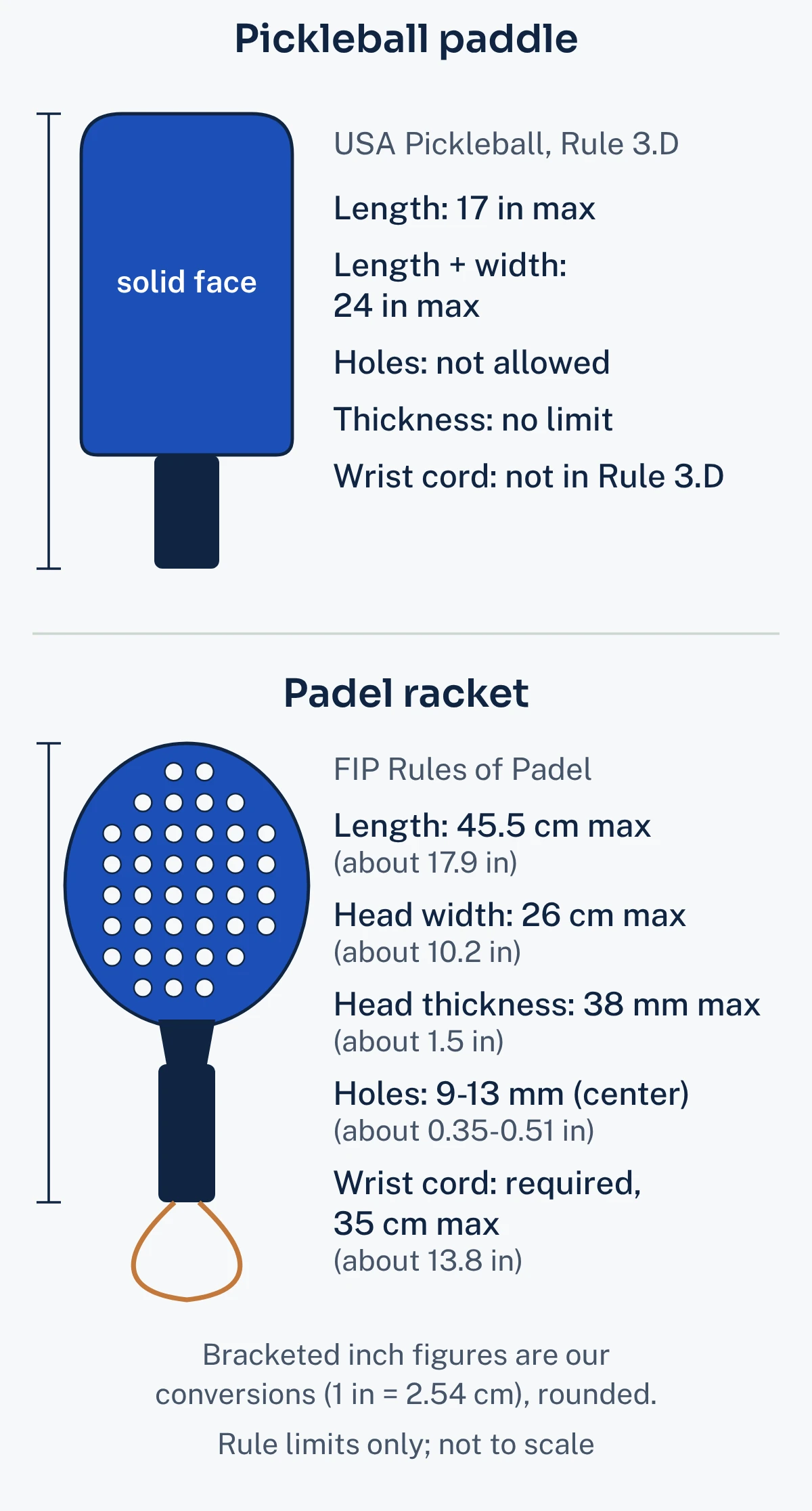
USA Pickleball caps a paddle at 17 inches long and 24 inches for length plus width, and its hitting surface must not contain holes. The International Padel Federation (FIP) caps a padel racket at 45.5 cm long, with a head up to 26 cm wide and 38 mm thick, a perforated face and a required wrist cord.
Padel is a separate sport from pickleball, with its own governing body, its own ball and its own racket. People call that racket a “padel paddle”, a “padel racket” or, misspelled, a “paddle”; the FIP’s rules call it a racket.
This page compares the equipment only. The rule figures come from the two governing bodies’ current texts, checked on October 22, 2026: USA Pickleball’s 2026 Official Rulebook and the FIP Rules of Padel that apply from January 1, 2026. Everything else is attributed to the maker that published it, with maker figures as listed on their pages on October 22, 2026.
The two side by side
| Pickleball paddle | Padel racket | |
|---|---|---|
| Rule text | USA Pickleball 2026 Official Rulebook, Rule 3.D | FIP Rules of Padel (applies from Jan. 1, 2026), racket section |
| Length | 17 in (43.18 cm) max | 45.5 cm max, head plus handle (about 17.9 in) |
| Width | Length plus width 24 in (60.96 cm) max | Head: 26 cm max (about 10.2 in) |
| Thickness | No limit; Selkirk: cores around 13 mm and 16 mm | Head: 38 mm max (about 1.5 in; 2.5% tolerance); Babolat and Bullpadel list 38 mm |
| Weight | No limit; Selkirk’s midweight band: 7.3–8.4 oz | No figure in the rules; Babolat: 350 to 390 grams (about 12.3–13.8 oz) |
| Face | Must not contain holes | Perforated; holes 9 to 13 mm in the center area (about 0.35–0.51 in) |
| Surface | No rough texturing, no rubber | Flat; “may be smooth or rough” |
| Core | Polypropylene honeycomb is common (Selkirk, Onix); foam cores also sold (Paddletek, Onix) | EVA or foam (Wilson, adidas, Babolat, Bullpadel) |
| Wrist cord | Not in Rule 3.D | Required; 35 cm max (about 13.8 in) |
| Ball | Molded, 26 to 40 holes, 2.87–2.97 in across | Rubber sphere, 6.35–6.77 cm across (about 2.50–2.67 in) |
Inch/ounce figures in brackets beside metric rule or maker figures are our conversions (1 in = 2.54 cm, 1 oz = 28.35 g), rounded.
The sections below quote the rule and maker wording behind each cell.
Size: length, width and thickness
USA Pickleball’s Rule 3.D.2 reads: “The combined length and width of the paddle, including any edge guard and butt cap, must not exceed 24 inches (60.96 cm). The paddle length must not exceed 17 inches (43.18 cm). There is no restriction on paddle thickness.” The same limits appear in USA Pickleball’s Equipment Standards Manual (Revision 3.0, January 2025), section 2.E.3.
The FIP writes its limits in metric. Its racket rules say: “Head: variable length. The length of the head plus the length of the handle may not exceed 45.5 cm, maximum width: 26 cm, maximum thickness: 38 mm.” The handle has its own rule: “Handle: maximum length: 20 cm, wide maximum (of throat, not considering the free space in between): 50 mm, maximum thickness: 50 mm.” When rackets are measured, “a tolerance of 2.5% in the thickness will be allowed.” So the 26 cm and 38 mm limits are for the head, and the 45.5 cm is for head plus handle. In inches, our conversion: 45.5 cm is about 17.9 in, the head’s 26 cm about 10.2 in and 38 mm about 1.5 in, and the handle’s 20 cm about 7.9 in and 50 mm about 2.0 in. The FIP states metric only.
In centimeters, the padel cap is the longer one: 45.5 cm against USA Pickleball’s 43.18 cm. USA Pickleball sets no thickness limit at all. Selkirk and Onix give core thicknesses in their own words: Selkirk’s construction guide says “However, paddle cores vary by material and thickness. Thinner paddles, around 13 mm, are designed for power and thicker paddles, around 16 mm, are designed for control.” Onix says its Theory “features a Solid Foam Cryo Core in both 14mm and 16mm options.” JOOLA’s Perseus Pro IV page lists “Thickness: 16mm” and a 14mm option, without saying whether that is core or overall thickness. The padel makers cited here list rackets at the FIP ceiling: Babolat lists its Technical Viper 3.0 at “38 mm / 1.5 in” and Bullpadel lists its Vertex 05 at “PROFILE: 38mm”. Our 14mm vs 16mm paddle comparison covers what the two common pickleball core thicknesses mean in practice.
The face: solid or perforated
USA Pickleball’s Rule 3.D.5 lists what a paddle’s hitting surface must not contain, starting with “Holes, cracks, delamination, or indentations that break the paddle skin or surface.” The same list bars “Rough texturing” and “Natural or synthetic rubber.”
The FIP requires the opposite: “The hitting surface of the racket is perforated by an unlimited number of cylindrical holes each measuring between 9 and 13 mm in the center area. Around the edge in an area of no more than 4 cm (measured from the edge of the racket) the holes may have a larger diameter or a different shape with a variable length and width, not more than 20 mm, while this does not affect the essence of the game.” In inches, our conversion: 9 to 13 mm is about 0.35 to 0.51 in, 20 mm about 0.79 in and 4 cm about 1.6 in. On texture, the FIP allows what USA Pickleball restricts: “Both sides of the racket must be flat but may be smooth or rough.”
Carbon fiber faces turn up in both sports. Selkirk says most paddles are built by a “sandwich method”, “in which the core is sandwiched between two paddle face sheets,” and names carbon fiber, fiberglass, graphite and Kevlar among face materials. On the padel side, Babolat lists “SURFACE: 3K Carbon” for its Technical Viper 3.0, and Bullpadel lists carbon (“X-TEND CARBON 12K”) on one Vertex 05 model and “FIBRIX” on another. Our guide to what pickleball paddles are made of goes layer by layer.
Inside: honeycomb, foam and EVA cores
Selkirk writes that “Most pickleball paddles feature a honeycomb structure in the core because the shape creates a lightweight, sturdy base,” and Onix calls polypropylene honeycomb “one of the most common core constructions in pickleball.” Paddletek describes it as “Honeycomb polymer (polypropylene in hexagonal cells)” that “has been the standard for decades.”
Foam is not unique to padel, though. Paddletek says “Full-foam cores replace that grid with engineered foam,” and its own foam line uses a “low-density EPP core” wrapped “in high-performance EVA foam.” Onix sells foam-core paddles too, and Selkirk lists “EVA, EPS, EPP” among the foam types in use. Paddletek’s verdict on the two: “Neither is categorically better.”
The padel makers cited here build around EVA rubber or foam. Wilson’s padel guide says “There are three main foam types, which include Core Foam, Soft EVA Foam, and Firm EVA foam.” adidas padel says “At adidas we work with three EVA rubbers that differentiate the performance of each of the padel rackets.” Babolat lists “CORE: Hard EVA” for the Technical Viper 3.0 and “CORE: X-EVA” for the Air Viper 2.6, and Bullpadel lists “INTERNAL COMPOSITION: MULTIEVA” for the Vertex 05.
Weight
Neither rulebook sets a weight. USA Pickleball’s Rule 3.D.3 says “There is no restriction on paddle weight,” and the FIP’s racket section gives no weight figure at all.
Makers fill the gap with their own ranges:
- Pickleball (Selkirk’s bands): “Lightweight (<7.2 oz):”, “Midweight (7.3–8.4 oz):” and “Heavyweight (8.5+ oz):”. Other makers draw the lines a little differently; our pickleball paddle weight guide compares them.
- Padel (Babolat): a padel racket “has a solid surface with perforated holes and weighs between 350 and 390 grams” (about 12.3 to 13.8 oz; our conversion). Babolat lists the Technical Viper 3.0 at “370 g +/- 10g / 13.05 oz” and the Air Viper 2.6 at “355 g +/- 10g / 12.5 oz”.
- Padel (Bullpadel): “WEIGHT: 365-375 grams” for the Vertex 05 (about 12.9 to 13.2 oz; our conversion) and “WEIGHT: 350-360 grams” for the Vertex 05 Light (about 12.3 to 12.7 oz; our conversion).
Padel Market, a padel retailer, sums it up as “Padel rackets are heavier, larger and designed for a low-pressure ball, while pickleball paddles are lighter, often built with composite materials such as carbon fibre, and made for a perforated plastic ball.”
The wrist cord
A padel racket comes with a cord on the handle, and the FIP makes using it compulsory: “The racket must have a non-elastic cord of a maximum length of 35 cm fixed into the handle which must be put around the wrist as protection against accidents. Its use is obligatory.” In inches, our conversion: 35 cm is about 13.8 in.
USA Pickleball’s paddle rules (3.D.1 to 3.D.7) contain no cord or strap requirement.
The balls each one is built for
The two balls differ in material, size and weight.
- Pickleball: USA Pickleball’s Equipment Standards Manual says “The ball shall be 2.87 inches (7.29 cm) to 2.97 inches (7.54 cm) in diameter” and “The ball shall weigh between 0.78 and 0.935 ounces (22.1 and 26.5 grams),” with “a minimum of 26 to a maximum of 40 circular holes.” Our guide to the types of pickleball balls explains the indoor and outdoor patterns.
- Padel: the FIP rules say “The ball should be a rubber sphere” and “Its diameter should measure between 6.35 and 6.77 cm and its weight between 56.0 y 59.4 grams.” In US units, our conversion: about 2.50 to 2.67 in and 1.98 to 2.10 oz. The FIP also sets an internal pressure for the ball.
Can you use one for the other?
For pickleball, none of the sources cited here approves a padel racket. USA Pickleball’s rulebook bars a hitting surface with holes, and the paddle section adds that “The complete list of approved paddles is posted on the USA Pickleball Approved Paddle List.” Padel Market answers the question directly: “No, a padel racket isn’t suitable for pickleball.” In an archived r/Pickleball thread from about four years ago asking the same thing, one commenter replied “Padel paddles aren’t suitable or approved.”
For padel, the FIP rules state that “The game is played with a racket manufactured in according with the Annex Padel Rackets Homologation issued by the International Padel Federation (FIP).” They also require the perforated hitting surface and the wrist cord quoted above, while a pickleball paddle’s face must not contain holes under USA Pickleball’s rules. None of the sources cited here approves a pickleball paddle for padel.
Which one do you need?
Each rulebook describes its own equipment, so the choice follows the sport you play.
- Choose a pickleball paddle if you play pickleball. USA Pickleball’s Rule 3.D points players to its Approved Paddle List.
- Choose a padel racket if you play padel. The FIP rules expect a racket built to its homologation annex, with the perforated face, a head no more than 38 mm thick and the wrist cord.
- If you are starting pickleball after padel or tennis, our beginner paddle roundup lists entry-level pickleball picks.
Ready to buy?
Compare current picks in our roundup of pickleball paddles, or start with the beginner paddle picks.
Frequently Asked Questions
Q. Is a padel racket bigger than a pickleball paddle?
By the rule caps, its maximum length is longer: the FIP allows 45.5 cm (about 17.9 in; our conversion), against USA Pickleball’s 17 inches (43.18 cm). A padel racket’s head may be up to 38 mm thick (about 1.5 in; our conversion), while USA Pickleball sets no thickness limit and Selkirk describes paddle cores of around 13 mm and around 16 mm.
Q. Do pickleball paddles have holes like padel rackets?
No. USA Pickleball’s Rule 3.D.5 bars holes that break the paddle skin or surface, while the FIP requires a perforated face.
Q. Are pickleball paddles made with foam like padel rackets?
Some are. Paddletek and Onix both sell foam-core pickleball paddles, though Selkirk and Onix describe polypropylene honeycomb as the common core.
Q. Is padel the same as paddle tennis?
Not always. In the US, “paddle tennis” can also mean platform tennis, a separate sport; the American Platform Tennis Association’s rules say “The paddle can measure up to 18 inches in overall length and 12 inches in width.”
Q. Is a padel racket heavier than a pickleball paddle?
The makers’ figures say so: Babolat gives 350 to 390 grams (about 12.3 to 13.8 oz; our conversion) for a padel racket, and lists models at 12.5 oz and 13.05 oz, while Selkirk’s Heavyweight pickleball band starts at 8.5 oz.
Sources (18)
- USA Pickleball, 2026 Official Rulebook (Rule 3.D, paddle specifications)
- USA Pickleball, Equipment Standards Manual, Revision 3.0 (January 2025)
- International Padel Federation, Rules of Padel (review of application 01.01.2026)
- Selkirk, The ultimate guide to pickleball paddle construction (Dec. 18, 2023)
- Selkirk, How to choose your perfect pickleball paddle: 10 key factors (Aug. 1, 2025)
- Paddletek, Full Foam vs. Honeycomb: How Modern Paddle Cores Actually Work (July 28, 2026)
- Onix, Pickleball Paddle Cores Explained: Foam vs. Honeycomb
- JOOLA, Perseus Pro IV 16mm product page
- Babolat, Padel rules: The complete beginner’s guide
- Babolat, Technical Viper 3.0 padel racquet
- Babolat, Air Viper 2.6 padel racquet
- Bullpadel, Vertex 05 Argentina 26
- Bullpadel, Vertex 05 Light Brussels 26
- Wilson, How to Choose A Padel Racket (updated Sept. 12, 2026)
- adidas padel, Technologies
- Padel Market (retailer), Padel vs Pickleball: Comparison, Rules and Key Differences
- r/Pickleball (forum), Padel (paddle tennis) paddles in pickleball?
- American Platform Tennis Association, Rules