The short answer
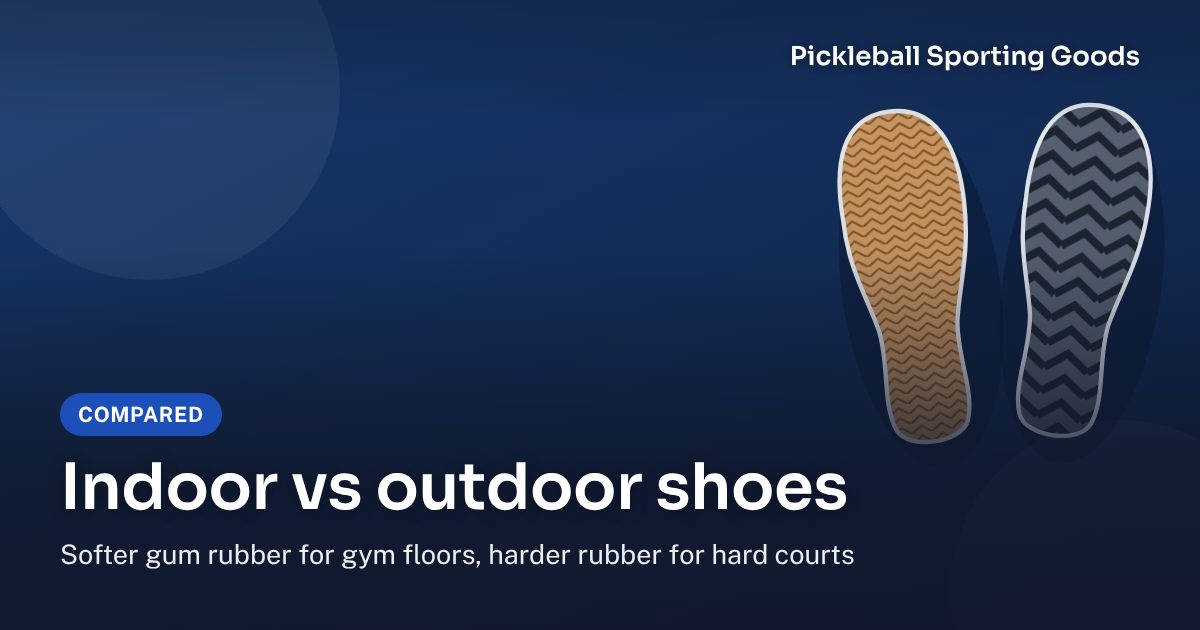
Yes. Shoe makers such as Selkirk, PB5star and DAPS describe indoor shoes with softer, grippier rubber, often gum rubber, for gym floors, and outdoor shoes with harder rubber built for asphalt and concrete. The makers agree indoor soles wear faster outdoors; they disagree about wearing outdoor soles indoors. Some shoes are rated for both.
The makers below write their indoor shoes for gym floors, and not every indoor court is one. Pickleball Warehouse, a retailer, puts it this way: “Although most pickleball is played on a hard court, whether there is a roof over the court or not, the sport is also played on wood laminate surfaces which are almost always indoors.” Selkirk, which makes pickleball shoes, adds that “Indoor pickleball can be played on many different types of surfaces.”
Below, the two kinds are set side by side with the maker behind each line, followed by what happens when you cross over, where the sources disagree, and a choice for each kind of player.
Indoor vs outdoor pickleball shoes, side by side
| Attribute | Indoor shoes | Outdoor shoes | Who says |
|---|---|---|---|
| Made for | Sealed wood or synthetic gym floors | Concrete and asphalt | PB5star |
| Outsole rubber | Softer and tackier, often gum rubber | Harder, firmer, more durable | Selkirk; PB5star; DAPS |
| Tread | Fine or tighter herringbone, siped or wave patterns | Deeper or wider grooves, more open channels | PB5star; DAPS |
| Gym-floor marks | Almost always non-marking | Black outdoor soles can mark | DAPS; ASICS |
| Wear on rough courts | Wears faster outdoors | Longer wear life on rough courts | Selkirk; ASICS; PB5star |
| Build | Floor feel and braking | Abrasion guards, reinforced uppers | PB5star |
What the table rests on, in the makers’ own words:
- Rubber. Selkirk’s guide (by Jaclyn Brandt, July 30, 2024) says “Indoor pickleball shoes are going to be made of a different material than outdoor pickleball shoes, including softer material like gum rubber, with more grip.” and “Outdoor materials will be more hard rubber that is able to withstand harder surfaces.” PB5star, a pickleball shoe maker, wrote in February 2026: “Indoor shoes typically use softer, tackier rubber compounds designed for use on sealed wood or synthetic gym floors.” and “Outdoor shoes flip this approach, using firmer rubber that resists the constant scraping against concrete and asphalt.” DAPS, which sells its own pickleball shoe, says in a July 2026 post by Vijay Kanth: “Indoor pickleball shoes typically use a gum rubber outsole.” and “Outdoor pickleball shoes use a harder, more durable rubber compound.”
- The trade-off. PB5star on the outdoor compound: “The trade-off delivers slightly less initial grip but extends wear life significantly on rough playing areas.”
- Tread. PB5star: “Indoor designs often feature fine herringbone or siped patterns that create clean multi-directional traction on smooth floors.” and “Outdoor shoes lean into deeper or wider grooves that channel dust, grit, and court chalk away from where the shoe meets the court.” DAPS: “The tread pattern on an indoor shoe is often a tighter herringbone or wave pattern, designed to create more contact points across a flat surface.” and “The tread pattern on outdoor shoes tends to be more aggressive, with wider and more open channels.”
- Marks. DAPS: “Indoor shoes also almost always carry a non-marking designation.” and “Black rubber outdoor soles can scuff and mark polished floors.” ASICS’s pickleball shoe guide: “For indoor players, the tough rubber sole of outdoor shoes is likely to leave scuff marks on the hardwood court.” Not every sole built for hard courts marks: Diadem says the Court Burst’s outsole “grips hard courts without marking” (see the three shoes further down).
- Build. PB5star: “Outdoor models feature abrasion guards around the toe and medial areas, as well as reinforced uppers that withstand repeated scraping against rough courts.”
Good to know
PB5star and DAPS agree that outdoor treads are more open. PB5star describes “deeper or wider grooves” on outdoor shoes, and DAPS says outdoor treads have “wider and more open channels.” DAPS adds a caveat in its FAQ, set against running shoes: “Tread depth matters differently in court sports than in running. Deep lugs are not the goal. What matters is the sharpness of the tread edges and how the pattern distributes contact across the surface.” So the open channels are for clearing grit and debris, not a reason to look for the deepest lugs.
Pick the sole by the floor, not the roof
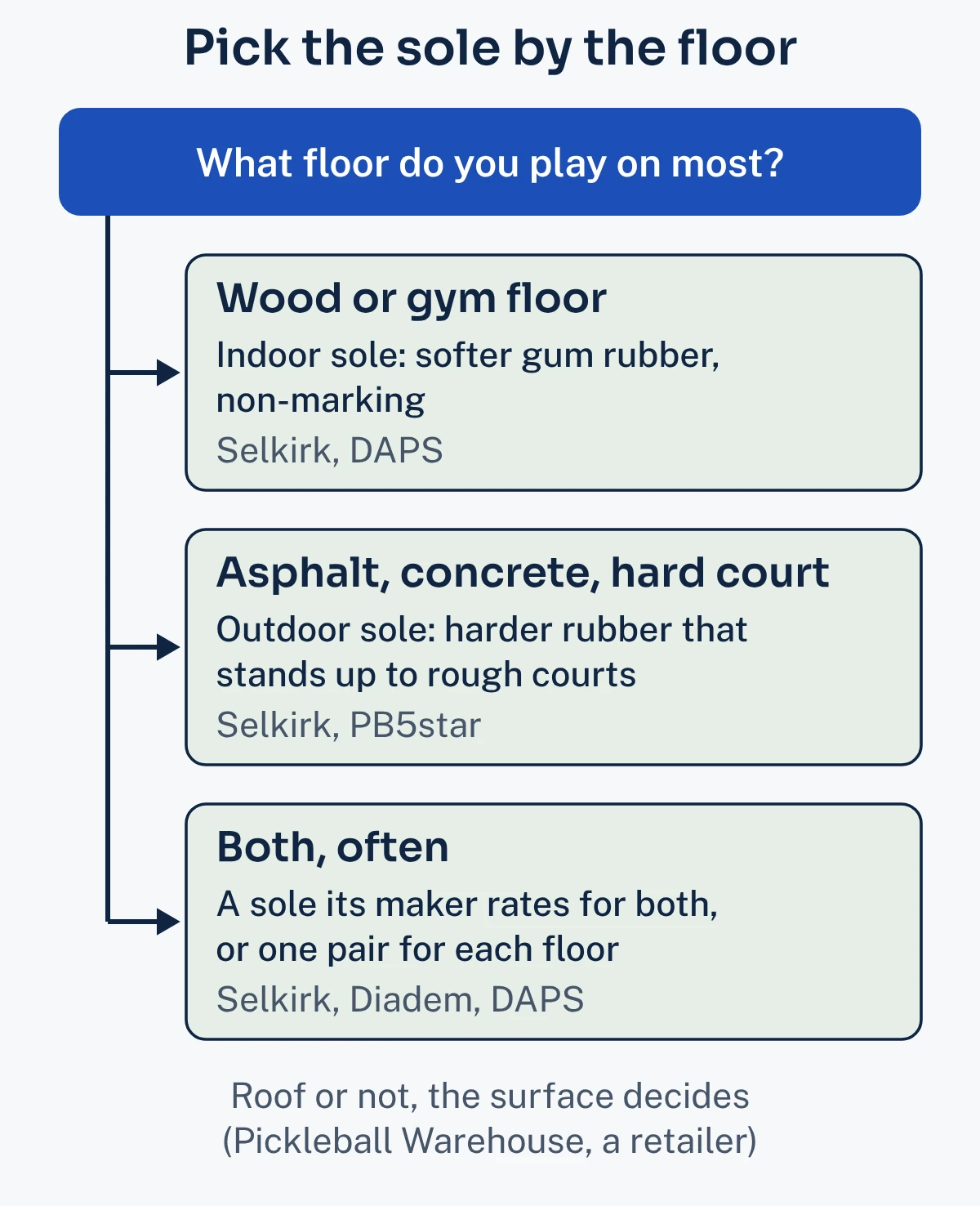
Selkirk writes its softer shoes for one kind of floor: “The softer and grippier types of shoes are made for surfaces like gym floors.” Pickleball Warehouse’s shoe guide (updated December 2024) follows its roof-or-not line with “Due to this fact it is important for the shoe to have an outsole specifically designed for the type of surface you’re playing on.” Of the asphalt hard court it says “This court type is more demanding on a shoe’s outsole durability”. So an indoor club with hard courts is, for your shoes, a hard-court venue, by the retailer’s own reasoning.
Indoor-only shoes are also the smaller group. Pickleball Warehouse notes: “Although there are indoor specific pickleball shoes available, hard court options far out number the indoor.” If you mostly play on a gym floor, our indoor pickleball shoes roundup lists shoes whose makers name a non-marking or gum outsole, or an indoor label.
Can you wear indoor shoes outside?
The makers agree that you can, and that the sole pays for it:
- Selkirk: “you can wear your indoor shoes to play pickleball outdoors. However, the sole material will likely wear out much more quickly than it would indoors.”
- ASICS: “If needed, you can wear your indoor shoes on outdoor courts.” It goes on: “However, the soft rubber will wear down more easily against asphalt, so it’s best to have shoes designed specifically for the outdoor courts.”
- DAPS: “On concrete or asphalt, a gum rubber sole wears down quickly.”
- Montis, a pickleball shoe maker: “While they work great for indoor surfaces, softer outsoles will wear faster if used on outdoor courts.”
Pickleball Warehouse adds a point about feel: “using an indoor shoe on an outdoor court will deliver good traction, but may result in the outsole wearing quickly, and depending on tread pattern, may even feel a bit too sticky.”
Wearing indoor court shoes on the street is a separate question, about the floor rather than the shoe. In a September 2024 r/Pickleball thread about clubs that require court shoes, the top reply (26 votes) points to “whatever dirt and debree they track in off the street.” Gina Family, an IPTPA-certified instructor who writes the Pickleball518 site, says of outdoor soles on gym floors: “The grit and grime ruins the poly floor and force facilities to resurface.”
Can you wear outdoor shoes inside? The sources disagree
Some makers and one retailer say yes, with a condition:
- Selkirk: outdoor shoes are made of harder material, “but you can still wear them for indoor pickleball play”. Its condition: “you should make sure your shoes are non-scuffing, so they do not leave black marks all over a gym court.”
- Montis: “Shoes designed to withstand outdoor surfaces will often work on indoor courts as well, where shoes designed specifically for indoor surfaces, like wood, will often wear down much faster if used on outdoor courts.”
- Pickleball Warehouse’s outdoor-shoe guide (undated): “If you intend to play both outdoors and indoors, we recommend using an outdoor shoe for both.”
Others say no, at least on a gym floor:
- DAPS: “First, the harder compound does not grip smooth gym floors as reliably.” On marking soles: “Many gyms and rec centers will turn you away at the door for this reason alone.”
- ASICS: the scuff-mark warning quoted in the table section above.
- Pickleball Warehouse’s shoe-selection guide, from the same shop as the outdoor guide: “We do not advocate wearing outdoor court shoes on a wood laminate flooring because traction is less than ideal.”
- Gina Family (Pickleball518): “Some pickleball shoes now are promoted as Hybrid or Indoor/Outdoor: PLEASE only use your shoes on on one surface type. Do not wear your outdoor shoes indoors on a gym floor surface.”
Your venue has the last word. In a September 2024 r/Pickleball thread about clubs that require court shoes, the top reply (26 votes) says such shoes are “required mostly because they do not mark the court.” Another owner (5 votes) answers “Basketball shoes do not mark courts either. In fact almost all athletic shoes won’t mark a court.” These are owner opinions, not a rule. Our guide to what to wear for pickleball quotes club footwear rules that ask for non-marking soles.
Quick check
DAPS says “Many shoe brands indicate non-marking status on the product page or box.” Its FAQ adds: “If you are unsure, test by pressing the sole firmly against a clean white surface and twisting slightly.”
Are pickleball shoes made for indoor or outdoor use?
Selkirk says many are made for both, though not everyone treats that as settled. Its advice for one shoe on both courts is to “look for a pickleball-specific shoe. Many brands have started to release pickleball shoes, which will allow you to play both indoors and outdoors.” DAPS, which sells a shoe it describes for both courts, splits the answer by player: “For serious or competitive players, two pairs is the right answer.” and “For recreational players who move between courts, one pair with a non-marking, durable outsole and a versatile tread pattern is a practical solution.”
Gina Family, the IPTPA-certified instructor behind Pickleball518, names the counter-view quoted above: keep each pair to one surface type, even a shoe sold as hybrid or indoor/outdoor. Owners split the same way. In a February 2025 r/Pickleball thread from a player who plays on a wooden gym floor and on outdoor courts, one reply (4 votes) reads “Yes, two pairs of shoes.” and another (4 votes) reads “Just get tennis shoes 1 pair works for all surfaces”. Our guide on wearing tennis shoes for pickleball covers that second option.
Three shoes from our roundups show the three kinds of sole. K-Swiss’s product description, quoted in our men’s indoor pickleball shoes roundup, says the “Hypercourt Express 3 Indoor, with its gum rubber outsole, is the ideal choice for all wood court sports”; the roundup also notes that the same K-Swiss page’s feature panel describes the shoe for “the demands of modern tennis”. Nike sells the Vapor Lite 3 as “Men’s Hard Court Tennis Shoes”; it is one of the picks in our men’s outdoor pickleball shoes roundup, which compares it with other shoes for hard courts. Diadem writes that “The high-abrasion rubber outsole grips hard courts without marking, making the Court Burst a go-to pickleball shoe and tennis shoe for both indoor and outdoor play”; it is compared in our indoor pickleball shoes roundup.
| # | Preview | Product | Price | Link |
|---|---|---|---|---|
| 1 |  | K-Swiss Men's Hypercourt Express 3 Indoor Tennis Shoe…Gum outsole for wood courts | Check on Amazon | |
| 2 |  | Nike Men's Vapor Lite 3 Hard Court Tennis Shoes…Hard-court outsole | $90.00 | Check on Amazon |
| 3 |  | Diadem Court Burst Shoe, Pickleball/Tennis, Black/Gum, 10…Rated for indoor and outdoor | $149.95 | Check on Amazon |
Which to choose: indoor, outdoor or both
- Choose an indoor shoe if you play mostly on a wood or gym floor. Selkirk and DAPS name gum rubber for these floors, and DAPS says of non-marking soles: “Most gyms and recreation centers require this”. Our roundups of men’s indoor pickleball shoes and women’s indoor pickleball shoes compare models by outsole.
- Choose an outdoor shoe if you play mostly on asphalt, concrete or a hard court. Selkirk, PB5star and DAPS describe harder rubber for these courts, and ASICS says “you need one with a sole made of strong rubber”. Pickleball Warehouse, a retailer, counts covered hard courts here too: “whether there is a roof over the court or not”. Check the venue’s non-marking rule first, because DAPS says marking soles can get you turned away. See our outdoor pickleball shoes roundup.
- Choose a shoe its maker rates for both, or two pairs, if you split your time. DAPS ties the choice to how seriously you play, Pickleball518 asks players to keep even a hybrid pair to one surface, and Pickleball Warehouse’s two guides land on different sides, so check your venue’s rule on non-marking soles before you settle on one pair.
For width, size and the other checks on any pair, our guide to choosing pickleball shoes goes step by step.
Ready to buy?
Our indoor pickleball shoes roundup compares gym-floor shoes, and our outdoor pickleball shoes roundup compares shoes for hard courts.
Frequently Asked Questions
Q. What shoes should you not wear for pickleball?
ASICS warns off running shoes: “many running shoes are made for straight-line movement, which limits the support they provide when moving side-to-side.” On a gym floor, a sole that marks it can also get you turned away, according to DAPS.
Q. Is gum rubber good for outdoor courts?
Pickleball Warehouse says an indoor shoe gives good traction outdoors but may wear quickly and, depending on the tread, feel too sticky. Selkirk, ASICS, DAPS and Montis all say a soft indoor sole wears faster on outdoor courts.
Q. Are men’s and women’s indoor shoes different?
The makers quoted here describe the sole, not a men’s or women’s version. K-Swiss sells the Hypercourt Express 3 Indoor in both, and our women’s indoor pickleball shoes roundup picks the women’s version.
Q. Do I need separate shoes for indoor and outdoor pickleball?
Not always. DAPS suggests two pairs for competitive players and one versatile pair for recreational players who move between courts; Gina Family of Pickleball518 says to keep each pair to one surface type, even a shoe sold as hybrid; owners on r/Pickleball are split.
Q. Do indoor and outdoor balls differ as well?
That is a separate question about the ball, not the shoe. Our guide to indoor vs outdoor pickleball balls covers it.
Sources (13)
- Selkirk, Indoor vs. outdoor pickleball shoes
- ASICS, A guide to pickleball shoes
- PB5star, Indoor vs Outdoor Pickleball Court Shoes: What You Really Need
- DAPS, The real difference between indoor and outdoor pickleball shoes
- Montis Pickleball, How to Choose the Best Pickleball Shoes for Indoor vs. Outdoor Courts
- Pickleball Warehouse (retailer), Selecting pickleball shoes
- Pickleball Warehouse (retailer), Best outdoor pickleball shoes
- Pickleball518, 3 things you need for indoor pickleball
- r/Pickleball (forum), Indoor vs outdoor shoes
- r/Pickleball (forum), Club question on requiring dedicated court shoes
- K-Swiss, Hypercourt Express 3 Indoor
- Nike, Vapor Lite 3 men’s hard court tennis shoes
- Diadem, Court Burst
Product prices and availability are accurate as of the date/time indicated and are subject to change. Any price and availability information displayed on Amazon.com at the time of purchase will apply to the purchase of this product.