If a live pickleball hits you or your clothing before it bounces on the court, you lose the rally. It’s one of those rules that feels a bit counterintuitive at first, but it’s a fundamental part of the game. As someone who has spent countless hours on the pickleball court, both playing and coaching, I've seen the look of surprise on players' faces when this exact situation happens. It can be confusing, especially when you’re standing way outside the court and a ball that was clearly going out clips your shirt. This guide is here to clear up all that confusion. We’re going to dive deep into exactly what happens in pickleball when a player is hit with the ball, exploring every possible scenario so you can play with confidence and know the rules inside and out.

The Core Rule: Understanding the Fault
At its heart, the rule is straightforward. According to the official rules that govern pickleball, any time a live ball hits a player, their clothing, or anything they are wearing or carrying (except for their paddle), it is a fault against that player. The key phrases here are "live ball" and "before it bounces." A ball is considered live from the moment it is served until a fault is committed, the point ends, or the ball becomes dead.
This means that if your opponent hits a hard drive straight at you and you can't get your paddle on it, and it hits your arm, leg, or torso, you lose the point. It doesn't matter if you were inside or outside the court boundaries. The moment the ball makes contact with your person, the rally is over. Think of your body as a surface that automatically ends the point in your opponent's favor.
Key Scenarios: Where and When It Matters
While the core rule is simple, the application can get tricky depending on where you are on or off the court. Let's break down the most common scenarios you’ll encounter to understand exactly what happens in pickleball when a player is hit with the ball.
Getting Hit Inside the Court Boundaries
This is the most clear-cut situation. If you are standing anywhere inside the court lines—from the baseline to the non-volley zone—and the ball hits you before it bounces, it is a fault. You lose the rally immediately. This often happens during fast-paced exchanges at the kitchen line when players try to "speed up" the ball, and the opponent doesn't have time to react. I once lost a crucial game point because a fast shot caught my sleeve. It was frustrating, but the call was correct.
What if You're Standing Outside the Court?
This is where most of the confusion comes from. Many players believe that if they are standing outside the court boundaries, they are "safe." This is incorrect. The rule applies regardless of your position. If your opponent hits a shot that is clearly flying ten feet out of bounds, but it hits you in the air before it lands, you still lose the point.
The logic is that the ball was still live. By striking you, you interfered with the ball's natural trajectory and ended the play. The best practice is always to let an out-ball bounce. It's a lesson you learn quickly after losing a point you thought you had already won. Just get out of the way and watch it land.
The Non-Volley Zone (Kitchen) Complication
There are no special rules about getting hit by the ball while you are in the non-volley zone, or "kitchen." The general rule still applies. If you are standing in the kitchen and the ball hits you before it bounces, it's a fault on you, and you lose the rally. This is no different than being hit while standing at the baseline. The unique rules of the kitchen only relate to volleying the ball, not being struck by it.

It Hit My Paddle, Then Me. Is It Still a Fault?
This is another great question that comes up during play. The answer depends on the sequence of events. If the ball hits your paddle and then, in the same continuous swinging motion, ricochets off your paddle and hits your hand or body, play continues. The ball is still considered legally in play. Your hand, below the wrist, is considered part of the paddle.
However, if the ball hits your body first and then your paddle, it is a fault. The rally ended the moment the ball touched you. Similarly, if the ball hits your paddle, bounces off, and then you hit it a second time deliberately or it hits another part of your body, it's a fault. The key is that it must be a single, continuous, unintentional act for the play to continue.
What About Your Partner? The Doubles Dilemma
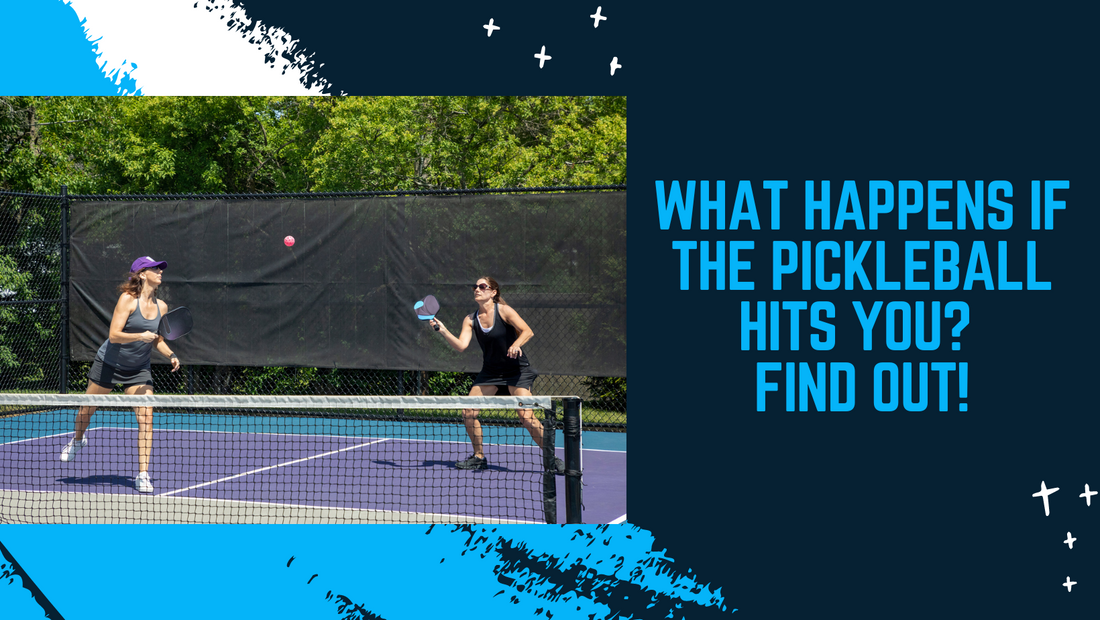
In doubles, the rule extends to both you and your partner. If the ball hits either player on your team, or their apparel, before it bounces, your team commits a fault and loses the rally. It doesn't matter who the ball was "aimed" at or which player was closer to it.
I've seen many rallies end where a player ducks out of the way of a hard shot, only for it to hit their unsuspecting partner standing behind them. It can be a funny moment, but it's still a lost point. Communication and court awareness are key to avoiding these kinds of unforced errors in doubles play. Always be aware of where your partner is, especially during intense, fast-paced exchanges.

Frequently Asked Questions
What if the ball was clearly going out when it hit me?
It is still a fault against you. The ball is considered live until it hits the ground out of bounds. If it strikes you or your clothing first, you have interfered with a live ball, and you lose the point.
Does it matter where on my body the ball hits me?
No, it does not matter. Whether the ball hits your hand, arm, leg, shirt, or hat, the result is the same. Any contact with your person or apparel before the ball bounces is a fault.
Can my opponent aim for me on purpose?
Yes, it is legal within the rules of pickleball for a player to aim the ball at an opponent's body. While some consider this poor sportsmanship, it is a valid strategy, especially in competitive play, to win a point.
What if the ball hits my clothing or something I'm carrying?
This is treated the same as the ball hitting your body. If the ball hits your shirt, shorts, hat, or even a paddle you are carrying but not using, it is a fault against you.
Does the ball have to be 'live' for this rule to apply?
Yes, this rule only applies to a live ball. For example, if your opponent's serve hits the net and then hits you, it's just a service fault (a let did not exist after 2021). The ball was not live over the net.
Conclusion
Understanding what happens in pickleball when a player is hit with the ball is crucial for fair and enjoyable play. The main takeaway is simple: if a live ball hits you or anything you are wearing before it bounces, you lose the point, regardless of where you are standing. It’s a rule that rewards quick reflexes and smart court positioning.
Instead of fearing the ball, use this knowledge to your advantage. Practice defensive blocks, work on your footwork to get out of the way of out-balls, and communicate with your partner. Now that you're armed with this information, you can step onto the court with more confidence. Have you ever lost a point this way? Share your story or any other questions in the comments below