The short answer
An overgrip is a thin wrap over the grip already on your paddle. Players add one for tackiness, sweat or a fresher base grip. It is optional. Sources differ on changing it: Pickleball NVZ says every 4-6 weeks for casual players, and Exo Sports weekly or more often for frequent players; both sell grips.
One owner on r/Pickleball sums up the logic: “Much easier/cheaper to replace an overgrip than the original grip.” What follows sets out what that layer is, how it differs from a replacement grip, what it does to grip size, and how often named sources say to change it.
If you already know you want one and are choosing between brands, our overgrip roundup compares eight of them by pack, thickness and feel.
What an overgrip is
Pickleheads, a pickleball review site, defines an overgrip as “a thin, replaceable wrap that goes over the handle of your paddle. It adds tackiness, absorbs sweat, and can make your grip feel softer or more cushioned.”
The makers describe the same thing. Tourna’s page for its pickleball overgrip says it is “meant to wrap over the original grip on a Pickle ball paddle”, and Onix tells you to “Place over current grip for extra support with a tacky surface for excellent grip during pickleball play.” In both cases the paddle’s own grip stays on, and the overgrip is the outer layer your hand touches.
Why players put one on
Pickleheads is clear that you do not need one: “There’s no right or wrong time. You don’t have to use an overgrip – if your paddle’s base grip works for you, that’s great!” It adds that “Most beginners aren’t worried about their paddle’s grip just yet, so it’s usually once players get more experienced that they find an overgrip improves their performance and comfort,” and that “Most intermediate to advanced players do use overgrips, though.” Pickleheads gives no figure for that.
The reasons the sources give fall into five groups:
| Reason | What the source says | Source |
|---|---|---|
| Sweat and slip | “The standard base grips on most paddles aren’t tacky enough to stay secure when your hands get sweaty.” | Pickleheads |
| A fresh base grip | “An overgrip will prolong the life of your paddle’s grip and keep it feeling fresh.” | Gamma’s blog |
| The same feel on every paddle | “I personally prefer to stick with one specific type of grip and then use it on all of my paddles.” | The Slice |
| A thicker handle | “You can always ADD an over-grip (or two) to your paddle to increase the circumference.” / “If you’re between grip sizes, go with the smaller size and add an overgrip to arrive at the ideal fit.” | Selkirk; Pickleball Warehouse |
| Looks | “Some players simply want to customize their paddle’s look.” | Pickleheads |
The Gamma line comes from a guide on the paddle maker Gamma’s site, written by Pickleheads co-founder Brandon Mackie. The Slice, a pickleball review site, also puts an overgrip on a paddle the day it arrives: “throwing on an overgrip as soon as you get a new paddle in will make sure the base grip stays nice and fresh.”
Owners say much the same in an r/Pickleball thread titled “Why overgrip?”. One writes, “I use them because my hand sweats.” Another: “Overgrip is cheap and saves your stock grip.” A third simply likes the feel: “Plain and simple, it feels better in my hand. It’s thicker and a bit softer.” These are single forum replies, not a survey.
Overgrip or replacement grip
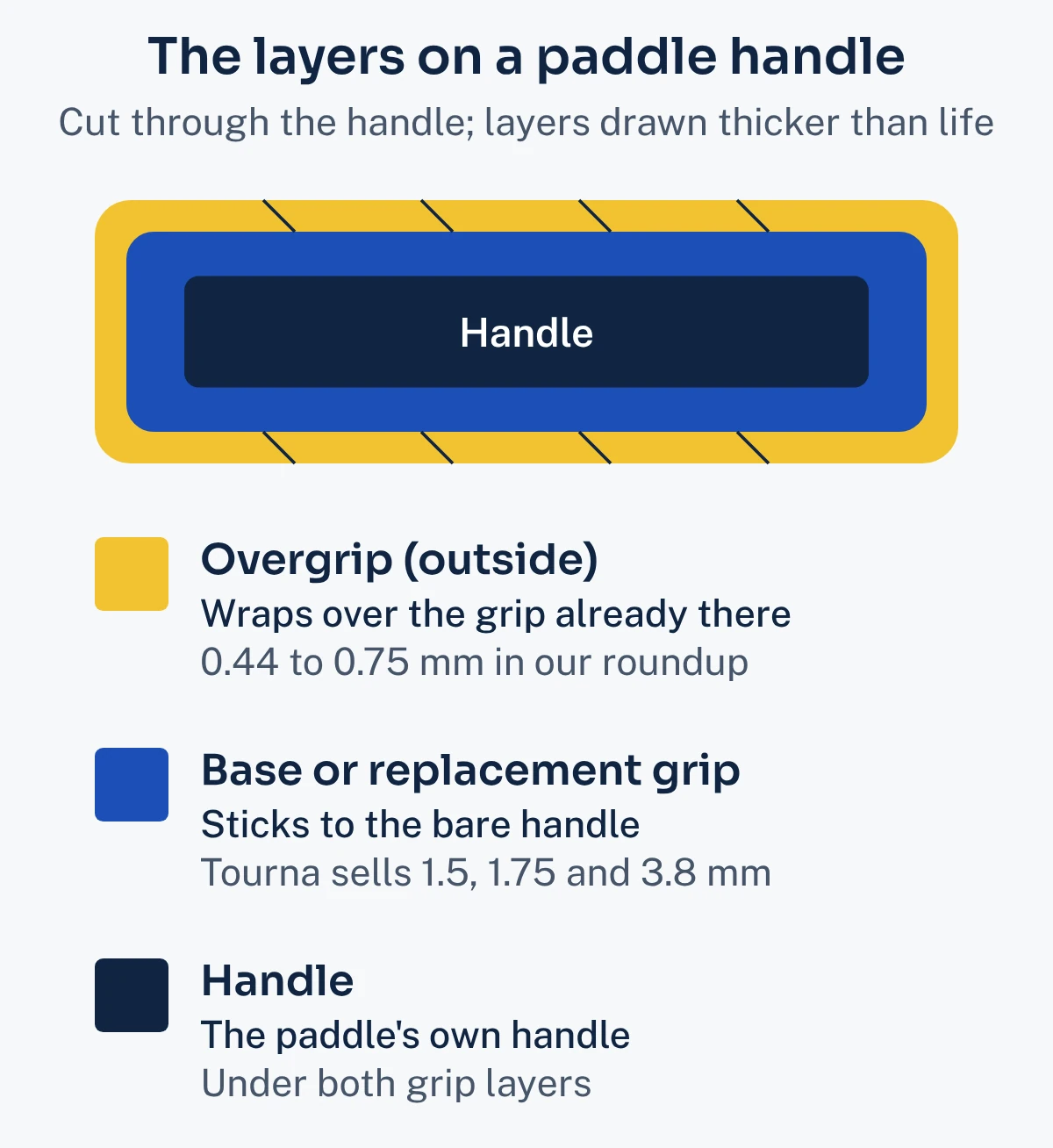
A replacement grip (also called a base grip) is a different product. It comes off the paddle’s handle and a new one goes on in its place; an overgrip goes on top. Tourna sells both kinds for pickleball, so its figures show the difference within one maker’s range:
| Overgrip | Replacement grip | |
|---|---|---|
| Where it goes | Over the original grip | On the bare handle, in place of the original |
| How it stays on | Wrapped from the butt up; Pickleheads says to “Peel the backing off the tapered end” to start it, and Pickleheads and Pickleball NVZ mention finishing tape at the top, and Tourna’s pack “Includes finishing tape” (Tourna) | Tourna: “Backed with adhesive so the grip stays put” |
| Tourna’s thickness | 0.44 mm (Tourna Grip) | 1.5 mm (Mega Wrap), 1.75 mm, 3.8 mm (Cushion) |
| Pickleball NVZ’s typical range | 0.4 to 0.6 mm | 1.5 to 1.8 mm |
| How often changed (NVZ) | “Most players replace overgrip every 5-15 sessions depending on how much they sweat.” | “most players replace the base grip once or twice a year” |
Tourna’s Mega Wrap replacement grip is “designed to effortlessly replace your original paddle grip”, its standard replacement grip is “Backed with adhesive so the grip stays put”, and for its 3.8 mm Cushion grip it says: “Simply remove your old grip and place this grip on the bare handle.” Tourna’s own page for the Tourna Grip says it “is a thin . 44mm over grip, that is meant to wrap over the original grip on a Pickle ball paddle”.
Pickleball NVZ, a shop that sells grips, gives the ranges in the last two rows. It says an overgrip “is a thin tape (typically 0.4-0.6 mm) that wraps over your existing paddle grip”, while a replacement grip “is thicker (1.5-1.8 mm) and replaces the original grip on the paddle handle entirely.” Its “typically” matters: in our roundup, Bodhi prints 0.65 mm and ADV 0.75 mm for their overgrips.
Which one do you need? Pickleball NVZ’s rule: “If your paddle still has its original grip and you just want to refresh the feel: use an overgrip. If the original grip is peeling, cracked, or completely flat: replace it.” Selkirk’s re-grip guide gives a similar check for the base grip: “Check for any cracks, tears, or wear on the grip, especially in high-contact areas.”
How an overgrip changes grip size
The sources here agree that an overgrip adds to the handle. They differ on how much that matters.
- Selkirk, the paddle maker, treats it as a way to size up: “You can always ADD an over-grip (or two) to your paddle to increase the circumference.”
- Pickleball Warehouse, a retailer, gives a figure: “A typical overgrip will increase a grip by 1/16 inch.”
- Third Shot Drop, a pickleball shop, puts it in sizes: “Typically, an overgrip will add either half or one whole size (1/16 to 1/8 inch) to the racquet.”
- Pickleball NVZ, the shop above, plays it down: an overgrip “adds tackiness and absorbs sweat without significantly changing the grip size.”
- The Slice notes that “the overgrip will also potentially add a layer of thickness to your grip – so you’ll need to be aware of that.”
Pickleball Warehouse notes that “It’s easier to increase handle size on most paddles,” and its advice for in-between hands is: “If you’re between grip sizes, go with the smaller size and add an overgrip to arrive at the ideal fit.” An owner in the r/Pickleball thread puts the same point another way: “You can add to the circumference, but you can’t take away.” Our guide to pickleball paddle size has the hand measurement and height charts Selkirk and Dick’s publish, and our pickleball grip size guide covers choosing a grip size.
Thickness varies from one overgrip to the next. In the words of our roundup, “The thicknesses the makers print here run from 0.44 mm (the two Tourna grips) through 0.6 mm (CRBN) and 0.65 mm (Bodhi) to 0.75 mm (ADV)”. These three picks from the overgrip roundup span that range, thinnest first:
| # | Preview | Product | Price | Link |
|---|---|---|---|---|
| 1 |  | Tourna Pickleball Grip Overgrip – 2 Pack – Sweat Absorbing…Thin dry-feel 2-pack, 0.44 mm | $6.97 | Check on Amazon |
| 2 |  | Bodhi Performance PROtack Premium Pickleball Overgrips…Soft tacky 12-pack, 0.65 mm | $23.99 | Check on Amazon |
| 3 |  | ADV FeltTac Pickleball Overgrip, Absorbent Dry Grip Tape…Felt-finish 12-pack, 0.75 mm | $20.95 | Check on Amazon |
For tournament play, the equipment rules allow grip wraps. USA Pickleball’s Equipment Standards Manual (Revision 3, January 2025) says in rule 2.E.5 that “Altered paddles must meet all specifications,” and rule 2.E.5.a reads in full: “Player alterations or additions to a commercially produced paddle as certified, may include such items as edge guard tape/replacements, weighted tape, weights for an Original Equipment Manufacturer (OEM) integrated weight system, changes to the grip size via inserts, grip wraps, OEM interchangeable grips, OEM replacement paddle faces, and name decals and/or other identification markings on the paddle face.” We read the January 2025 manual; we did not check the 2026 rulebook, which did not open for us.
How often to change an overgrip
None of the paddle makers’ pages we read (Selkirk, Tourna, Onix and the guide on Gamma’s site) gives an interval. The figures below come from an overgrip brand, a newsletter and a shop, and they differ:
| Who says it | How often | Source type |
|---|---|---|
| Exo Sports | Recreational players (1-4 hours a week): “bi-weekly”; club players (several times a week): once a week; competitive players (daily training): “maybe 2-3 times a week” | paddle and overgrip brand |
| The Dink | Every 1-2 months for casual players (1-2 times a week); every 3-4 weeks for regular players (3-5 times a week); every 1-2 weeks for daily players or heavy sweaters; weekly for competitive players | pickleball newsletter (links Selkirk overgrips through a referral link) |
| Pickleball NVZ | “Most players replace overgrip every 5-15 sessions depending on how much they sweat.” That is what players do; its own guidelines are in the note below | shop |
A few notes on reading that table. Pickleball NVZ’s “General guidelines” are “Casual players (1-2x/week): replace every 4-6 weeks”, “Regular players (3-4x/week): replace every 2-3 weeks” and “Heavy sweaters: replace every 5-8 sessions regardless of schedule”. Exo Sports says “If you play pickleball casually a few times a week, replacing your overgrip bi-weekly is a good starting point,” and does not say whether “bi-weekly” means twice a week or every two weeks. Exo Sports sells its own overgrips, and NVZ sells grips too. The Dink words its bands as “Change it” under a section about “the grip”, and its next section says: “If you don’t want to replace your grip constantly, here’s a secret: use an overgrip.” The page does not make clear which layer the bands mean, so read them as the least certain row. Its page also carries a referral link to Selkirk overgrips (“We’re big fans of Selkirk’s overgrips”).
The Dink also asked its readers how often they change their grip: 44.97% said about a month, 13.09% every two weeks, 10.6% once a week, 2.35% after every game, and 28.99% said they never do. That is a reader poll, not a test.
Two of the sources also go by wear, not only the calendar. Pickleball NVZ suggests a quick check: “A simple test: press your thumb into the grip. Fresh overgrip rebounds slightly and feels tacky. Worn overgrip feels flat, slick, or slightly shiny.” Exo Sports adds that “Frequent players may need to replace their overgrips weekly or more often.”
Picking a feel
Makers and reviewers describe overgrips by feel. The guide on Gamma’s site says “Generally, overgrips fall into three different categories”: tacky, dry and textured. Pickleheads sorts them into two: sweat-focused, high-tack grips and comfort-focused, softer ones. The Slice’s view is that “it’s going to come down to your personal preference when you choose your grip,” and the sources in our roundup sometimes describe the same grip differently.
Ready to buy?
Our overgrip roundup compares eight overgrips by pack, thickness and feel, as each maker words them. Still choosing the paddle itself? See our roundup of the best pickleball paddles.
Frequently Asked Questions
Q. Is an overgrip necessary on a pickleball paddle?
No. Pickleheads says you do not have to use one if your paddle’s base grip works for you. It is an add-on for feel, sweat and grip life.
Q. Is a replacement grip better than an overgrip?
They do different jobs. An overgrip is a thin outer layer you change often; a replacement grip is a thicker, adhesive-backed grip that replaces the paddle’s original one. One goes on top of the other: The Slice puts an overgrip on a new paddle so the base grip “stays nice and fresh”.
Q. Can you use a tennis overgrip on a pickleball paddle?
Players do. The Slice describes Tourna’s original grip as the “patented light blue color you’ll see on tennis rackets and pickleball paddles everywhere.” Tourna also sells a pickleball version, “Cut specifically for the size of a Pickle ball paddle so there is no need to cut or waste.”
Q. Why don’t paddles come with an overgrip?
Some do: one owner in the r/Pickleball thread has had “a paddle or two that came with overgrip as a bonus.” Other replies there say “overgrips are a personal preference,” and that grip can be built up but not taken away.
Q. Can you put two overgrips on?
Selkirk says you can add “an over-grip (or two)” to increase the circumference. Each layer adds to the handle, so check your grip size first; our paddle size guide shows how.
Q. How do you put an overgrip on?
Pickleheads’ short version: start at the butt cap and finish with the tape that came with the grip. Step-by-step wrapping is in our guide to wrapping a pickleball paddle.
Sources (17)
- Pickleheads (review site), When to use an overgrip in pickleball
- Tourna (maker), Pickleball Tourna Grip
- Tourna (maker), Pickleball Replacement Grip 1.75mm
- Tourna (maker), Pickleball Mega Wrap Replacement Grip
- Tourna (maker), Pickleball Cushion Replacement Grip 3.8mm
- Onix (maker), Paddle Overgrip
- Gamma (maker’s blog, by Pickleheads co-founder Brandon Mackie), How to Choose the Best Pickleball Overgrips
- The Slice (review site), The Top Five Pickleball Paddle Overgrips
- Selkirk (maker), How do I find my pickleball paddle grip size?
- Selkirk (maker), How to replace the grip on a pickleball paddle
- Pickleball Warehouse (retailer), How to Choose a Pickleball Paddle
- Third Shot Drop (pickleball shop), How to Find Your Pickleball Paddle Grip Size
- Pickleball NVZ (shop), Best Pickleball Overgrip: When to Replace and What to Use
- Exo Sports (paddle and overgrip brand), How Often to Replace Pickleball Overgrip
- The Dink (newsletter), How Often Should You Change Your Pickleball Paddle Overgrip?
- USA Pickleball, Equipment Standards Manual, Revision 3 (January 2025)
- r/Pickleball (forum), Why overgrip?
Product prices and availability are accurate as of the date/time indicated and are subject to change. Any price and availability information displayed on Amazon.com at the time of purchase will apply to the purchase of this product.