The short answer
For very dirty balls, Pickleball Nation and Pickleball Union wash them in warm water with a few drops of mild soap, scrub gently, rinse off all the soap and air-dry them fully, out of direct sun. Pickleball Nation and AIM7 warn against harsh chemicals.
Among its reasons, Pickleball Nation, a pickleball retailer, writes that “Dirt and debris can alter the texture and weight of pickleball balls, leading to unpredictable bounces and flight patterns,” and that “dirty pickleballs can transfer grit and grime to your pickleball paddle.” If the paddle is the problem, our guide to cleaning a pickleball paddle covers each face type.
Not every player bothers. On r/Pickleball, one owner sees little point “b/c the ball will be constantly rolling and bouncing on a dirty court, I think that would be somewhat futile,” while another gives a middle answer: “If they get muddy or something, yes, wash them. Otherwise, normal wear is fine.”
Which balls these steps cover
The care pages we read were written for plastic balls, and the soak-and-scrub steps below follow them. Foam quiet balls are a different material, and none of those pages covers them. One owner in r/Pickleball’s thread on Gamma’s Librarian foam ball reports: “Make sure the balls don’t get wet! That will make them get softer faster and change their characteristics.” That is one owner’s report, not a maker’s instruction. For how the ball types differ in build, see our explainer on the types of pickleball balls.
| Ball type | Material | What the sources say about washing |
|---|---|---|
| Outdoor | “Made from a more durable plastic” (Pickleball Nation) | Pickleball Nation’s outdoor section soaks them 15-20 minutes; Hudef: damp cloth after each game, mild soap and water when very dirty |
| Indoor | “Typically made of a softer plastic material” (Pickleball Nation) | Pickleball Nation’s indoor section soaks them 10-15 minutes in warm water and mild soap |
| Quiet, soft plastic | Hudef says its silent ball’s quiet comes from “the softer plastics used in the ball” | Hudef, for that ball: “Wash them with warm water.” |
| Quiet, foam | Foam | No care instructions in the pages we read. One Gamma Librarian owner’s report on r/Pickleball: “Make sure the balls don’t get wet! That will make them get softer faster and change their characteristics.” Follow the maker’s packaging |
The box below shows an outdoor, an indoor and a foam ball from our guides: Franklin’s X-40 outdoor ball from our pickleball balls roundup, the X-26 indoor ball in the 100-ball club box from our indoor pickleball balls guide, and Gamma’s Librarian foam ball from our quiet pickleball balls roundup. Each is compared in full there.
| # | Preview | Product | Price | Link |
|---|---|---|---|---|
| 1 |  | Franklin Sports x-40 Performance Outdoor Pickleballs…Outdoor plastic ball | Check on Amazon | |
| 2 |  | Franklin Sports X-26 Pickleballs – Indoor – 100 Pack…Indoor plastic ball, club bucket | $149.89 Prime | Check on Amazon |
| 3 |  | Gamma Librarian Foam Quiet Pickleball Balls – Low-Noise…Foam quiet ball | $12.99 Prime | Check on Amazon |
Wipe, wash or replace?
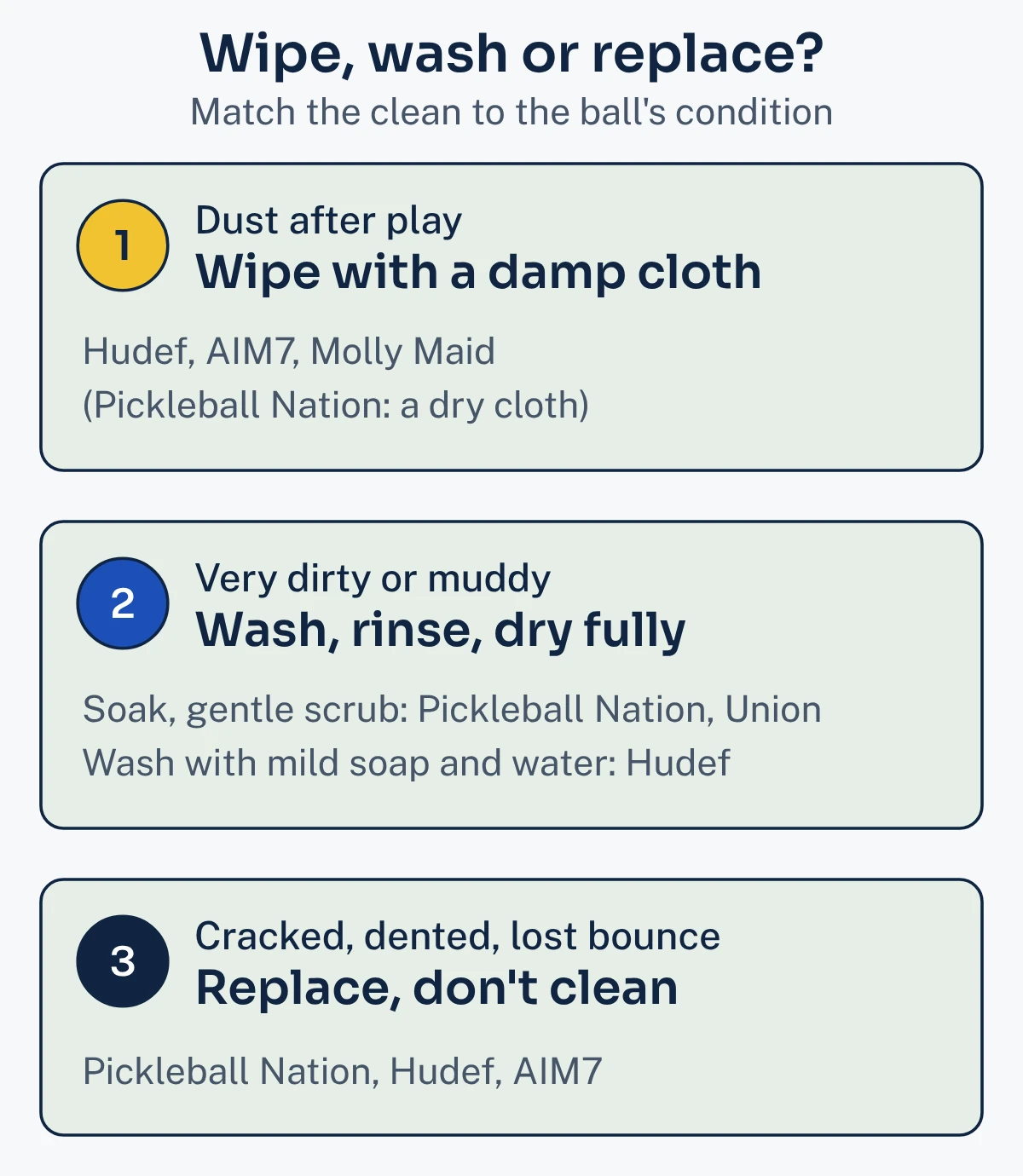
The sources agree on the light routine and differ on how often to do the full wash:
- After each game, a wipe. Hudef Sport, which sells its own balls: “You should clean your balls after each game. Use a damp cloth to wipe off dirt and dust.” AIM7, a training-app company, says the same “After each play session,” and Molly Maid, a house-cleaning franchise, also uses a damp cloth or sponge. Pickleball Nation’s version is dry: “After each game, take a moment to wipe down your pickleballs with a dry cloth.”
- A full wash, when needed. Hudef: “If your balls get very dirty, wash them with mild soap and water.” Pickleball Nation sets a calendar instead: “Depending on how often you play, aim to clean them at least once a month. For most recreational players, a quick wash every few weeks is typically sufficient.”
- Replace, do not wash. Pickleball Nation: “Cracked, dented, or excessively worn pickleballs should be replaced rather than cleaned and returned to play.”
What you need
- A bucket or large bowl
- Warm water
- Mild soap or dish detergent (a few drops)
- A soft cloth or sponge
- A toothbrush or soft-bristle brush, for scuffs
- A towel, and a well-ventilated spot out of direct sun for drying
- A mesh bag for storage
How to clean pickleball balls, step by step
These steps follow the plastic-ball pages above. They do not cover foam balls; one Gamma Librarian owner says that foam ball should not get wet.
Sort out damaged balls first
Check each ball for cracks and dents, and set those aside rather than washing them. Hudef: “Always check your pickleball balls for cracks or faded color. Replace any ball that does not bounce well or looks damaged.”
Mix warm water with a few drops of mild soap
Pickleball Nation: “Fill a bucket or large bowl with warm water and add a few drops of mild soap or dish detergent.” Keep it mild: “Avoid using harsh chemicals or abrasive cleaners, as these can damage the pickleballs’ surface.”
Soak the balls briefly, then take them out
Times differ by source. Pickleball Union, a pickleball publication, writes: “Let them soak for a few minutes.” Pickleball Nation says to “allow them to soak for 10-15 minutes”; its outdoor-ball section allows 15-20, but its list of mistakes says: “Limit routine soaking time to 10-15 minutes unless the cleaning instructions for a specific ball say otherwise.” It warns that “over-soaking can cause problems and may contribute to warping or degradation.”
Scrub gently with a soft cloth or brush
Pickleball Union: “Be careful not to scrub too hard as you don’t want to damage the surface texture of the balls.” For marks, Pickleball Nation adds: “For stubborn dirt or scuff marks, use a toothbrush or soft-bristle brush.”
Rinse off every trace of soap
Pickleball Nation: “Make sure all soap residue is removed, as leftover soap can make the balls slippery and affect their performance.” Pickleball Union gives the same reason.
Dry them completely, out of direct sun
Pickleball Nation’s outdoor section says: “Dry them with a towel and let them air dry completely before storing.” Pickleball Union says to “allow them to air dry completely by placing them in a well-ventilated area or outdoors, but avoid direct sunlight which might degrade the plastic”. Hudef: “Make sure you dry them completely before storing.” None of the pages we read suggests heat to speed this up.
Store them dry, in a mesh bag, somewhere cool
Pickleball Nation: “Store your pickleballs in a mesh bag to allow air circulation and prevent moisture buildup,” and “Do not place the balls in direct sunlight, and do not let them sit in a hot car or freezing storage area.” Pickleball Union advises against a sealed box: “While it’s tempting to seal pickleballs in an airtight container, allowing for some air circulation can prevent moisture buildup.”
Good to know
Hudef Sport, which sells balls, speaks to storage: “Keep them away from sunlight and heat, which can make them crack or lose shape.” Selkirk, which makes balls, explains what heat does to them during play: “This is because the plastic softens in the heat, altering the ball’s hardness and shape, which in turn affects its bounce and the overall gameplay.” Selkirk writes about hot-weather games, not drying, but it is the maker’s account of heat and ball plastic.
Where the sources disagree
| Question | One view | The other view |
|---|---|---|
| How often to wash | Hudef: a damp-cloth wipe “after each game”, a wash when “very dirty” | Pickleball Nation: “at least once a month”; an r/Pickleball owner: only if muddy |
| How long to soak | Pickleball Union: “a few minutes” | Pickleball Nation: 10-15 minutes, 15-20 in its outdoor section |
| Scuff marks | Molly Maid: “You can also use melamine foam (or Magic Eraser).” | Pickleball Nation: “For stubborn dirt or scuff marks, use a toothbrush or soft-bristle brush.” |
| Anything stronger than soap | Pickleball Nation, for stubborn stains only: “For deep cleaning, mix a small amount of isopropyl alcohol with water.” | Hudef, Pickleball Union and Molly Maid name mild soap and water, and no other source mentions alcohol. Pickleball Nation and AIM7 both warn against “harsh chemicals” without listing which |
Pickleball Nation limits its alcohol mix to stains soap will not shift: “Use it only when routine cleaning is not enough.” No other source we read suggests it, and no ball maker we read mentions it. Your ball maker’s instructions, where they exist, settle both the scuff and the alcohol questions.
Washing machine and dishwasher
No ball maker or guide we read mentions either. What exists are owner reports from the Pickleball Forum group on Facebook, read without logging in, which shows only some of the replies in each thread.
- Washing machine. Asked how to clean about 100 balls used in a ball machine, one member replied: “Washing machine, throw in an old towel & run thru a wash cycle using cold water.” Another wrote: “Put in washer with towels and soap.” Note that the cycle named is cold, while Pickleball Nation, Pickleball Union and Hudef’s silent-ball page use warm water.
- Dishwasher. Asked whether the dishwasher would damage the balls, one member answered with a guess, not a test: “I would think that the heat in the dishwasher would not be good for them.”
Hand-washing has its own owner report. A member of the same group wrote, in a third thread read the same way: “Our indoor balls get very dirty, to the point it affects visibility. I’ve washed them in soap & water and with a scrub brush they clean up nicely, but it is a lot of work.”
What not to do
Each of these also sits in the step it guards:
- No harsh chemicals or abrasive cleaners (step 2): Pickleball Nation and AIM7.
- No long soaks (step 3): Pickleball Nation says over-soaking “may contribute to warping or degradation”.
- No soap left on the ball (step 5): it makes the balls slippery.
- No storing them damp or sealed (steps 6 and 7): “Damp balls can attract more dust,” per Pickleball Nation.
- No direct sun, hot car or freezing storage (steps 6 and 7): Pickleball Nation, Pickleball Union and AIM7.
- No cracked or dented ball back into play (step 1): replace it.
Check your ball maker’s word last
The one maker routine we found for plastic balls is Hudef’s, in full: “You should clean your balls after each game. Use a damp cloth to wipe off dirt and dust. This keeps the bounce strong and the surface smooth. If your balls get very dirty, wash them with mild soap and water. Make sure you dry them completely before storing.”
If your ball’s box or maker page gives other instructions, follow those. Even Pickleball Nation’s soak limit stands only “unless the cleaning instructions for a specific ball say otherwise.” For foam quiet balls, none of the pages we read covers them, and the soak steps above are written for plastic balls. One r/Pickleball owner of Gamma’s Librarian foam ball reports: “Make sure the balls don’t get wet! That will make them get softer faster and change their characteristics.” (thread). For foam, follow the maker’s packaging.
Ready to buy?
Our roundup of pickleball balls compares outdoor, indoor and quiet balls in one place, with separate guides to indoor pickleball balls, outdoor pickleball balls and quiet pickleball balls.
Frequently Asked Questions
Q. Is there a special cleaner for pickleball balls?
None of the makers or guides we read names one. They use mild soap or dish detergent in water, and the one stronger option we found is Pickleball Nation’s diluted alcohol for stubborn stains, which no ball maker we read mentions.
Q. Will cleaning bring back a ball’s bounce?
Cleaning removes dirt, which Hudef says “keeps the bounce strong.” A ball that has lost its bounce is a different matter: AIM7 writes, “If your pickleballs become excessively dirty or start to lose their bounce, it may be time to replace them with a fresh set.”
Q. Can pickleball balls go bad?
They wear out. Pickleball Nation says “Cracked, dented, or excessively worn pickleballs should be replaced rather than cleaned and returned to play,” and Hudef’s check is for “cracks or faded color” and to replace “any ball that does not bounce well or looks damaged.” On temperature, Selkirk, a maker writing about playing conditions rather than storage, says: “Because pickleballs are made of plastic, they are subject to contraction, which causes increased brittleness in lower temperatures.” In heat, it says, “they tend to go out of round or become mushy in high temperatures.”
Q. Should you wash brand-new pickleballs?
No source we read says to. Pickleball Tutor, a ball-machine maker, notes that “New balls have a slight ‘film’ coating from the manufacturing process. This film can be slippery and affect the ‘grab’ or friction needed between the machine throwing wheels and the balls.” For its machine, it says: “If possible, using slightly used balls is best.”
Sources (13)
- Pickleball Nation (retailer), How To Clean Pickleballs
- Hudef Sport (maker), Pro USAPA Certified Outdoor Pickleball Balls
- Hudef Sport (maker), silent pickleball ball guide
- Selkirk (maker), How temperature affects a pickleball
- Pickleball Tutor (ball-machine maker), FAQ
- Pickleball Union (publication), How To Maintain And Store Pickleballs
- AIM7 (training-app company), Outdoor vs. Indoor Pickleballs
- Molly Maid (house-cleaning franchise), Essential pickleball maintenance
- r/Pickleball (forum), Gamma Librarian experiences?
- r/Pickleball (forum), Might be a dumb question
- Pickleball Forum on Facebook (forum), efficient way to clean pickleballs, read without logging in, which shows only some of the replies
- Pickleball Forum on Facebook (forum), methods for cleaning pickleball balls, read without logging in, which shows only some of the replies
- Pickleball Forum on Facebook (forum), cleaning pickleballs in the dishwasher, read without logging in, which shows only some of the replies
Product prices and availability are accurate as of the date/time indicated and are subject to change. Any price and availability information displayed on Amazon.com at the time of purchase will apply to the purchase of this product.