The short answer
K-Swiss’s engineers told The Dink you can estimate by how much you play: about a year at once a week, 4 to 6 months at twice a week and 2 to 3 months at three to five times a week. Other makers, retailers and owners give anything from a few weeks to a few years.
None of the makers and retailers below publishes a test method, and they count differently: most in months, one in hours on court, owners until the sole wears through. Selkirk and Pickleball Central both say the toe box wears down first.
What makers, retailers, testers and players report
| Source | Who they are | Figure |
|---|---|---|
| K-Swiss engineers, via The Dink | shoe maker, asked by a pickleball publication | about 1 year at once a week; 4-6 months at twice a week; 2-3 months at three to five times a week |
| Selkirk | paddle and shoe maker | the same three figures as K-Swiss; elsewhere “a few months to a few years” |
| Pickleball.com help centre | pickleball site | 3-6 months at several times a week; 6-12 months for casual players |
| Pickleball Depot | retailer | 6-8 months for most shoes; 3-4 months for aggressive regular players |
| Rackets & Runners | racquet and running retailer | 50-60 hours of play |
The Dink says it “asked the engineers at K-Swiss”, who estimate by how much you play: “Once a week – You should get about a year out of your pickleball court shoes.” “Two times a week – expect to get about 4-6 months of use.” “Three to five times a week – replace your shoes every 2-3 months.” Selkirk’s blog repeats them, credited to The Dink and K-Swiss, and a second Selkirk page calls them “Selkirk’s general estimates”. Selkirk’s shoe FAQ is looser: “In general, your pickleball shoes could last anywhere from a few months to a few years — depending on the different factors.”
Pickleball.com’s help centre says: “Players who play several times per week often go through a pair of court shoes every 3–6 months, while more casual players may get 6–12 months out of a pair.”
The two retailers count differently. Pickleball Depot names no play frequency: “Typically, most shoes are designed to last between 6-8 months, but this also depends on a wide range of factors”, and that “Aggressive players who play regularly will find themselves changing their shoes even every 3-4 months, while less-aggressive players will definitely keep their shoes for longer.” Rackets & Runners counts hours instead: “Generally, it’s recommended to replace your court shoes every 50–60 hours of use. For example, if you play once a week for an hour, you should consider getting a new pair once a year.” That example lands on the same year as K-Swiss’s once-a-week figure, but K-Swiss does not say how long each session is. By its count, two hours once a week reaches 50 to 60 hours in 25 to 30 weeks (worked from its figure: 50 to 60 hours divided by 2).
Related guide: How Long Do Pickleball Balls Last, and When Should You Replace Them?
Testers and players report shorter and longer lives than the frequency figures above:
- Pickleheads’ reviewer, on the K-Swiss Express Light: “Heavy dink sliding usually wears a hole near the big toe within a month or two, and these show only slight wear after three months thanks to the DragGuard outsole.”
- Pickleheads’ test of the Selkirk CourtStrike Pro 2.0: “The outsole wore down after about two months, though Selkirk backs the sole with a 6-month warranty.”
- Travis Rettenmaier, who The Dink (2024) describes as a former ATP doubles player now on the pro pickleball tours, told it: “if the style is primarily mesh then it can only last me a few days. But a solid shoe like the new Hypercourt from K-Swiss will last me a few months since it’s way more durable.”
- Owners on r/Pickleball, in a 2023 thread: the poster, who plays “3-4 days a week typically for 2-3 hours at a time”, reports “Adidas Ubersonic 4 – lasted 2.5 months, with the sole ripping in multiple places”; another writes “I play 3 times a week and I get about 4-5 months out of a pair of shoes before the soles get worn smooth”; a Mizuno Wave Enforce owner who plays 8 to 10 hours a week on converted tennis courts says “They made it 5 weeks before starting to wear through the outsole in the toe area”; and an Adidas Gamecourt 2.0 owner says “Mine have last me for over a year and half playing about six hours a week, mostly doubles and mostly indoors.”
What wears a pair out faster
Selkirk’s blog lists the causes:
- “How you move.”
- “How much you play, including:” “How many times per week.” “How many hours per session.” “Whether you play indoors or outdoors.”
- “Do you drag your feet or lift them up when you move?”
- “The weight of your shoe.”
- “How competitive the level of play is.”
The other sources add detail to that list:
- Court surface. Pickleball.com’s help centre says “Outdoor play on rough asphalt accelerates wear compared to indoor play on smooth gym floors, so outdoor-focused players typically replace shoes more frequently.”
- The sole compound. Pickleball Depot warns against wearing “a shoe with a gum rubber sole designed for indoor play which will get completely destroyed on outside courts.” Pickleball Central, a retailer, ties rubber to weight: “A heavier shoe has harder, more dense rubber that is meant to maintain its tread for months of play.” “Light shoes typically use a softer rubber that is less dense.”
- Sliding and toe drag. Rackets & Runners says “sliding is going to destroy every outsole” and that a slide wears the inner side of the back shoe. For toe draggers, it describes the moment “you just put a hole through the toe.”
- Player weight. Pickleball Depot says “heavier players will wear out their shoes quicker than lighter players simply because the extra weight exerts more pressure on the shoes.”
- Wet shoes. Selkirk says “Playing with wet shoes will cause your pickleball shoes to break down more quickly, so you might consider buying two pairs to alternate, especially if you play a lot.”
How to check a pair for wear
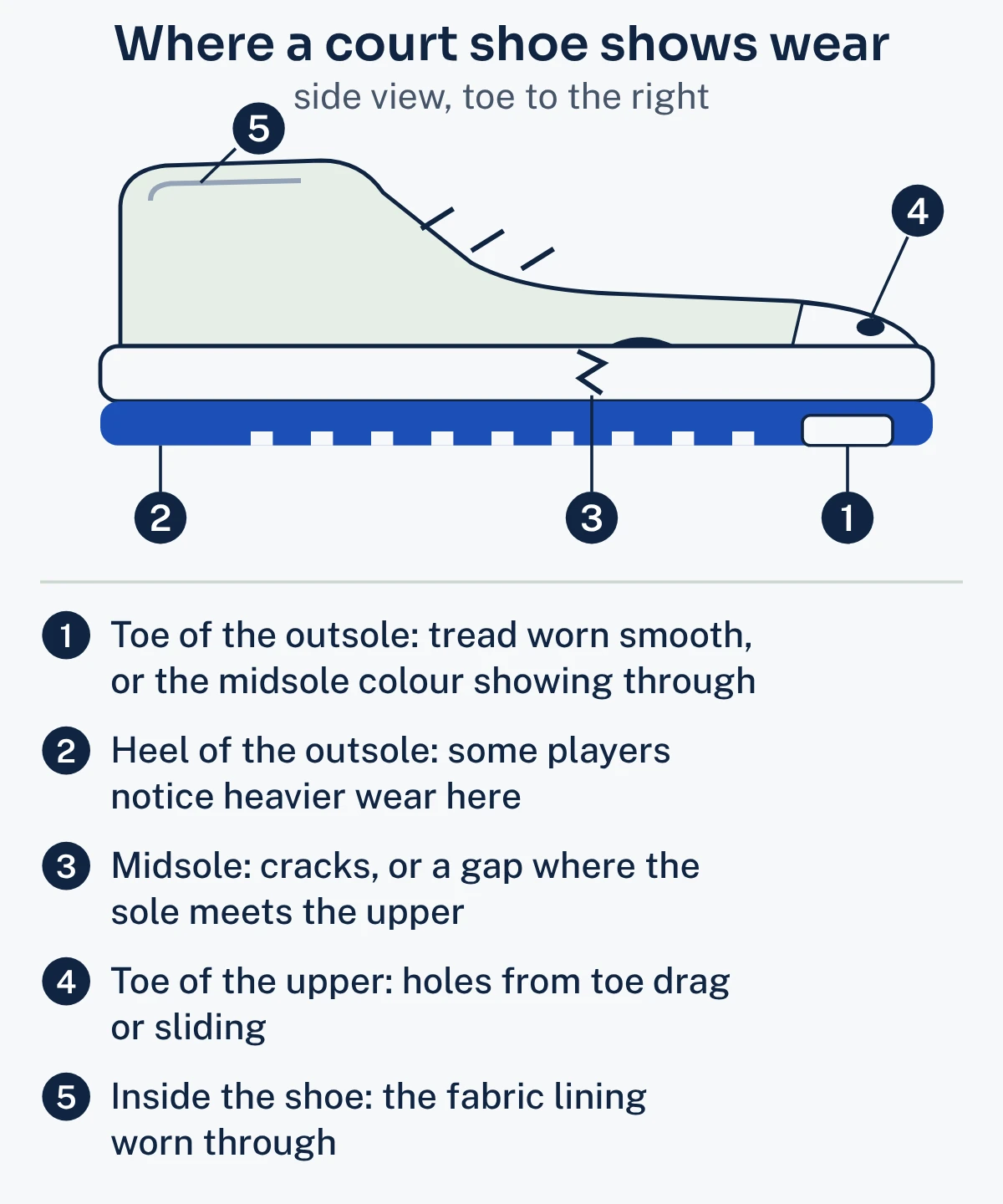
A court shoe has three parts that wear: the rubber outsole that touches the court, the foam midsole above it, and the upper (mesh, synthetic leather or rubber overlays, with a fabric lining inside). These are the checks the sources describe.
Look at the toe of the outsole
Selkirk says “You will probably notice the toe box area will wear down first.” Replace the pair, Selkirk says, “when you see any part of the sole is smooth, with no more tread.”
Look for a second colour under the tread
Selkirk: “If your shoe has an outsole with a different color than the midsole, the moment you can see the midsole showing through is another good indication it’s time to replace your pickleball shoe.” Pickleball Central calls it “an immediate indication your shoes are worn out.”
Check the heel
Pickleball Central notes that “Some players notice heavier wear on the heel of their shoes”.
Stand the shoes on a flat surface
Pickleball Depot suggests “placing them on a flat surface and seeing if they sit uneven on that surface,” and adds that “Completely worn out shoes will also have very obvious signs of creasing on them.”
Flex and twist the shoe
Rackets & Runners: “Flex and twist the shoe in any direction — this should be difficult, and it shouldn’t fold on itself like a runner.”
Check where the sole meets the upper
Pickleball.com’s help centre: “Any separation between the sole and upper, or visible cracking in the midsole, is a clear sign of structural failure.”
Check the upper and the lining
Selkirk lists “Holes are appearing in any area of the shoe.” Pickleball Depot says that the more a player wears a shoe, “the more they will erode this fabric lining out.”
How to make a pair last longer
Each step gives the makers’ instructions first; where a retailer disagrees, both are given.
Wear them on court only
Selkirk’s care list says “Use your pickleball shoes only for pickleball.” Pickleball Depot goes further: “Keep your court shoes for court use only- this even means going to and from the courts in street shoes.” It also says off-court use will “void any outsole warranty your shoe may come with”; that is the retailer’s reading, so check your maker’s terms (see the warranty section).
Match the sole to the court
Keep an indoor gum-rubber sole off outdoor courts, as Pickleball Depot warns above. Our picks of outdoor pickleball shoes, men’s outdoor pickleball shoes and indoor pickleball shoes sort shoes by court, and our pickleball shoes for traction roundup describes each outsole.
Wipe the outsole after play
Skechers: “After using the shoe on a dusty or clay court, gently wipe the outsole with a damp cloth to clear dust from the tread.” Selkirk says “Cleaning the outsoles weekly and rotating between two pairs of shoes will ensure maximum traction and maximize the value of the manufacturer’s warranty.”
Clean the uppers by hand
Selkirk’s routine: “A simple routine using household items like a damp microfiber towel, a gentle toothbrush for stubborn spots, and mild dish soap can effectively remove dirt without causing damage.” For fabric and mesh, Skechers warns to “be careful not to oversaturate the material with water”, and says “DON’T use bleach or hot water.”
Keep them out of the washing machine unless the maker allows it
The makers disagree here. Selkirk says shoes “should always be left to air dry and kept completely out of washing machines and dryers.” Skechers allows the machine only for its machine-washable styles: “DO check for the “Machine Washable” icon on the product detail page or original packaging before washing. When in doubt, hand wash!” For those styles: “Use the gentle cycle with cold water and a mild detergent.”
Air dry, away from heat and sun
Skechers: “Never put your shoes in the dryer or in direct sunlight. Allow them to air dry fully after a match to prevent odor and material breakdown.” Its cleaning guide adds: “Never expose your shoes to direct heat sources like radiators, space heaters, or hair dryers.” To dry the inside, Skechers says to “stuff them with clean, white paper towels” and to avoid newspaper, because “the ink can bleed and transfer onto the inside of your shoes when wet.”
Rotate two pairs
The Dink reports that K-Swiss’s engineers “suggest buying multiple pairs at once, which allows you to rotate them and provide proper time to dry out between uses.” Skechers says “If you play multiple times a week, consider rotating between two pairs.” The sources disagree on how much rotation adds: Pickleball Depot says it “will double the lifespan of each pair”, while Pickleball.com’s help centre says “Rotating between two pairs can extend the usable life of each pair somewhat”.
Store them clean, dry and ventilated
Skechers: “Always make sure your shoes are completely clean and dry before you store them.” Keep them “in a closet or room with good air circulation, away from direct sunlight,” and “Avoid sealing shoes in plastic bags or airtight containers.”
What not to do
From the steps above:
- Don’t wear court shoes off court, to walk, hike or train (step 1).
- Don’t play outdoors in indoor gum-rubber soles (step 2).
- Don’t use bleach or hot water (step 4).
- Don’t machine wash a pair whose maker does not allow it (step 5).
- Don’t use a dryer, a heater, a hair dryer or direct sun to dry them (step 6).
- Don’t put wet shoes straight back on court or into storage (steps 6 to 8).
Outsole warranties: what the terms actually say
Pickleball Central’s blog sums up six-month outsole guarantees this way: “Some shoes even come with a 6 month outsole guarantee, which means the tread should stay intact for 6 months and if you wear through them in that timeframe, the brand will send you a new pair for free.” The makers’ own terms are narrower than that summary. Two makers’ coverage terms, in full:
Selkirk’s 6-month Sole Warranty reads:
- “Selkirk Sport CourtStrike and CourtStrike Pro Pickleball shoes are covered by a 6-month Sole Warranty for the outsole. This warranty covers instances where the outsole is worn down and exposes the midsole within 6 months from the purchase date.”
- “The warranty only covers the rubber outsole of the shoe. Any damage to the toe bumper or upper material of the shoe is not covered under the outsole warranty.”
- “Each sole warranty claim is limited to a one-time replacement.”
- “Selkirk Sport reserves the right to evaluate and decide whether the shoe qualifies for replacement.”
- “Should the purchased shoe be discontinued, store credit in the amount of the original purchase price on the invoice may be applied toward another pair of shoes.”
- “Sole warranties are valid in the United States and Canada.”
Mizuno’s 6-Month Outsole Limited Warranty Guarantee reads:
- “The useful life of a racquet sports shoe will vary depending upon the frequency of its use, the surfaces upon which it is used and the wearer’s style of play. Mizuno’s 6-month outsole limited warranty guarantee applies as detailed below.”
- “This limited guarantee covers the Wave Exceed Tour 4 AC, the Wave Exceed Tour 5 AC, the Wave Exceed Tour 6 AC and the Wave Enforce Tour AC models. All Clay-Court (CC) models are excluded from this outsole warranty.”
- “To qualify for this 6-month outsole limited warranty guarantee, the outsole must be completely worn through, exposing the midsole of the shoe, within 6 months of purchase.”
- “The upper and the toe bumper are not covered under this 6-month outsole limited warranty guarantee.”
- “This wear must be the result of playing tennis or pickleball or a normal hard court racquet sports surface. Damage caused by misuse, abuse, improper or unauthorized repairs, “acts of God” or other events beyond Mizuno’s control will not qualify for this guarantee.”
- “Mizuno 6-month outsole limited warranty guarantee claims MUST be initiated by the consumer ONLY. Mizuno 6-month outsole limited warranty guarantee claims will NOT be accepted from any dealer.”
- “Mizuno 6-month outsole limited warranty may be used 1 time per purchased pair.”
- “Approved Outsole Limited Warranty claims will be satisfied with a replacement pair of similar style or color of the same or higher value.”
- “This is the entire warranty. No other warranty, express or implied, shall apply except as expressly stated above.”
Read the terms page as well as the product page: Mizuno’s page for the newer Wave Exceed Tour 7 AC says it is “offering a 6-month outsole guarantee for long-lasting performance”, while the terms page above still names only earlier models. The terms page also lists what a claim email must include.
A warranty is not a forecast of how long a sole lasts. A December 2025 r/Pickleball thread asks about the durability of Selkirk’s earlier CourtStrike Pro shoes (before the 3.0). Its poster says the view at launch was “holes within 1-2 weeks”, and most owners who reply say their pairs wore out within a few weeks to two months; one, four weeks in, reports no problems yet. The owner who writes “Lasted less than a month for me (I’m admittedly very hard on shoes)” adds “they did honor their 6 month outsole warranty with no issue”; another writes “I did a warranty claim on one but it took 12 weeks to get a replacement”, and a third “It took Selkirk 6 months to send a warranty pair.” One reply quotes a review site saying Selkirk “revised the rubber compound”; the poster could not find a Selkirk statement confirming a fix.
The three shoes below carry a maker’s outsole warranty: Selkirk’s men’s and women’s CourtStrike Pro 3.0, compared in our pickleball shoes roundup and our women’s pickleball shoes roundup, and Mizuno’s Wave Exceed Tour 7 AC (stated on its product page), compared in our men’s pickleball shoes roundup, which also notes the terms-page gap.
| # | Preview | Product | Price | Link |
|---|---|---|---|---|
| 1 |  | Selkirk Sport Men's CourtStrike Pro 3.0 Pickleball Shoe…Six-month sole warranty, men's | $127.99 | Check on Amazon |
| 2 |  | Selkirk Sport Women's CourtStrike Pro 3.0 Pickleball Shoe…Six-month sole warranty, women's | $127.99 | Check on Amazon |
| 3 |  | Mizuno Wave Exceed Tour 7 All Court Men's Racquet Sports…Six-month outsole guarantee (US) | $155.00 Prime | Check on Amazon |
Ready to buy?
Our roundup of pickleball shoes compares shoes for men and women.
Your maker’s instructions come first
The care page, label or box insert for your own pair is the final word on cleaning and drying, and its warranty terms decide what wear it will replace. Where it says nothing, these are the steps Selkirk and Skechers both give: clean the outsole, clean by hand (Skechers’ default when in doubt), air dry without a dryer, and rotate two pairs.
Frequently Asked Questions
Q. Do men’s pickleball shoes last a different length of time than women’s?
None of the sources here gives separate figures for men’s and women’s shoes; the makers’ estimates go by how often you play. Pickleball Depot names player weight as a factor, saying heavier players wear shoes out faster. For choosing the next pair, see our guide to choosing pickleball shoes.
Q. How long do K-Swiss pickleball shoes last?
K-Swiss’s figures in the table are for court shoes in general. For one model, Pickleheads’ reviewer found the Express Light showed “only slight wear after three months”; for the Hypercourt, Travis Rettenmaier says “a few months”.
Q. How long do Skechers pickleball shoes last?
Skechers’ pickleball guide says to replace a pair by its wear: “Once the tread pattern is significantly worn down or the cushioning feels flat, it’s time to replace the shoe”. In a 2023 r/Pickleball thread, two Viper Pro owners report: one wrote they have had them “for 6 months” at “3 days of playing with 3 hrs per”, and another, playing outdoors 4 to 5 days a week, says “I’ve only had them for 2 months but see no wear”; a reply about the non-Pro Viper Court says its “soles are really worn down and developing holes both in the interior and toe box after 3.5 months.”
Q. Can you wear pickleball shoes for walking?
Pickleball Central and Pickleball Depot both advise against it; Depot says walking and other off-court use will “greatly reduce your shoe lifespan”. Our guide to what to wear for pickleball covers the rest of the kit.
Q. Does a 6-month outsole warranty mean the shoes last six months?
Not by Selkirk’s or Mizuno’s terms. Each gives a one-time replacement per claim, subject to the maker’s approval, when the outsole wears through to the midsole within 6 months, and neither covers the upper or the toe bumper. Mizuno’s terms also name only four AC models and require wear from “playing tennis or pickleball or a normal hard court racquet sports surface”.
Sources (18)
- The Dink, The Differences Between Tennis and Pickleball Court Shoes
- The Dink, A Pro Players’ Guide to Buying Pickleball Shoes
- Selkirk, How long should pickleball shoes last?
- Selkirk, Best pickleball shoes
- Selkirk, Pickleball shoe FAQ
- Selkirk, How to properly clean and maintain pickleball shoes
- Selkirk, 6-month Sole Warranty
- Mizuno, 6-Month Outsole Limited Warranty Guarantee
- Mizuno, Wave Exceed Tour 7 AC (men’s)
- Skechers, Your guide to Skechers pickleball shoes
- Skechers, How to Clean Your Skechers
- Pickleball.com help centre, How Do I Know When to Replace My Pickleball Shoes?
- Pickleball Central (retailer), When Should I Replace My Pickleball Shoes?
- Pickleball Depot (retailer), When To Replace Your Court Shoes
- Rackets & Runners (retailer), When should you replace your court shoes?
- Pickleheads, Best Pickleball Shoes (2026)
- r/Pickleball, How long do your shoes typically last you?
- r/Pickleball, Selkirk Shoes (Courtstrike Pro) Durability?
Product prices and availability are accurate as of the date/time indicated and are subject to change. Any price and availability information displayed on Amazon.com at the time of purchase will apply to the purchase of this product.