The short answer
Gen 4 usually means a full foam core in place of a polypropylene honeycomb. Gen 5 has no agreed meaning: DadGum and CPX use it for their full-foam cores, and retailers in Vietnam and Australia use it for JOOLA’s Pro V. Neither is a USA Pickleball category, so compare the core and tester data, not the number.
Gen 4 and Gen 5 are marketing terms, not industry standards or USA Pickleball categories. Pickleball Effect, an independent tester, explains where the numbers came from: “You’ll see reviewers and brands refer to these different construction methods as generations (e.g., Gen 1, Gen 2), since they were adopted in that order.” Below, each definition is quoted from the maker, tester or retailer that uses it, with dates where the page gives one. Where they disagree, the versions sit side by side.
Several sources here earn money when readers buy. Pickleball Effect’s paddle pages say: “This page contains affiliate links. We may earn a commission, but our testing and opinions remain neutral.” John Kew, another tester, says of the JOHNKEW discount code that “I earn a commission that helps support the website”, and that the Gearbox paddle in the review quoted below “was sent for testing, with no payment and no editorial input”. Pickleball Studio, an independent reviewer, says: “We earn a small commission at no extra cost to you if you purchase through our links.” Pickleball Union, a news site, tells readers: “When you buy through our links, you support independent pickleball journalism.” Its Gen 5 article also offers a discount on the HYPER+ from CPX, one of the two Gen 5 makers cited here: “Save 10% with code PICKLEBALLUNION”. The makers and retailers sell the paddles they describe.
Related guide: Can Pickleball Be Quieter? How Quiet Paddles and Quiet Balls Work
Not a rulebook category
USA Pickleball’s 2026 Official Rulebook and its Equipment Standards Manual (Revision 3, January 2025) do not use the word “generation” for paddles (both searched October 25, 2026). USA Pickleball approves paddles by brand and model, and Rule 3.D points to its Approved Paddle List. Rule 3.D reads in full: “Paddle Specifications. The requirements for the paddle are set forth in Rules 3.D.1 through 3.D.7. The complete list of approved paddles is posted on the USA Pickleball Approved Paddle List.”
The manual’s naming rule, 2.E.7 (Model Designation), reads in full: “The manufacturer must have a clearly marked brand and model name or model number on the paddle, and must also include the ‘USA Pickleball Approved’ seal or text treatment. Paddles with different core material, surface material, or other significant differences must have a unique name or number.” The rule asks for a new name when the core material changes; it says nothing about generations.
USA Pickleball does use the generations in its own article, “From Wood to Foam” (June 10, 2026), as a description rather than a rule: “Today, paddle technology continues to evolve with what many consider Generation 4 construction.” Its timeline stops at Generation 4.
Pickleball Union (published August 14, 2026, updated September 24, 2026) says of the next number: “there is no official definition of a Gen 5 pickleball paddle.” It adds that right now the label “means different things depending on who is selling the paddle.” Its summary line: “The generation number is marketing shorthand. The core architecture is the real technology.”
Gen 1 to Gen 4, as two sources define them
USA Pickleball’s article and Pickleball Effect’s paddle buyer’s guide list the same order, in their own words:
| Generation | USA Pickleball’s article (June 10, 2026) | Pickleball Effect’s buyer’s guide (dated March 1, 2025, read Oct 25, 2026) |
|---|---|---|
| Gen 1 | “a honeycomb core sandwiched between two face layers” | Cold pressed: “the paddle’s facing layers are adhered to the polymer core, and then an edge guard is wrapped around it” |
| Gen 1.5 | Not listed | Light thermoforming: “constructed similarly to Gen 1, cold-pressed paddles, but with the added feature of expanding foam injected around the perimeter” |
| Gen 2 | “Generation 2 paddles introduced thermoforming” | Full thermoforming: “Thermoformed paddles are made by applying heat to fuse the facing layers and a carbon fiber perimeter. They often have foam injected around the edges” |
| Gen 3 | “a polypropylene honeycomb core surrounded by an EVA foam perimeter” | Widened foam edge: “utilize thermoforming but incorporate additional foam around the perimeter, creating a dual foam wall.” |
| Gen 4 | “full foam core designs, often incorporating multiple foam densities, materials, and internal layups” | Full foam core: “Paddles in this category utilize a full foam core, a departure from the polypropylene cores used in previous generations.” |
| Gen 5 | Not listed | Not listed |
In the guide’s Gen 4 entry, the sentence that follows reads in full: “Popularized by CRBN, this method can produce a variety of paddle types and is known for enhancing feel and durability compared to polypropylene cores.”
Two details matter for Gen 5. USA Pickleball’s Gen 4 already allows “multiple foam densities”, which is close to how DadGum and Pickleball Union describe Gen 5 (below). And both sources call the Gen 4 build new. USA Pickleball: “Because this technology is still relatively new, manufacturers are continuing to experiment with different combinations of materials and construction methods.” Pickleball Effect: “As this technology is still new to the industry, it continues to be evaluated and developed.”
Pickleball Effect adds a caution before its list: “However, a newer construction method isn’t necessarily superior to an older one.”
What makers mean by Gen 4
Makers that use the number tie it to foam:
- CRBN describes its TruFoam series on its collection page: “These 4th Gen paddles feature a 100% foam core built for durability and high performance.”
- Six Zero names the core of its Black Opal a “G4 Aerospace Solid Foam Core”.
- Honolulu files its foam paddles in a collection called “HONOLULU FOAM GEN 4”, yet labels its J2NF “Gen. 4.5”: “Multi density, all foam floating – pivoting core Pickleball Paddle EPP core interlaced with EVA PERIMETER FOAM”. Pickleball Union reports that “Honolulu has used Gen 5 terminology around the family”, and Pickleball Effect lists the same paddle as “Gen 4”.
- Gearbox‘s Pressure X sits awkwardly in the scheme, according to John Kew (September 13, 2026): “The Pressure X 8E is a Gen-4, full-foam build. Well, with a Gearbox twist, of course, which makes assigning this cleanly to any category difficult.”
Other makers sell foam cores without a number. Selkirk’s foam technology article makes a durability claim for its own core and gives no generation: “By replacing traditional polypropylene with high-density foam, Selkirk has engineered a core that resists crushing and deformation, ensuring consistent performance and an extended paddle lifespan.” Vatic’s V-Sol Pro page lists a “Floating EPP Core with an EVA Perimeter foam ring” and no generation either.
What “Gen 5” means, and who uses it
Two makers put “Gen 5” on full-foam paddles:
- DadGum sells the Legend as a “GEN 5” paddle with a “premium hybrid EPP + EVA full-foam core”, and says: “GEN 5 Foam Core Technology takes it to another level.”
- CPX markets the HYPER+ with a “GEN 5 HYPERFOAM” core and describes the build as “FULL FOAM THERMOFORMED CORE”.
Pickleball Union sums up what is sold under the label as “Usually multiple foam types or more complex full-foam architecture”. Set that beside USA Pickleball’s Gen 4, “often incorporating multiple foam densities, materials, and internal layups”, and the two descriptions overlap. The same layout can carry different numbers depending on who labels it:
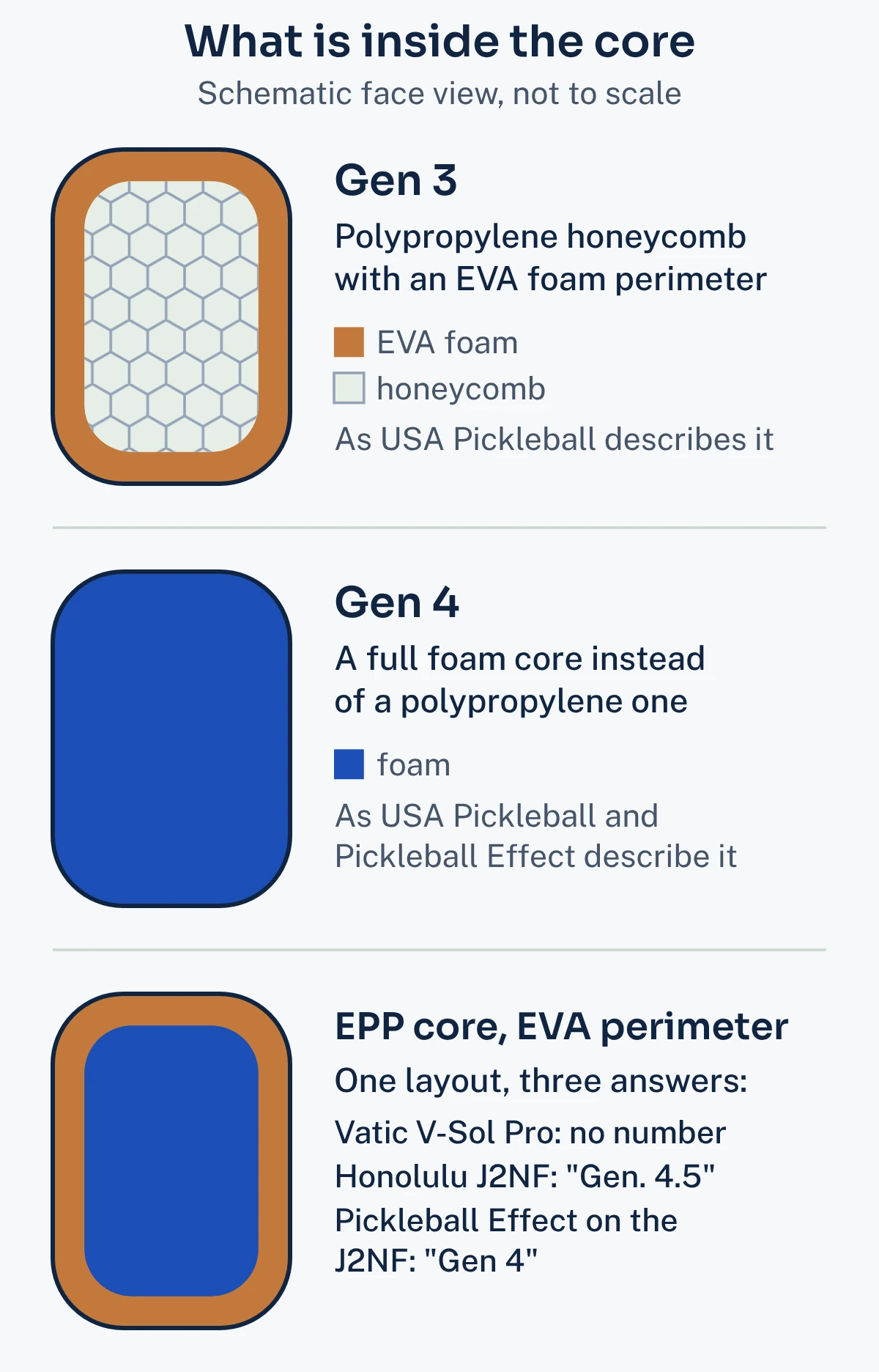
| Paddle | Core, in the maker’s words | Maker’s label | Tester’s label |
|---|---|---|---|
| Honolulu J2NF | “EPP core interlaced with EVA PERIMETER FOAM” | “Gen. 4.5” on its page; Pickleball Union reports “Gen 5 terminology” | Pickleball Effect: Gen 4 |
| Vatic V-Sol Pro | “Floating EPP Core with an EVA Perimeter foam ring” | None on its product page | Not checked for this article |
| DadGum Legend | “hybrid EPP + EVA full-foam core” | “GEN 5” | None read for this article |
| CPX HYPER+ | “FULL FOAM THERMOFORMED CORE” | “GEN 5” | None read for this article |
| CRBN TruFoam Genesis | “100% foam core” | “4th Gen” | Pickleball Effect (Genesis 1): Gen 4 |
| JOOLA Perseus Pro V | “Propulsion Core” | None on JOOLA’s Pro V pages read | Pickleball Effect: Gen 3 |
Gen 4 vs Gen 5 side by side
| Attribute | Gen 4 | Gen 5 |
|---|---|---|
| Core | Full foam: USA Pickleball, Pickleball Effect and the makers above | Full foam, often mixed foams: DadGum, CPX, Pickleball Union |
| Who uses the label | Makers CRBN, Six Zero and Honolulu; testers Pickleball Effect and John Kew; USA Pickleball’s article | Makers DadGum and CPX; retailers PicklePlay and Pickld for JOOLA’s Pro V; Pickleball Union (news site) lists the Pro V and the Honolulu J2NF as “Real Paddles Being Marketed As Gen 5” |
| Agreed definition | The sources quoted here agree on a full foam core | No: it “means different things depending on who is selling the paddle” (Pickleball Union) |
| In testers’ databases | A build class at Pickleball Effect and John Kew | No class at either (read Oct 25, 2026) |
| Power | Pickleball Union: “Varies enormously” | Pickleball Union: “Often engineered for stronger rebound”; asked “Are Gen 5 Paddles More Powerful?”, its text answers “Not necessarily.” |
| Long-term durability | USA Pickleball lists “Increased durability” as a potential advantage; owner reports gathered by Pickleball Effect: “The surface wears out before the core does.” | Pickleball Union: “Potentially durable, but long-term data is still limited” |
Does the label predict power or durability?
Power
USA Pickleball caps power with a lab test that applies to every paddle it approves, whatever the label. The manual says Revision 3 brought “the introduction of the Paddle/Ball Coefficient of Restitution (PBCoR) test to characterize the level of power for a pickleball paddle.” Its limit reads, as the January 2025 manual words it: “PBCoR Test — Not To Exceed Limits: 0.44 effective Nov. 1, 2024, and will be reduced to 0.43 effective Nov. 1, 2025.”
For these four paddles, the generation label does not line up with Pickleball Effect’s serve-speed results. Its power figure is the paddle’s speed over “10 max serves, speed gun”, scored against “the last three model years of our paddle database”:
| Paddle | Maker’s label | Pickleball Effect’s build | Serve speed | Percentile (scorecard) |
|---|---|---|---|---|
| Six Zero Black Opal | “G4” core | Gen 4 | 57.6 MPH | 99th |
| JOOLA Perseus Pro V (16mm) | None on JOOLA’s pages read | Gen 3 | 56.4 MPH | 60th |
| Honolulu J2NF | “Gen. 4.5” | Gen 4 | 56.1 MPH | 45th |
| CRBN TruFoam Genesis 1 | “4th Gen” | Gen 4 | 55.8 MPH | 32nd |
The three paddles Pickleball Effect classes as Gen 4 run from the 32nd to the 99th percentile, and the Gen 3 Pro V sits between them. The percentiles are the scorecard figures; for the Pro V, the page’s text gives “56.4 MPH (68th percentile)”. This is one tester’s rig and four paddles, read on October 25, 2026, and the percentiles move as the database grows. Our power paddle roundup compares paddles chosen for pace.
Pickleball Union’s opening sentence reads in full: “Gen 5 pickleball paddles typically use more complex foam-core designs, but ‘Gen 5’ is not an official standard.” The next sentence reads in full: “Compared with Gen 4, they may offer more tuned power, stability, and feel, yet construction, swing weight, shape, and testing data matter more than the generation label.” Our swing weight explainer covers one of those numbers.
Durability
Makers’ durability claims for foam are about the core. Selkirk, as quoted above, says its foam core “resists crushing and deformation”. USA Pickleball’s article lists four “Potential advantages” of Generation 4 construction: “New opportunities for performance tuning”, “Increased durability”, “Improved consistency” and “Greater design flexibility for manufacturers”. Pickleball Effect’s buyer’s guide says the full foam core method is “known for enhancing feel and durability compared to polypropylene cores”, and, in its notes on generations: “Generation 1 and 1.5 paddles are generally more durable and do not degrade as quickly as Generation 2 or 3 paddles. Generation 4 paddles show promise as a more durable material, and we will continue to monitor their development.”
Pickleball Effect gathered owner reports on foam paddles (June 3, 2026): “Across a wide range of brands and constructions, players with anywhere from 100 to 500+ hours on their paddles are reporting similar experiences around stable cores, predictable performance, and fewer durability concerns than many expected.” It found that “positive long-term durability experiences outnumbered significant failure reports by roughly 3:1 in the Reddit discussion”.
The same page names what fails instead. “The surface wears out before the core does.” And: “The most commonly reported structural issue was disbonding, where the facesheet separates from the foam core.” It adds: “A smaller number of players reported dead spots, softened feel, or a noticeable loss of power after months of heavy use.” Kew measures grit wear on their own rig; in the Pressure X review, the paddle’s “spin durability tests at Tier 2, well ahead of the raw-carbon Tier 4 surface most Gen-4 paddles ship with”.
For Gen 5, Pickleball Union’s table says “Potentially durable, but long-term data is still limited”. Our guide to how long a pickleball paddle lasts covers wear on any paddle.
Pro IV and Pro V: JOOLA’s own generations, not Gen 4 and Gen 5
JOOLA counts versions of its flagship line, and its Pro IV page speaks of them as generations. Its Pro IV collection page says TechFlex Power is “the signature tech of the Pro IV generation”. Asked there “Is Pro IV still a good option compared to the newer Pro V?”, JOOLA answers: “Yes. Pro IV remains an innovative, pro-level, dual-certified paddle line at a lower price point than Pro V, making it a strong choice for players who want pro-grade performance without the latest-generation price tag.” Asked in the same FAQ “How is Pro IV different from Pro V?”, JOOLA also answers: “Neither is a strict upgrade; it depends on whether you want the paddle to create offense for you or amplify offense you bring yourself.” Its Pro V collection page describes the change as a frame, not a new core: “The Pro V introduces KineticFrame, a redesigned throat geometry that changes how the paddle flexes and releases energy.” The JOOLA Pro V pages read for this article do not call it Gen 5.
Some retailers do. PicklePlay in Vietnam lists the Pro V models under a collection titled “Joola Gen 5 Pickleball Paddle”, and Pickld in Australia sells “Gen 5 Pro V flagships” on its JOOLA page. Pickleball Union, a news site, lists the JOOLA Pro V under “Real Paddles Being Marketed As Gen 5”, and adds a caveat: JOOLA pairs KineticFrame “with JOOLA’s Propulsion Core, rather than simply replacing the entire interior with a uniform block of foam.”
Testers put the Pro V in Gen 3. Pickleball Effect lists the Perseus Pro V 16mm as “Gen 3”. Pickleball Studio (April 16, 2026; JOOLA supplied two of its review units) writes: “There’s no longer lasting grit, no full foam, and no other major additions.” It adds: “I think it’s very safe to say this is just an iteration of a Pro IV, which was also an iteration of the 3S, which was also an iteration of the original gen 3”. On power, its reviewer reports from play rather than a lab test: “None of the people I drilled with or played against ever made comments that any type of shot was significantly hotter or slower when bouncing between the Pro IV and Pro V.”
Our paddle roundup lists each maker’s core. For the Perseus Pro V: “16 mm Propulsion Core, polypropylene with carbon fiber and EVA foam, Hyperfoam edge wall”. For the Perseus Pro IV: “16 mm polypropylene with EVA foam wall”. For CRBN’s Genesis 1: “14 mm, 100% foam (TruFoam)”. Here they are side by side, two JOOLA Pro models on polypropylene cores and one paddle CRBN calls 4th Gen:
| # | Preview | Product | Price | Link |
|---|---|---|---|---|
| 1 |  | JOOLA Ben Johns Perseus Pro IV 16mm Pickleball Paddle…Pro IV: polypropylene core, EVA foam wall | $149.95 Prime | Check on Amazon |
| 2 |  | JOOLA Pro V Pickleball Paddle – 14mm/16mm – Raw Carbon…Pro V: polypropylene Propulsion Core | $299.95 Prime | Check on Amazon |
| 3 |  | CRBN Pickleball, TruFoam Genesis, Carbon Fiber Pickleball…100% foam core; CRBN calls it 4th Gen | $199.99 | Check on Amazon |
All three are compared in our best pickleball paddles roundup.
Choosing between a Gen 4 paddle and one sold as Gen 5
Choose by the core and the data:
- Choose a paddle sold as Gen 4 if you want a full foam core, which the sources quoted here agree is what Gen 4 means. Pickleball Effect and John Kew both class paddles as Gen 4 and publish lab numbers for them.
- Choose a paddle sold as Gen 5 if its maker’s own core design is what you want, such as DadGum’s EPP and EVA mix, and you are content to judge it on that model’s own data. Neither database had a Gen 5 class on October 25, 2026, but tester data is filed under Gen 4 even when the maker says 4.5: Pickleball Effect classes the Honolulu J2NF, which Honolulu labels “Gen. 4.5”, as Gen 4.
- If a listing calls a JOOLA Pro V “Gen 5”, note that JOOLA’s own generation naming is Pro IV and Pro V. Retailers and Pickleball Union label the Pro V Gen 5, Pickleball Effect classes the Perseus Pro V as Gen 3, and our roundup lists its core as polypropylene.
Three checks work for any paddle, whatever its label:
Read the core line in the maker’s specs
Look for polypropylene or honeycomb against foam, and which foams. That line describes what the generation numbers stand for.
Find the model on the USA Pickleball Approved Paddle List
Rule 3.D points there for “The complete list of approved paddles”, and approval goes by brand and model, not by generation.
Compare measured numbers within one tester’s database
Pickleball Effect, for example, publishes serve speed and percentiles for each paddle it tests.
Ready to buy?
Our best pickleball paddles roundup lists the maker’s core for each pick, foam and polypropylene alike. For pace, see our power paddle roundup.
Frequently Asked Questions
Q. What is the difference between Gen 1, 2, 3 and 4 paddles?
In USA Pickleball’s article, Gen 1 is a honeycomb core between two face layers, Gen 2 adds thermoforming, Gen 3 adds an EVA foam perimeter around a polypropylene honeycomb, and Gen 4 is a full foam core. Pickleball Effect adds a Gen 1.5 between Gen 1 and Gen 2.
Q. Is the JOOLA Pro V a Gen 5 paddle?
PicklePlay and Pickld, retailers in Vietnam and Australia, sell it as Gen 5, and Pickleball Union lists it under “Real Paddles Being Marketed As Gen 5”. JOOLA’s own pages count its flagship lines as Pro IV and Pro V, and its Pro V pages read for this article do not use the term. Its Pro IV page adds: “Neither is a strict upgrade; it depends on whether you want the paddle to create offense for you or amplify offense you bring yourself.” Pickleball Effect lists the Perseus Pro V 16mm as Gen 3.
Q. What is a Gen 4.5 paddle?
Honolulu uses “Gen. 4.5” for its J2NF, an all-foam paddle with an EPP core and EVA perimeter foam. Pickleball Effect lists the same paddle as Gen 4, and Pickleball Union says Honolulu “has used Gen 5 terminology around the family”.
Q. Are Gen 5 paddles approved for sanctioned play?
Approval is by brand and model, so check the model on the USA Pickleball Approved Paddle List. DadGum and CPX both say their Gen 5 paddles are approved: DadGum’s page title ends “USAP Approved” and CPX’s page says “USA Pickleball Approved”.
Q. Is a Gen 5 paddle better than a Gen 4 paddle?
Sources quoted here give both sides. Pickleball Union writes that Gen 5 paddles “may offer more tuned power, stability, and feel” compared with Gen 4, and also that “calling Gen 5 simply ‘better than Gen 4’ makes no sense”. Pickleball Effect’s buyer’s guide says “a newer construction method isn’t necessarily superior to an older one”, and no source quoted here has measured one group against the other.
Sources (24)
- USA Pickleball, 2026 Official Rulebook
- USA Pickleball, Equipment Standards Manual (Revision 3, January 2025)
- USA Pickleball, From Wood to Foam: The Evolution of Pickleball Paddle Technology
- Pickleball Effect (independent tester), Pickleball Paddle Specs Explained: buyer’s guide
- Pickleball Effect, What Players Are Saying About Foam Paddle Durability
- Pickleball Effect, Six Zero Black Opal
- Pickleball Effect, JOOLA Perseus Pro V (16mm)
- Pickleball Effect, Honolulu J2NF
- Pickleball Effect, CRBN TruFoam Genesis 1
- John Kew Pickleball (independent tester), Gearbox Pressure X 8E Elongated Review
- John Kew Pickleball, Paddle Database
- Pickleball Studio (independent reviewer), Joola Perseus Pro V Review
- Pickleball Union (news site), Gen 5 Pickleball Paddles Are Here—But What Does “Gen 5” Actually Mean?
- CRBN (maker), TruFoam Series
- Six Zero (maker), Black Opal 14mm
- Honolulu Pickleball Company (maker), Sword & Shield J2NF
- Vatic Pro (maker), V-Sol Pro (16mm)
- Selkirk (maker), How foam technology is redefining pickleball paddles
- DadGum Paddles (maker), Legend GEN 5
- CPX (maker), HYPER+
- JOOLA (maker), Pro IV collection
- JOOLA (maker), Pro V collection
- PicklePlay (retailer, Vietnam), Joola Gen 5 Pickleball Paddle
- Pickld (retailer, Australia), JOOLA Paddles
Product prices and availability are accurate as of the date/time indicated and are subject to change. Any price and availability information displayed on Amazon.com at the time of purchase will apply to the purchase of this product.