The short answer
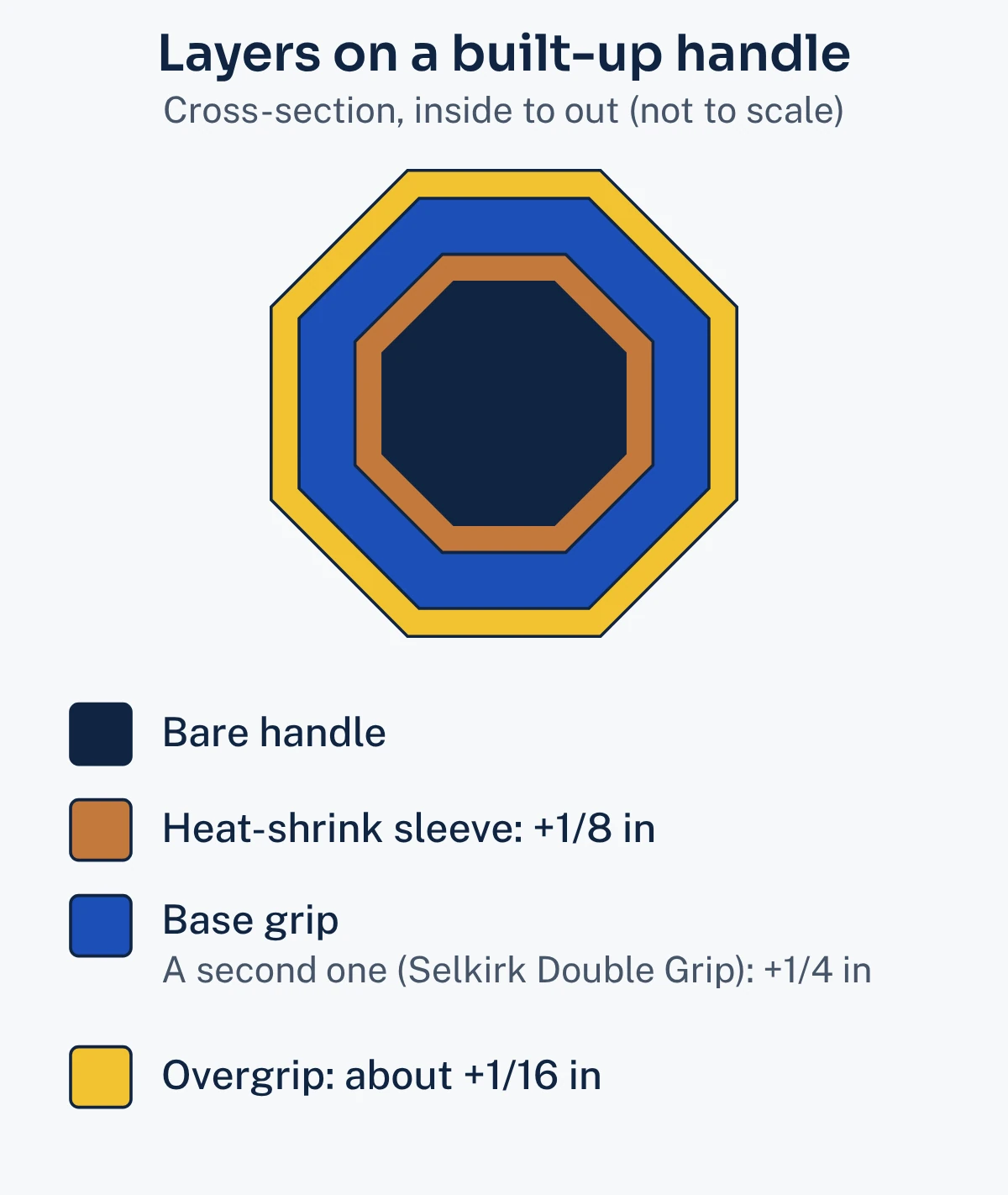
Add layers, smallest first. One overgrip adds about 1/16 inch (Pickleball Warehouse, Helios, ARTI); IQGrip puts two at about 1/8 inch. Selkirk’s Double Grip, a second Comfort Grip, took its handle from 4.25 to 4.5 inches. Under the grip, a heat-shrink sleeve adds 1/8 inch per full-size sleeve, Gamma says.
To find the size you are aiming for, start with our pickleball grip size guide, which covers the hand measurement and three makers’ charts.
Work from the method you can undo most easily. An overgrip unwraps; a heat-shrink sleeve has to be cut off.
How much each method adds
| Method | Adds to the circumference | Where it goes | To undo it |
|---|---|---|---|
| One overgrip | About 1/16 in (1.6 mm): Pickleball Warehouse (retailer), Helios and ARTI (paddle makers). Third Shot Drop (shop): 1/16 to 1/8 in | Over the base grip | Unwrap it |
| Two overgrips | About 1/8 in (3.2 mm), says IQGrip | Over the base grip | Unwrap them |
| Second base grip | 1/4 in (6.4 mm) for Selkirk’s Double Grip only: our arithmetic from Selkirk’s 4.5 in (Double Grip) and 4.25 in (one Comfort Grip) | Over the first base grip | Unwrap it |
| Hesacore sleeve | Medium measured 4.56 in on a 4.25 in handle (Pickleball Studio, via The Dink) | In place of the base grip | Slide it off |
| Heat-shrink sleeve | 1/8 in (3.2 mm) per full-size sleeve, says Gamma | On the bare handle, under the base grip | Cut it off |
Pickleball Warehouse writes “A typical overgrip will increase a grip by 1/16 inch.” IQGrip, which sells grip insert kits, says “Each overgrip adds roughly 1/16 inch to the circumference” and that “two take you a full size up”. Pickleball NVZ, a shop, sees one layer differently: an overgrip “adds tackiness and absorbs sweat without significantly changing the grip size.”
The Hesacore row is a measurement, not a maker figure: The Dink, a pickleball publication, reports it from Pickleball Studio’s test on a Bread and Butter paddle. Hesacore’s own page warns that its thickness figures are not handle sizes: “Hesacore thickness refers to the material wall of the grip — not the handle size.”
| # | Preview | Product | Price | Link |
|---|---|---|---|---|
| 1 |  | Selkirk Sport Non-Slip Pickleball Grip Tape | Comfort Pro…Cushioned overgrip, single | $7.99 | Check on Amazon |
| 2 |  | CRBN Replacement Base Grip, Pickleball Paddle Grip 3-Pack…Base grip, 2 mm, 3-pack | $11.99 | Check on Amazon |
| 3 |  | Hesacore Pickleball Paddle Grip – 5.25in – Regular Feel…Slip-on sleeve, S or M | $26.90 | Check on Amazon |
The three products above are one layer of each kind: a cushioned single overgrip (Selkirk prints no thickness for it), a 2 mm base grip sold three to a pack, and Hesacore’s slip-on sleeve, which Hesacore makes in a 1.5 mm small and a 2.0 mm medium. The overgrip is compared in our overgrip roundup and in our roundup of grip tape for sweaty hands; the base grip and the Hesacore are in our replacement grip roundup.
What you need
- A soft tape measure, to measure the handle before and after.
- The layer you are adding: overgrips, a base (replacement) grip, a slip-on sleeve such as Hesacore, or a heat-shrink sleeve.
- Scissors and finishing tape. Pickleball Warehouse lists “Finishing tape (included with grip/overgrip)”.
- A utility knife or scissors to take off a base grip. Selkirk: “Use a utility knife or scissors to cut along the length of the grip and carefully peel it off the handle.”
- For a heat-shrink sleeve: a heat gun or hair dryer, and a razor knife. Tennis Warehouse, a tennis racquet retailer, lists a “Razor knife to trim heat-shrink sleeve” and a “Heat gun”; Pickleball Warehouse says “You will need a heat gun or very hot hair dryer”.
Measure first, then pick a method
Measure round the middle of the handle
Third Shot Drop says grip sizes “are often measured at the very middle of the paddle handle”, “including any grip that may be applied”. Write the number down.
Take it away from the size you want
The gap points you to a row of the table above: about 1/16 inch is one overgrip, and 1/8 inch is two overgrips or one heat-shrink sleeve. For a bigger gap, see the second base grip and Hesacore rows; what they add depends on the grip.
Check your paddle’s return terms before you cut off a stock grip
Six Zero’s return policy counts as damaged “paddles that have stock grips removed”, and its warranty excludes “Any modifications made to the paddle after purchasing.” Selkirk’s warranty does not cover “damage caused by abuse, negligence/user modification”. Other makers’ terms differ, so read your own paddle’s. An overgrip leaves the stock grip in place.
Add overgrips (about 1/16 inch each)
Selkirk’s advice for a bigger handle: “You can always ADD an over-grip (or two) to your paddle to increase the circumference”. The full wrapping method, step by step, is in our guide to wrapping a pickleball paddle handle; the steps below are the parts that matter for size.
Wrap the first overgrip over the base grip
Start at the butt cap with the tapered end. Pickleball Warehouse: “Start by placing the tail on a bevel and fully wrap around the grip one time.” Then spiral up the handle, overlapping each turn.
Overlap a little more if you want a little more size
Olaben, a paddle brand, notes that “Using more overlap creates a thicker handle.”
Cut the tail instead of winding it round
Winding the spare length over itself “may leave a bulge at the top of the grip”, Pickleball Warehouse warns. Trim it and secure the end with finishing tape.
Measure, then add a second overgrip only if you need it
Wrap it over the first the same way. How many is too many varies by source: an r/Pickleball owner who wanted a much bigger handle found “Multiple overgrips just don’t add enough circumference and are too squishy,” and IQGrip says “stacking more than two starts to feel dead — you lose feedback from the paddle”.
An overgrip does more than add size. Our guide to why players put an overgrip on a pickleball paddle covers the rest.
Go up a bigger step: a second base grip or a slip-on sleeve
A base grip is the thicker layer. Pickleball NVZ puts an overgrip at “typically 0.4-0.6 mm” and a replacement (base) grip at “1.5-1.8 mm”, so one layer moves the size further. What a second base grip adds depends on the grip; the 1/4 inch in the table is for Selkirk’s Double Grip.
For a second base grip, wrap it over the one already on the handle
This is how Selkirk builds its 4.5-inch Double Grip, a Comfort Grip “wrapped over another Comfort Grip”. Wrap it like any replacement grip, from the butt cap up, then add an overgrip on top if you use one.
For a Hesacore sleeve, take the stock grip off first
Hesacore’s page says “Hesacore replaces your stock grip entirely.” Cut the old grip along its length and peel it off; Selkirk warns that “It might take some effort and patience to peel it off without damaging the handle.” Then, in Selkirk’s words, “Be sure to remove any chunks of adhesive residue left behind, as they may interfere with applying the new grip.”
Slide the sleeve on and line it up
Follow the instructions in the Hesacore pack. The Dink says: “Make sure the logo sits on the sides of your handle, not the top and bottom.”
Wrap an overgrip over the sleeve
The Dink: “Playing without an overgrip on top of the Hesacore is slippery and not recommended.” Hesacore also suggests one of its overgrips on top “to fine-tune feel and thickness.”
Build up the bare handle with a heat-shrink sleeve
A heat-shrink sleeve is a tube that shrinks onto the bare handle when heated, under the grip. The instructions are written for tennis racquets: Gamma’s sheet (updated 09.11.13) speaks of a racquet throughout, and Pickleball Warehouse, a pickleball retailer, sells a sleeve with steps that are also written for a racquet. Gamma’s sheet also covers a half-size sleeve: “The application of 1 half size Grip Build-Up Sleeve will increase the racquet grip size by 1/16″.” Two r/Pickleball owners report fitting sleeves to paddles. One writes: “I have put it on 2 different paddles before. And used a heat gun for each. Although it was a battery operated heat gun. Not as hot as my plug in one. But no damage to either paddle.” The other: “I used a hairdryer though. Was wary of using a heat gun.”
Take the grip off down to the bare handle
Gamma: “Remove the existing grip from the Racquet Handle and remove any excess tape or grip material.” Pickleball Warehouse adds “being careful not to tear the grip if reusing.”
Slide the sleeve over the butt cap
The sources differ on where it sits. Gamma’s diagram says “Position Sleeve even with edge of Butt Cap”, and its sheet adds: “In some applications, the Butt Cap may need to be removed before application of the Build-Up Sleeve.” Pickleball Warehouse leaves it “overlapping the handle end by about 3/8 inch” and trims it after heating.
Heat it from the butt cap up, turning the paddle as you go
Gamma uses a heat gun “set on the low setting” and says to “evenly heat the circumference of the sleeve”, starting at the butt cap and working up. Pickleball Warehouse keeps “the heat gun 3-4 inches away” and says to “Rotate the racquet while slowly moving the heat gun up the handle.” Holabird Sports, a racquet-sports retailer, uses “a heat gun or hair dryer on the high setting”. Use your heat gun or dryer as its own manual says, and keep the heat moving and on the sleeve. Gamma’s sheet warns, in full: “(CAUTION: Prolonged concentration of heat in one location may result in damage to the racquet and Build-Up Sleeve.)” Selkirk, a paddle maker, says “Extreme heat or cold can cause damage to your paddles.”
Let it cool, then trim the excess at the butt cap
Gamma: “Allow the Racquet Handle to cool to room temperature, then trim any excess sleeve using a sharp blade.” Pickleball Warehouse says to “place the racquet on a stable surface” and keep the blade still: “Turn the racquet as you hold the razor knife steady until the sleeve is completely trimmed.”
Wrap a base grip over the sleeve
Gamma’s last step: “Apply a new grip to the racquet handle.” Add an overgrip on top if you use one.
Need more? Measure before you add a second sleeve
Gamma says “For larger increases, several Grip Build-Up Sleeves may be layered.” A buyer reviewing the sleeve on Pickleball Warehouse’s page, writing about a racquet, warns: “Don’t use two to try to increase 2 steps, otherwise the edges will round off.”
To take a sleeve off later, Tennis Warehouse, writing for racquets, says to “gently slice it lengthwise and peel off handle.”
Check the new size
Measure the middle of the handle again, with every layer on, the same way as before. Then play with it: Selkirk says “The best way to make sure a grip size is right for you is through actual court time.” Measure again after a few weeks, because “Grips can change size over time as they wear away or swell up with moisture” (Selkirk).
Mistakes and how to fix them
- The bevels have gone soft. One r/Pickleball owner tried a replacement grip plus one overgrip, and it “felt like way too much cushion, and I completely lost the bevel.” Pickleball Warehouse says heat-shrink sleeves “retain the handle’s bevels”, and another buyer’s review on that page, which names neither racquet nor paddle, says it “Increased the grip size and kept the feel of the bevels.”
- A lump at the top of the handle. It comes from winding the spare overgrip over itself; cut a tapered tail instead (Pickleball Warehouse).
- The handle is now too big. Unwrap the top layer. Taking a grip down below its original size is harder; Helios says it “typically requires removing the existing grip tape down to the bare handle.” Our grip size guide covers the options.
- A spare sleeve that has shrunk early. Gamma says to “Store Grip Build-Up Sleeves in a cool dry place until used,” because “Exposure to warm temperatures over long periods of time may cause the sleeves to shrink prematurely.”
- A built-up grip that slips in your hand. For slipping, our grip tape roundup for sweaty hands compares overgrips whose makers say they handle moisture.
Is a built-up grip allowed in sanctioned play?
USA Pickleball’s 2026 Official Rulebook lists what a player may change. Rule 3.D.6 opens: “Allowable Alterations. Altered paddles must meet all specifications. The only allowable alterations or additions by a player to a commercially produced paddle as certified are:” Three items on that list cover grips:
- 3.D.6.d: “Replacement of OEM interchangeable grips.”
- 3.D.6.g: “Changes to the grip size via inserts.”
- 3.D.6.h: “Addition or replacement of grip wrap.”
No rule in the rulebook sets a grip circumference. The list does not name heat-shrink sleeves or slip-on sleeves such as Hesacore, and this guide gives no ruling beyond the rule text.
Ready to buy?
Our overgrip roundup compares eight overgrips by pack, thickness and feel, as each maker words them. For a thicker base layer, our replacement grip roundup compares eight replacement grips: six wraps and two slip-on sleeves.
Frequently Asked Questions
Q. How can I increase the size of my tennis grip?
The same ways. Tennis Warehouse, a tennis retailer, says “Applying a single overgrip should increase your grip size by about 1/16 of an inch,” and that “you can also increase your handle by a full size by installing a heat-shrink sleeve.”
Q. Can you change the grip on a pickleball paddle?
Yes. USA Pickleball’s rule 3.D.6.h allows the “Addition or replacement of grip wrap.” Our handle wrapping guide shows how to take the old grip off and wrap a new one.
Q. Is a hair dryer hot enough for a heat-shrink sleeve?
The sources differ. Holabird and Pickleball Warehouse name a hair dryer as an option (Pickleball Warehouse says “very hot”), while Gamma’s sheet names only a heat gun on its low setting.
Q. Does a bigger grip make the paddle heavier?
Yes, a little. Selkirk says its Double Grip will “increase the weight of the paddle four-tenths of an ounce on average”, and an r/Pickleball owner who fitted a heat-shrink sleeve, then took it off, put the extra weight at “Like .5oz or so if I remember correctly.”
Q. Should I build up a paddle or buy one with a bigger grip?
If you are buying new, check the grip options first. Selkirk fits its 4.5-inch Double Grip on request (“If you request a double grip on your paddle”), which saves building one up. Our grip size guide lists what common paddles ship with. For the grip ranges sources give women, see our guide to paddle sizing for women: grip, weight and shape.
Sources (23)
- USA Pickleball, 2026 Official Rulebook (PDF), rule 3.D.6
- Gamma, Grip Build-Up Sleeves instruction sheet (PDF, scanned, updated 09.11.13)
- Selkirk, grip guide
- Selkirk, How do I know my pickleball grip size?
- Selkirk, How to replace the grip on a pickleball paddle
- Selkirk, The basics of pickleball paddle care
- Selkirk, paddle warranty
- Six Zero, warranty and return policy
- Helios Pickleball, best grip size for small hands
- ARTI, pickleball paddle grip size guide
- Olaben, regrip your pickleball paddle in minutes
- Hesacore, Pickleball Original Grip
- The Dink, Hesacore grip review
- Pickleball Warehouse (retailer), Heat Shrink Sleeve (build one grip size)
- Pickleball Warehouse (retailer), how to grip a paddle
- Pickleball Warehouse (retailer), selecting a pickleball paddle
- Tennis Warehouse (tennis racquet retailer), How to increase your tennis grip size
- Holabird Sports (racquet-sports retailer), full size build-up sleeve
- Third Shot Drop (shop), find your pickleball paddle grip size
- Pickleball NVZ (shop), best pickleball overgrip
- IQGrip (grip insert maker), how to make a pickleball handle thicker
- r/Pickleball, “Anyone tried heat shrink sleeve on pickleball paddle?” (owner forum thread)
- r/Pickleball, “Increasing grip circumference” (owner forum thread)
Product prices and availability are accurate as of the date/time indicated and are subject to change. Any price and availability information displayed on Amazon.com at the time of purchase will apply to the purchase of this product.