
Use a paddle stacking system or a round-robin format for organized pickleball pairings for up to 4 courts. As someone who has spent countless hours on the courts, I've seen firsthand how a great day of pickleball can turn into a frustrating wait. The difference often comes down to one thing: a good system. If you're tired of the chaos of open play and want to ensure everyone gets fair, fun games, you've come to the right place. This guide breaks down the best methods for managing pickleball pairings for up to 4 courts, turning confusion into seamless, enjoyable play for everyone involved.

Why a Simple System is Your Best Friend on the Courts
Have you ever shown up to a busy set of courts and felt a wave of confusion? People are milling around, some players seem to be on the court forever, and nobody knows who is next. This is the classic sign of open play without a system. It can lead to long waits, mismatched games, and even a little bit of tension.
A clear organization system solves these problems. It ensures fairness, meaning everyone gets a similar amount of playing time. It also encourages social mixing, so you get to play with and against a variety of people, which is one of the best parts of the sport. I remember one particular Saturday morning that went from chaotic to amazing simply because one person stepped up with a whiteboard. Having a plan for pickleball pairings for up to 4 courts is a game-changer.
The Most Popular Pairing Systems Explained
When it comes to organizing play, you don't need to reinvent the wheel. A few tried-and-true methods work perfectly for groups of various sizes and skill levels. Each has its own vibe, from super casual to more structured and competitive.
Here are the three main systems you can use:
- The Paddle Stack: This is the most common and simple method for drop-in play. It’s wonderfully democratic and requires almost no management.
- The Round Robin: This format is perfect for ensuring everyone plays with everyone else. It’s ideal for leagues or groups that want structured, competitive fairness.
- King/Queen of the Court: This is a dynamic, fast-paced system where players move up or down courts based on wins and losses. It’s a fantastic way to create competitive matches.
Choosing the right format for pickleball pairings for up to 4 courts depends on your group's goals for the day. Are you there for laid-back fun or a competitive showdown?

The Classic Paddle Stack: Simple and Social
The paddle stack is the go-to system for a reason. It's incredibly easy to set up and manage, making it perfect for drop-in sessions where players are constantly arriving and leaving. I’ve used this method at countless parks, and it almost always keeps the peace and the games flowing.
Here’s how it works:
- Find a designated spot near the courts, like a bench, a fence, or a dedicated paddle rack.
- As players come off a court and want to play again, they place their paddle in the rack.
- You create groups of four paddles. The first four paddles in the line form the next game.
- When a court opens up, the next group of four grabs their paddles and heads out to play.
The beauty of this system is its simplicity. However, to keep things moving, especially with 16 or more players, it helps to establish a "winners stay and split" or "two on, two off" rule. This prevents the same four people from playing together all day and gives everyone a chance to mix in.
Running a Smooth Round Robin for Fair Play
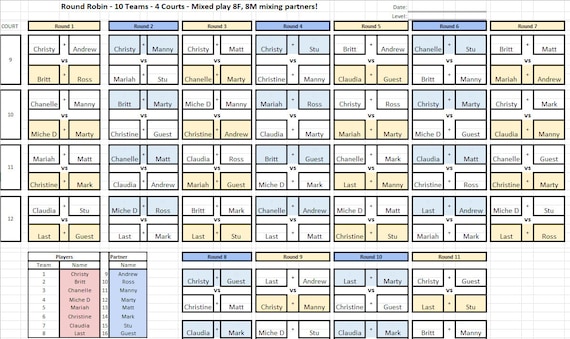
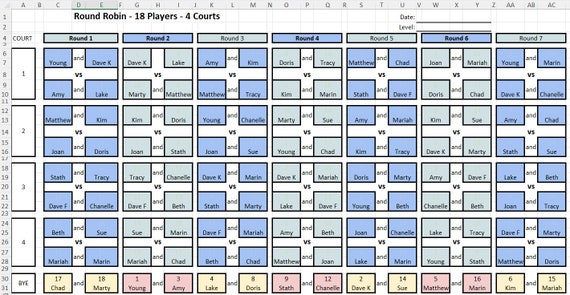
If you have a consistent group of players and want to ensure the most equitable playing time possible, a round robin is your answer. This method is a bit more structured but is the gold standard for creating fair matchups. It’s my personal favorite for club events or when we have exactly 16 people for four courts.
A round robin for 16 players on 4 courts could look like this:
- Round 1: Players are assigned a number from 1 to 16. Pairings could be (1,2) vs (3,4) on Court 1, (5,6) vs (7,8) on Court 2, and so on.
- Round 2: Rotate partners. For example, player 1 might now partner with player 3 to play against player 2 and player 4.
- Continue Rotating: You can find pre-made round-robin sheets online that lay out all the rotations for you. Just print one out and post it.
This system guarantees that everyone plays with a variety of partners and against a variety of opponents. It’s the ultimate solution for organized pickleball pairings for up to 4 courts when fairness is the top priority. It just needs one person to act as the organizer to get it started.
.jpg)
King/Queen of the Court: The Competitive Ladder
For groups that thrive on competition, the King or Queen of the Court format is exhilarating. This system naturally filters players by skill level, leading to increasingly competitive games as you move up the ladder. It creates a fun, energetic atmosphere where every point matters.
Here’s the basic flow:
- Label the courts from 1 to 4. Court 1 is the "King/Queen" court, and Court 4 is the entry court.
- Players start on any court. After each game, the winning pair on courts 2, 3, and 4 moves up one court. The losing pair moves down one court.
- The winners on Court 1 stay, earning the title of Kings or Queens. The losers from Court 1 move down to Court 2.
- Often, partners will split after each game and find a new partner on their new court. This keeps the pairings fresh.
This format is fantastic for training and improving your game because you are constantly challenged. It’s one of the most dynamic ways to handle pickleball pairings for up to 4 courts and works best when players have a similar competitive mindset.

Frequently Asked Questions of pickleball pairings for up to 4 courts
What is the best system for players of all different skill levels?
The paddle stack system is generally the best for mixed skill levels. It is random by nature, which means beginners get a chance to play with more experienced players in a low-pressure, social environment.
How many players do you need for 4 courts?
Ideally, you want at least 16 players to keep all four courts full. However, these systems can easily be adapted for anywhere from 8 to 24+ players, with some people waiting and rotating in.
What's the fastest way to get everyone playing?
The paddle stack is the fastest method. Players can organize themselves without a central coordinator, meaning the next group of four is always ready to jump on an open court immediately.
How do you handle an odd number of players?
If you have an odd number, one person will have to sit out each round. You can create a simple rotation where each player takes a turn sitting out one game, ensuring it is fair for everyone.
Can these systems work for just 2 or 3 courts?
Absolutely. All of these systems—paddle stacking, round-robin, and King of the Court—can be scaled down for any number of courts. You simply adjust the rotations or the size of the paddle queue.
Conclusion
Organizing court time doesn't have to be complicated. By choosing a system like the simple paddle stack, a structured round robin, or the competitive King of the Court, you can transform your pickleball sessions. You’ll spend less time waiting and more time playing the game you love. A good system makes the experience better for every single player.
The next time you head to a busy facility, be the one to suggest a plan. Grab a whiteboard or just start a paddle line on a bench. You’ll be surprised how quickly a little organization can boost the fun and fairness for everyone.
What system does your group use? Share your own tips and favorite methods for managing the courts in the comments below