
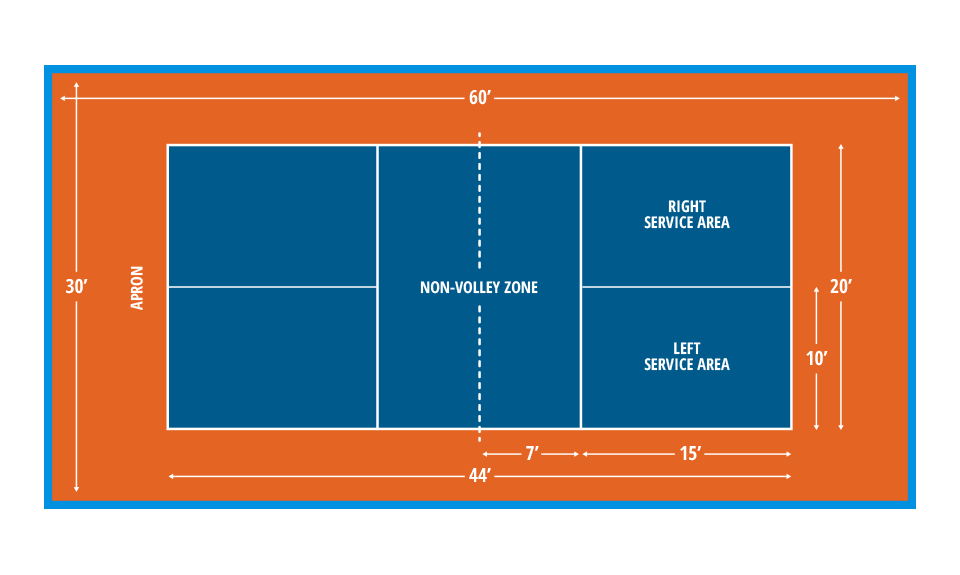
A standard pickleball court is 44 feet long and 20 feet wide for both singles and doubles play.
As someone who has spent countless hours on the court, from my very first clumsy dink to competing in local tournaments, I can tell you that understanding the court's layout is more than just knowing numbers. It's the first step to mastering the game's strategy. So, if you're wondering what is the size of a standard pickleball court, you've come to the right place. We're about to break down every line, zone, and dimension to give you the confidence you need to step onto any court and play your best game.
Breaking Down the Pickleball Court Dimensions
Let's start with the big picture. The playing surface of a standard pickleball court measures 44 feet from baseline to baseline and 20 feet from sideline to sideline. If that sounds familiar, it’s because these are the exact same dimensions as a doubles badminton court, which makes converting one to the other incredibly easy. This compact size is one of the reasons the sport is so accessible and action-packed.
However, the playing area is only part of the story. For safe and comfortable play, you need extra space around the court. The recommended total playing area, including the out-of-bounds space, is at least 30 feet wide and 60 feet long. This gives you enough room to chase down those wide shots without running into a fence or the players on the next court over. I've learned the hard way that a little extra room can be the difference between a great "get" and a scraped knee.
The Key Zones of a Pickleball Court
A pickleball court isn't just an empty rectangle. It's divided into specific zones that dictate the rules of play and shape every point's strategy. Knowing what these lines mean is crucial. Understanding what is the size of a standard pickleball court involves knowing these zones by heart.
The Non-Volley Zone (The Kitchen)
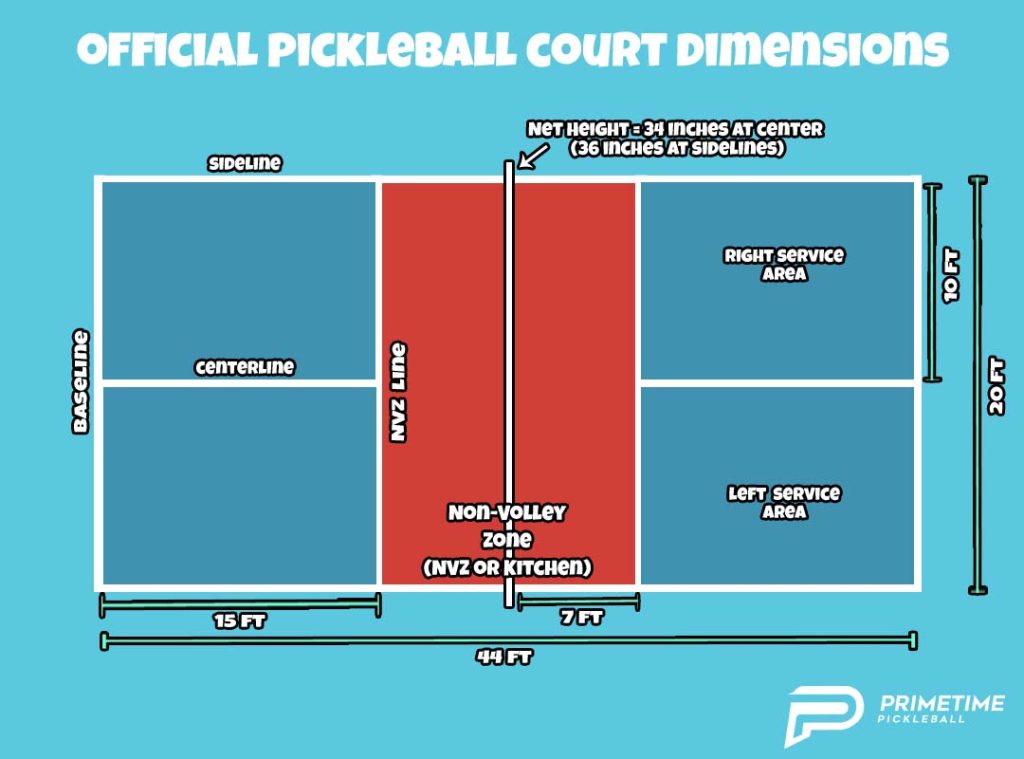
The most famous part of the court is the non-volley zone, affectionately known as "the kitchen." This area extends 7 feet from the net on both sides of the court, spanning the full 20-foot width. You'll see a line marking this zone, called the kitchen line. The rule is simple: you cannot hit a volley (hitting the ball out of the air) while your feet are inside the kitchen.
The kitchen is the great equalizer in pickleball. It prevents players from standing at the net and smashing every shot. It forces a softer, more strategic game of dinks and drop shots. When I first started, staying out of the kitchen felt impossible, but learning to respect its boundary is a key milestone for every player.
The Service Courts
Behind the kitchen, the rest of the court is divided into two halves by a centerline. This creates two service court areas on each side, each measuring 10 feet wide and 15 feet long. When you serve, you must hit the ball underhand and diagonally into the opposite service court. These boxes are your target for starting every point correctly.
The Baseline and Sidelines
The outer boundary lines are the baselines (the back lines) and the sidelines (the side lines). One of the most important rules to remember is that all lines are considered "in." If a ball lands on any part of the baseline, sideline, or kitchen line (except on a serve), it is a good shot. This small detail can decide a close match, so always play the lines.
[Code-Img]
Understanding the Pickleball Net
The net is a critical component that defines the challenge of the game. A standard pickleball net is 36 inches high at the sidelines and droops slightly to 34 inches in the center. This slight sag in the middle is intentional and creates a sweet spot for aiming shots that just barely clear the net.
The net itself should be 22 feet long, extending one foot past the sidelines on either side. This ensures complete coverage of the playing area. The height difference between the posts and the center might seem small, but experienced players use it to their advantage when placing their shots. Knowing the exact dimensions helps you visualize the target area over the net.

Why Pickleball Court Size Matters for Your Game
So, why obsess over these numbers? Because understanding what is the size of a standard pickleball court directly impacts how you play. The smaller court size means less ground to cover, making the game accessible to people of all ages and fitness levels. It also means the action is fast and requires quick reflexes at the net.
The presence of the 7-foot kitchen is a strategic game-changer. It creates a fascinating dynamic of soft dink shots and patient rallies as players wait for an opportunity to attack. Without the kitchen, pickleball would be a simple power game. With it, it becomes a game of chess, requiring finesse, patience, and smart shot placement. Knowing the exact pickleball court dimensions allows you to position yourself correctly and anticipate your opponent's next move.

Frequently Asked Questions of what is the size of a standard pickleball court
How does a pickleball court compare to a tennis court?
A pickleball court is significantly smaller than a tennis court. You can actually fit four standard pickleball courts into the space of one regulation tennis court, making it a very efficient use of space.
Are the lines in or out in pickleball?
In pickleball, all lines are considered in-bounds with one exception. If the serve lands on the non-volley zone (kitchen) line, it is a fault. Otherwise, if a ball touches any part of any other line, it is good.
What is the total recommended space for a pickleball court?
While the playing area is 44 feet by 20 feet, the recommended total area for a single court is 60 feet by 30 feet. This provides a safe buffer zone for players to move around the court during play.
Can you play pickleball on a badminton court?
Yes, you can! The dimensions of a standard pickleball court are identical to a doubles badminton court. You just need to lower the net to the correct pickleball height of 34 inches in the center.
Why is the non-volley zone called the "kitchen"?
The origin of the term "kitchen" is debated, but one popular theory comes from the game of shuffleboard. In shuffleboard, the "10-off" penalty area is called the kitchen, a place you want to avoid, much like the non-volley zone in pickleball.
Conclusion
Mastering the dimensions of a pickleball court is the foundation of becoming a skilled player. Knowing that the court is 44 feet long and 20 feet wide, with a 7-foot kitchen on each side of a 34-inch high net, gives you the blueprint for success. These measurements define the strategy, from the serve to the final dink.
Now that you know what is the size of a standard pickleball court, it’s time to put that knowledge into action. Grab a paddle, find a court, and experience the unique blend of strategy and fun for yourself. Let us know in the comments how understanding the court has changed your game