The short answer
Measure from your palm’s middle crease to the tip of your ring finger. Selkirk, Helios and ARTI all read that number as your grip circumference (Helios says it “corresponds directly”, ARTI “closely”), yet Helios’s and ARTI’s charts give different sizes for the same hand. Between sizes, the sources that address it say go smaller.
Grip size is the distance around the handle, and it is the one paddle number you choose from your own hand. Our pickleball paddle size guide covers the length and width limits, shapes and Selkirk’s height chart. This guide goes further on circumference: how to measure, how three makers turn the number into a size, what paddles actually ship with, and how overgrips move you up.
The ruler test, step by step
Selkirk, Dick’s Sporting Goods, Pickleball Warehouse, ARTI, Third Shot Drop and Helios all describe the same hand measurement. You need a ruler marked in inches.
Hold your playing hand palm up
Selkirk’s words: “Open your dominant hand face up, with your fingers extended.” ARTI adds the fingers “pressed together”.
Find the middle of the three creases
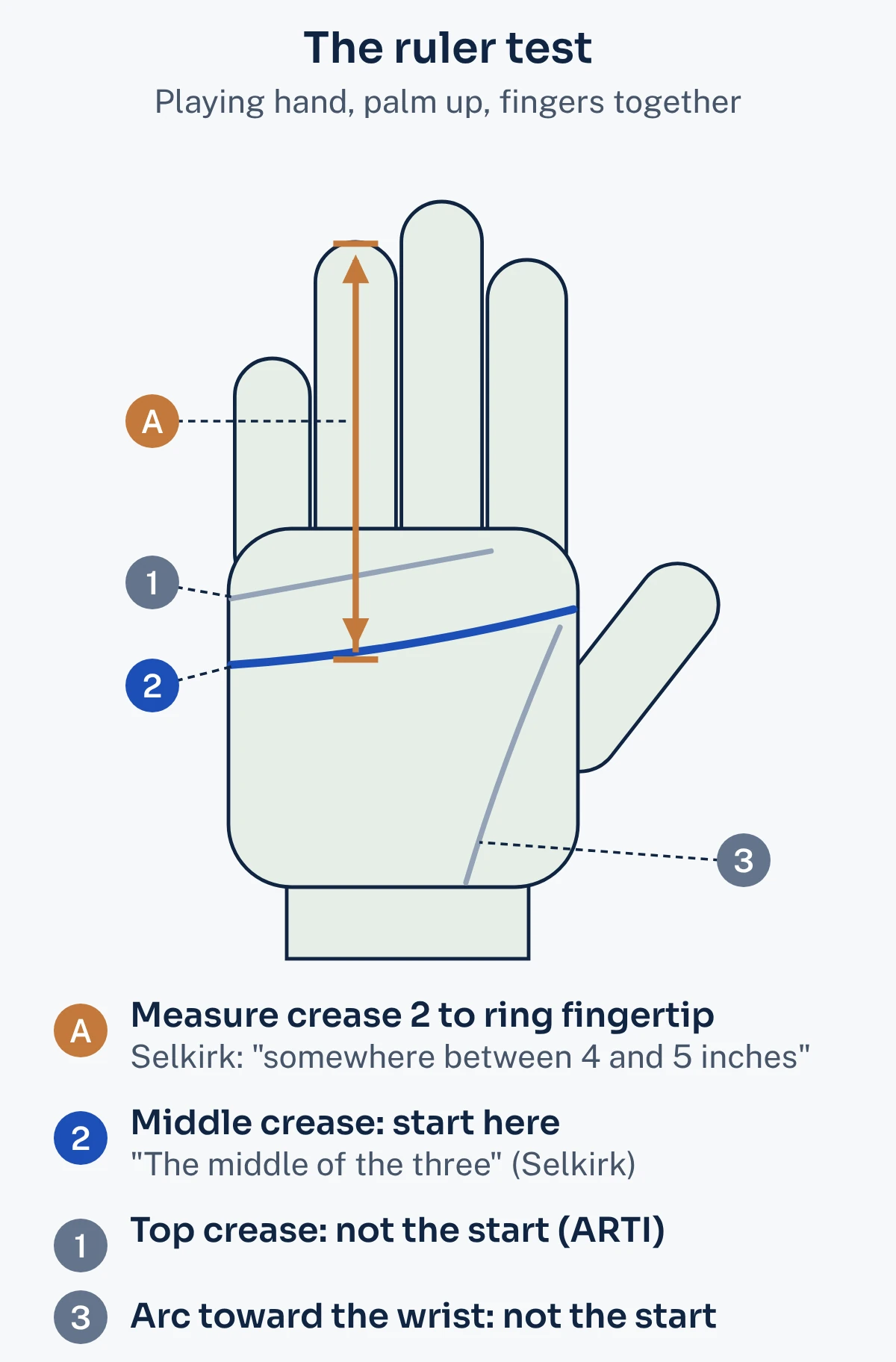
Selkirk says “you’ll notice two lateral creases and a crease that runs in an arc toward your wrist,” and starts from “the bottom lateral crease (the middle of the three)”. ARTI describes it as “the horizontal line that runs across the center of your palm, not the crease just below the base of your fingers.”
Measure from that crease to the tip of your ring finger
Third Shot Drop, a pickleball shop, lines the ruler up “parallel with your third finger (ring finger)”. Selkirk says “This measurement will be somewhere between 4 and 5 inches”.
Turn the number into a grip size with one maker’s chart
The next section shows that the charts do not agree, so note which one you used.
No ruler? Height is the fallback. Selkirk’s height chart is in our paddle size guide, and Selkirk calls it “less accurate than the ruler test.”
Turning your number into a grip size: three charts
All three read your measurement as (about) your grip circumference. Selkirk says it “should be the perfect circumference for your pickleball grip.” Helios says “Your measurement in inches corresponds directly to your recommended grip circumference.” ARTI says “That measurement, in inches, corresponds closely to your grip circumference.” Helios and ARTI, both paddle makers, then publish conversion charts, and those charts give different sizes for the same hand.
| Your measurement | Selkirk | Helios | ARTI |
|---|---|---|---|
| Under 4 in | Grips “start at 4 inches” | 4.0 in | 4 1/8 in |
| 4 to 4 1/4 in | Same as your number | 4.0 to 4.125 in | 4 1/4 in |
| 4 1/4 to 4 1/2 in | Same as your number | 4.25 in | 4 3/8 in |
| 4 1/2 to 4 3/4 in | Same as your number | 4.5 in | No row |
| Over 4 3/4 in | Up to 5 in | No row | No row |
The Helios and ARTI columns are copied from their charts (read October 22, 2026). The Selkirk column is worked out here from Selkirk’s rule above and its range: “Pickleball paddle grips start at 4 inches and go up to 5 inches in circumference.”
Worked from the chart: on every row the two conversion charts share, ARTI’s size is 1/8 inch or more above Helios’s. A 4 1/4 to 4 1/2-inch hand gets 4.25 inches from Helios and 4 3/8 inches from ARTI.
Neither maker treats its chart as final. ARTI calls its result “a starting point, not a verdict,” and Selkirk says “The best way to make sure a grip size is right for you is through actual court time.”
What small, medium and large mean, and what paddles ship with
Size names are not standard. Three sources put numbers on them:
| Source | Small or thin | Medium or standard | Large |
|---|---|---|---|
| Selkirk (its grip options) | Thin Grip, 4 in | Comfort and Contour Grips, 4.25 in | Double Grip, 4.5 in |
| Pickleball Central (retailer) | 4 to 4 1/8 in | 4 1/4 to 4 3/8 in | 4 1/2 in |
| ARTI (paddle maker) | 4 1/8 in | 4 1/4 in | 4 3/8 in |
They agree on 4 1/4 inches as the middle. ARTI adds: “A small number of manufacturers offer a 4 1/2-inch grip, but that size remains uncommon and is generally considered at the outer edge of what is practical for pickleball’s shorter, lighter handles.” They differ at the ends: “large” means 4 3/8 inches to ARTI, but 4 1/2 inches to Pickleball Central, which calls it “the largest grip size pickleball paddles manufactured.” Dick’s, a retailer, describes “thin, standard, and thick grips” running from 3 5/8 to 4.5 inches and up, and Paddletek says “the vast majority” of grips fall between 3.875 and 4.375 inches.
Grip size numbers (size 2, size 3)
Some grips are labelled with a number instead of inches. Third Shot Drop’s grip-size page prints a chart that pairs inches with a 0 to 6 scale:
| Size number | Circumference |
|---|---|
| 0 | 4 in |
| 1 | 4 1/8 in |
| 2 | 4 1/4 in |
| 3 | 4 3/8 in |
| 4 | 4 1/2 in |
| 5 | 4 5/8 in |
| 6 | 4 3/4 in |
Wilson, in its guide to tennis racket grips, uses the same pairs for sizes 0 to 5 and notes that “your endcap might say “3” instead of “4 3/8” but really those are the same grip size”. On both charts size 2 is 4 1/4 inches and size 3 is 4 3/8 inches.
What makers actually fit
Pickleball Central says “Most pickleball paddles are manufactured in a “Medium Grip” size”, which it puts at about 4-1/4 to 4-3/8 inches. PBPRO, a paddle brand, fits one size to all its paddles (“our paddles feature a 4.25-inch grip circumference”) and says “Instead of manufacturing many different grip sizes, many players simply customize the handle feel using overgrips.”
Some makers offer a choice. Selkirk’s grip guide lists four grips: the Comfort Grip is “the standard grip for our AMPED series”, the Contour Grip is “the standard grip for our PRIME series”, and the Thin and Double Grips are fitted on request. Paddletek lists the Tempest Wave II at 4 1/4 inches and the Tempest Wave Pro at 4 3/8 inches, and says “you can also get the Tempest Wave Pro in a thin grip, which is 4 1/8” inches.
The ten paddles in our pickleball paddle roundup show the same spread. Counted from the makers’ figures printed there: four have a 4.25-inch grip, three 4.125 inches and one 4 inches; the Six Zero Coral is listed at “4.0 to 4.13 in”, and Franklin’s listing for the C45 gives two figures. None of the ten is 4.5 inches. Three of them span the small-to-medium range:
| # | Preview | Product | Price | Link |
|---|---|---|---|---|
| 1 |  | Onix Graphite MOD Z5 Carbon Fiber Pickleball Paddle with…4-inch grip | $63.00 Prime | Check on Amazon |
| 2 |  | Vatic Pro Prism Flash Carbon Fiber 16mm – Foam Injected…4 1/8-inch grip | $99.99 | Check on Amazon |
| 3 |  | JOOLA Pro V Pickleball Paddle – 14mm/16mm – Raw Carbon…4 1/4-inch grip | $299.95 Prime | Check on Amazon |
All three are compared, with their full specs, in our pickleball paddle roundup; the Onix Graphite Z5 also appears in our beginner paddle roundup and the Vatic Pro Prism Flash in our budget paddle roundup.
Between two sizes? Take the smaller one
Every source here that addresses it says the same:
- Dick’s: “If you are unsure between two sizes, choose the smaller size.”
- Helios: “If your measurement lands between two sizes, choose the smaller option.”
- Pickleball Warehouse: “If you’re between grip sizes, go with the smaller size and add an overgrip to arrive at the ideal fit.”
- ARTI: “When in doubt between two sizes, the narrower grip paired with a layer of quality overgrip is the more versatile starting point.”
The reason is that the change only goes one way easily. Pickleball Central: “You can always add overgrips to increase grip size, there is very little you can do to decrease it.” Third Shot Drop says “it is more difficult and in some cases not possible to drop the size of a grip.”
How much an overgrip adds
An overgrip is the thin wrap that goes over the paddle’s own grip. The sources give different figures for one layer:
| Source | What one overgrip adds |
|---|---|
| Pickleball Warehouse (retailer) | “A typical overgrip will increase a grip by 1/16 inch.” |
| Helios (for its own overgrip) | “approximately 1/16 inch” |
| ARTI (paddle maker) | “A single layer of standard overgrip typically adds approximately 1/16 of an inch to the circumference.” |
| Third Shot Drop (shop) | “either half or one whole size (1/16 to 1/8 inch)”; “Overgrips will usually add about 1/16 of an inch to a grip” |
| Pickleball NVZ (shop) | “without significantly changing the grip size” |
Third Shot Drop’s range is the only figure here that reaches 1/8 inch.
A thicker base grip adds more. Selkirk’s Double Grip “is essentially a Comfort Grip wrapped over another Comfort Grip”, and it takes the handle from 4.25 to 4.5 inches, so, worked from Selkirk’s figures, that one extra layer adds 1/4 inch. Selkirk also says “You can always ADD an over-grip (or two) to your paddle to increase the circumference”. Our overgrip roundup compares eight overgrips by pack, thickness and feel, and our guide to why players put an overgrip on a pickleball paddle explains what one does.
USA Pickleball’s equipment rules allow grip wraps. USA Pickleball’s Equipment Standards Manual (Revision 3.0, January 2025) sets no grip circumference among its paddle specifications. Rule 2.E.5 says “Altered paddles must meet all specifications,” and rule 2.E.5.a reads in full:
Note
Rule 2.E.5.a, in full: “Player alterations or additions to a commercially produced paddle as certified, may include such items as edge guard tape/replacements, weighted tape, weights for an Original Equipment Manufacturer (OEM) integrated weight system, changes to the grip size via inserts, grip wraps, OEM interchangeable grips, OEM replacement paddle faces, and name decals and/or other identification markings on the paddle face.”
We quote the January 2025 manual as posted on USA Pickleball’s equipment site; the 2026 rulebook did not open for us (its site served a verification page), so its wording was not checked.
Making a grip smaller
Going down is harder, and the sources offer three routes:
- Order the thin option. Selkirk’s 4-inch Thin Grip “is essentially an overgrip wrapped closer together”, and Paddletek sells the Tempest Wave Pro with a thin 4 1/8-inch grip.
- Swap the base grip for something thinner. Helios: “Reducing grip size is difficult and typically requires removing the existing grip tape down to the bare handle.” PBPRO lists, among ways to make its 4.25-inch grip feel smaller: “Replace it with 1 or 2 thinner overgrips”.
- What one owner did. On r/Pickleball, one player reports: “Replacing the Engage OEM grip with Karakal Point-75 Air Overwrap reduced the size of my engage paddles by 1/8 inch (from 4-3/8 to 4-1/4)”. That is a single forum report, not a test.
There is a floor. Paddletek says “There are limits to how small grips can be based on the thickness of the paddle”.
Checking the fit on a paddle in your hand
Pickleball Warehouse, a retailer, gives an in-hand check: “Grip the paddle like you’re going to shake hands with or hold the paddle as though you were going to use the edge of it to chop wood.” Then “check to see how close the tip of the ring finger is with the skin just beneath the thumb. Ideally, you want a slight gap between the tip of the ring finger and where it would touch the area under the thumb. How much of a gap is where the grip size choice becomes subjective.”
You will also meet the index-finger test, which checks whether an index finger fits in the gap between your fingers and your palm. Dick’s, ARTI and Third Shot Drop recommend it. Dick’s: “If your index finger fits snug in the gap, then you will likely have the best pickleball grip size”. ARTI: “If your index finger fits snugly with light resistance, the grip is likely correct.” Third Shot Drop: “The best paddle grip size for you will be the one where your index finger fits snugly within this gap.” Selkirk calls it a misconception: “in Pickleball this rule of thumb is a myth and tends to cause people get a larger grip than what’s most comfortable to them.”
To check a paddle you already own, wrap a soft tape measure around the handle. Third Shot Drop says grip sizes “are often measured at the very middle of the paddle handle”, “including any grip that may be applied”. Recheck it now and then: Selkirk says “Grips can change size over time as they wear away or swell up with moisture”.
Your background and playing style
A few sources tie grip size to the player’s other sports or to what they want from the paddle. Their views, side by side:
| Who | What the source says | Source |
|---|---|---|
| Any player | “a larger grip diameter increases paddle stability, and a smaller grip increases paddle agility” | Pickleball Warehouse |
| Tennis players | “If your background is in tennis, having a slightly larger grip might be most comfortable to you.” | Selkirk |
| Tennis players | “individuals transitioning from tennis may or may not opt for a slightly smaller handle size” | Pickleball Warehouse |
| Table tennis players | “may be feel more comfortable going to a larger grip diameter” | Pickleball Warehouse |
| Table tennis players | “I know some ping pong players like a thinner and shorter grip.” | r/Pickleball owner |
| Baseball players | “I like a thicker grip size since it is closer to a baseball bat.” | r/Pickleball owner (played baseball “for over 18 years”) |
On table tennis players the sources point opposite ways, and the forum lines are single replies, not a survey. Pickleball Warehouse’s closing test is simple: “if you’re not giving any thought to your grip during play, that is a good sign that is a proper size”.
If this is your first paddle, our guide to what to look for in a beginner pickleball paddle covers grip alongside core and weight. Our pickleball paddle weight guide looks at weight on its own.
Ready to buy?
Our pickleball paddle roundup lists the handle length and grip circumference of every pick, so you can match your number before you order.
Frequently Asked Questions
Q. What is the most common pickleball grip size?
Around 4 1/4 inches. Pickleball Central says most paddles are made in its medium size, 4-1/4 to 4-3/8 inches; PBPRO calls 4.25 inches “one of the most common and versatile grip sizes”; and four of the ten paddles in our roundup are 4.25 inches.
Q. What grip size should a woman use?
The sources disagree. Helios says “Most women find grip sizes between 4.0 and 4.125 inches comfortable, though hand size varies regardless of gender,” while PBPRO says “Many female players and players with smaller hands prefer starting with a 4.25-inch grip.” Helios adds: “Always measure your hand rather than relying on general recommendations.”
Q. What grip size is right for a beginner?
Measure first. Selkirk recommends its Contour Grip for beginners because of its ridges (“so you can feel where the grip is in your hand”); it “has the same circumference as the Comfort Grip”, 4.25 inches. Pickleball Central says that “For players uncertain about their grip size preference, the medium grip serves as a safe starting point”.
Q. Is a 4.5-inch grip too big?
It depends on your hand measurement. Pickleball Central says “Men usually are happy with a grip this large as well as women with long fingers,” and Selkirk’s 4.5-inch Double Grip is “Preferred by those with very large hands.”
Q. What is pickleball grip size in centimetres?
Selkirk gives its own metric figures: 4 inches is 10.2 cm, 4.25 inches is 10.8 cm and 4.5 inches is 11.4 cm.
Q. What grip size does a child need?
Onix sells its Z Junior as “A reduced length paddle perfect for young players,” with a 4-inch grip.
Sources (19)
- Selkirk (paddle maker), How do I find my pickleball paddle grip size?
- Selkirk (paddle maker), Selkirk Grip Guide
- Helios (paddle maker), Best Pickleball Paddle Grip Size for Small Hands and Comfort
- ARTI (paddle maker), Pickleball Paddle Grip Size Guide: Finding the Right Circumference
- Paddletek (paddle maker), Paddle buyer’s guide
- PBPRO (paddle brand), How to Choose the Right Pickleball Grip Size
- Onix (paddle maker), Z Junior product page
- Wilson (racket and paddle maker), Four Steps to Determine Your Tennis Racket Grip Size
- USA Pickleball (governing body), Equipment Standards Manual, Revision 3.0, January 2025
- Dick’s Sporting Goods (retailer), Pickleball Paddle Buying Guide
- Pickleball Central (retailer), How to Choose a Pickleball Paddle
- Pickleball Central (retailer), Medium grip paddles
- Pickleball Central (retailer), Large grip paddles
- Pickleball Warehouse (retailer), The Importance of Pickleball Paddle Handle Length, Shape and Size
- Pickleball Warehouse (retailer), How to Choose a Pickleball Paddle
- Third Shot Drop (pickleball shop), How to Find Your Pickleball Paddle Grip Size
- Pickleball NVZ (shop), Best Pickleball Overgrip: When to Replace and What to Use
- r/Pickleball (forum), Reducing the circumference of pickleball paddle handle for a very small hand?
- r/Pickleball (forum), How to find your hand size & optimal grip size?
Product prices and availability are accurate as of the date/time indicated and are subject to change. Any price and availability information displayed on Amazon.com at the time of purchase will apply to the purchase of this product.