The short answer
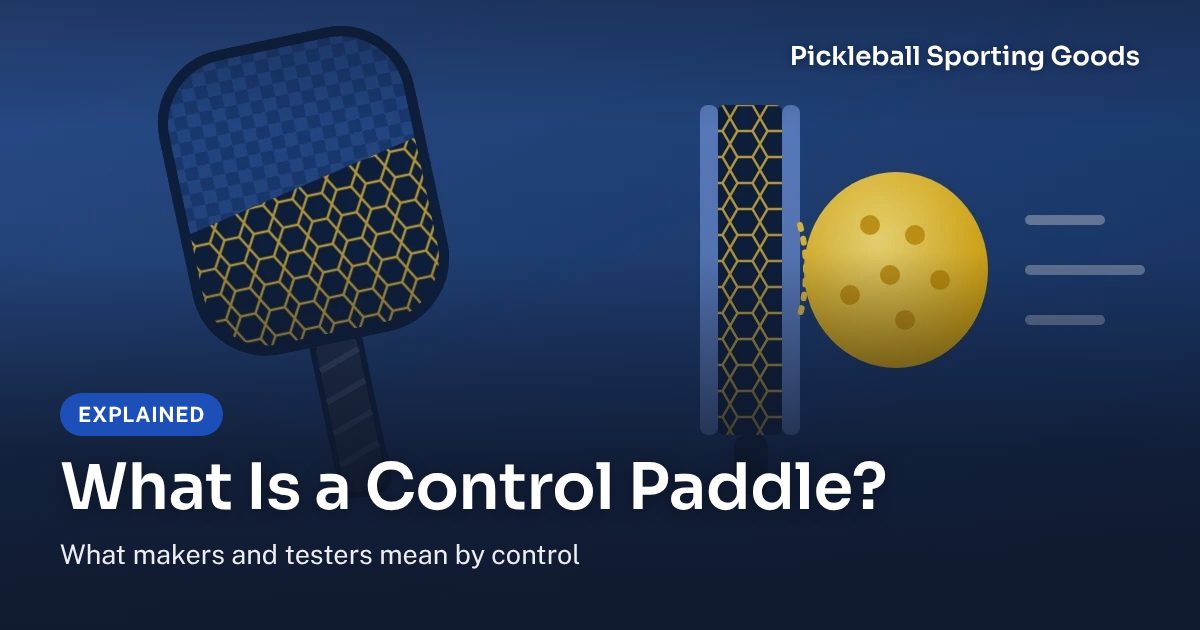
A control paddle is one built to take pace off the ball so it goes where you aim it. Pickleball Effect says the best ones “prioritize touch, consistency, and a predictable response”. Makers and testers link control to thicker cores and wider faces, but no trait is agreed by all: they differ on thickness, shape, weight, face and foam.
“Control” is a word paddle makers print on their products and testers use to sort their lists, and the two do not always mean the same thing. Each definition and design trait below is credited to a named maker, tester, publication or retailer, dated where the page gives a date. Where they disagree, both sides are shown.
Several of these sources earn money when readers buy. Pickleball Effect’s control list says: “Affiliate links. We may earn a commission at no extra cost to you, which never affects testing or placement.” Pickleball Studio earns “a small commission at no extra cost to you if you purchase through our links”. Pickleheads says: “If you buy through links on our site, we may earn an affiliate commission.” The Kitchen says it “may earn a commission from purchases at no extra cost to you”, and both The Kitchen and Pickleball Central sell paddles themselves.
What “control” means to makers, testers and retailers
Pickleball Effect, an independent paddle-testing site, opens its control paddle list (updated August 14, 2026) with this: “The best control pickleball paddles prioritize touch, consistency, and a predictable response, giving you more margin on drops, resets, and dinks.” Its list of who they suit starts with “Players who prioritize touch and placement over raw power” and ends with “Players who need help absorbing pace”.
Selkirk, the paddle maker, describes the category in its performance guide (June 11, 2026): control paddles “support players who prefer using finesse in their game. They typically feature a thicker core, a larger sweet spot, and materials that take pace off the ball.”
Pickleheads, a pickleball publication, puts it in terms of feel in its control list (updated May 18, 2026): “Control paddles are designed specially to give you the best possible feel and accuracy on your shots.” It adds: “They take pace off the ball and make it easier to hit the touch shots that so many beginner players struggle with.”
Pickleball Studio, an independent paddle reviewer, explains why players want one in its control list (April 27, 2026): “Whether you want something that doesn’t have a lot of pop to prevent you from floating your dinks and resets, or something that allows you to swing more freely and still keep the ball in, control paddles can do that really well.”
The Kitchen, a pickleball site that also runs a paddle shop, keeps it shortest in its control list (updated Jun 11, 2026): “To us, control is simple: “Does the ball go where I want it to go?”” The page’s text also reads “Last updated: October 2026”.
Dwell time
Several of these sources name dwell time. The retailer Pickleball Central lists it among the traits of control paddles: ““Touch” paddles are renowned for ball placement, maneuverability, dwell time, and incredible control.” Pickleheads describes what it is in its entry for one foam paddle: “The Gen 4 foam core creates dwell time that holds the ball on the face before it releases”. The Kitchen ties dwell to control even in paddles with some power: “some paddles on this list do offer high-ish power, but that’s also paired with high dwell time and good overall feel, which makes it easy to control the direction, pace and shape of shots”.
The design traits sources tie to control
Selkirk’s guide lists the traits one by one; the other sources agree with some of them and push back on others. This table sums them up; the details and dates follow.
| Trait | What sources tie to control | Who sees it differently |
|---|---|---|
| Core thickness | Thicker, “about 16 mm or more” (Selkirk); 16 mm for “control and feel” (JOOLA) | Pickleheads lists a 14 mm paddle for control; Pickleball Effect found a 14 mm paddle more controlled than expected |
| Shape and handle | Shorter and wider face, shorter handle (Selkirk); “maximum widths” (Pickleball Central) | Control lists include elongated paddles (Selkirk’s own LUXX Invikta; Pickleheads’ Holbrook Fuze) |
| Weight | Lighter, “around 7.3 ounces or less” (Selkirk performance guide); light paddles “increase agility and control” (Paddletek) | Selkirk’s buying guide: “Midweight (7.3–8.4 oz): Balanced power and control”; two testers’ control picks weigh 7.91 and 8.02 oz on their scales; Pickleball Studio says its lightest pick needs added weight |
| Face material | Carbon fiber or graphite (Selkirk, Pickleheads); carbon “softer” (Pickleball Studio) | Fiberglass for control and spin (Pickleball Central, 2023); Central’s control page lists carbon faces for most of its control paddles |
| Core material | Foam for dwell (Paddletek, Pickleheads); larger honeycomb cells (Paddletek) | Foam around polymer paddles’ edges adds power and pop (Pickleball Effect); “overly powerful foam paddles” (The Kitchen); Pickleheads’ top control pick has a honeycomb core |
Core thickness
Selkirk, JOOLA and Pickleheads all tie control to a thicker core. Selkirk’s performance guide says: “Control paddles often feature a thicker core, about 16 mm or more, to better absorb the ball’s energy.” Its 10-factor buying guide (August 1, 2025) puts numbers on both sides: “Thinner cores, around 13 mm, favor power, while thicker cores, around 16 mm, favor control.” JOOLA, another maker, says in its Scorpeus blog that its 16 mm paddle is “Often preferred by players who prioritize control and feel.” Pickleheads, reviewing the first-generation Selkirk LUXX Control Air in January 2024, wrote: “In a world where 16 mm core thickness is the standard for control paddles, this 20 mm paddle really stands out.”
Thickness is not the whole story, though. Pickleheads’ 2026 control list includes the 14 mm Volair Shift and says: “The thinner 14 mm core is what brings more power than a muted 16 mm core might.” Pickleball Effect’s Mach 2 Forza review (December 2023) reported: “Out of the box, the Mach 2 14mm offered more control and less power than I expected.” A forum view matches the makers’: one r/Pickleball commenter wrote in a January 2023 thread: “Things that help a paddle for control are thicker core (16mm is common) and lighter weight.” Our 14 mm vs 16 mm comparison sets the two thicknesses side by side.
Shape, width and handle
Selkirk’s performance guide says “A shorter and wider design creates a larger sweet spot” and “Shorter handles bring the sweet spot closer to a player’s hand and provide better paddle maneuverability.” Its buying guide says control players “often choose lighter, wider paddles for superior touch on dinks and drop shots.” Pickleball Central’s control page agrees on width: “The majority of these paddles have carbon fiber faces, thick cores, maximum widths, or other advanced technology that creates a larger, more consistent sweet spot.”
Control lists still carry long paddles. Selkirk’s own LUXX Control Air comes in the Invikta, which Selkirk’s control collection FAQ calls “the Selkirk elongated shape of pickleball paddle”. Pickleball Effect’s May 2025 review says the current InfiniGrit Invikta “still falls in the control category”. Pickleheads’ control list includes the paddle it names “The Holbrook Fuze 16 mm Elongated”. Wide paddles show up too. Volair sells the Mach 2 Forza as the “Volair Widebody Paddle”, and Pickleball Effect says it “is more control oriented than thermoformed hybrid and elongated shapes”. Our guide to pickleball paddle size explains the shapes and their limits.
Weight and swing weight
Selkirk’s performance guide says: “Lighter paddles, typically around 7.3 ounces or less, offer enhanced maneuverability, which is crucial for players who prioritize precision over power.” Its buying guide sorts weight into classes: “Midweight (7.3–8.4 oz): Balanced power and control” and “Heavyweight (8.5+ oz): Maximum power with less swing effort, but reduced finesse.” Paddletek, another maker, says in its weight guide: “Lightweight paddles (7.3 ounces and lighter) increase agility and control, whereas heavier pickleball paddles (8.3 ounces and up) increase power.”
Two testers give weights for their control picks, as their own measurements. Pickleball Effect weighed its “Best Pure Control” pick, the Vatic Pro Prism Flash 16mm, at 7.91 oz, and Pickleball Studio weighed the Mach 2 Forza 16mm at 8.02 oz. Of the Franklin Aurelius 16mm, Pickleball Studio says: “Of all the paddles in this list, this is by far the lightest control paddle.” Studio recommends added weight for most players, “because without it, the sweet spot is a bit smaller, and the paddle is just too fast in the hand”.
Swing weight (how heavy a paddle feels to swing) is part of the same picture. Pickleball Effect recommends the Prism Flash to players who want “a relatively quick control paddle at a 114 swing weight”. Pickleheads writes: “Speed on a control guide matters more than people think.” Our paddle weight guide covers static weight, swing weight and the weight classes in detail. Our explainer on what swing weight is covers the swing-weight number on its own.
Face material
Selkirk and Pickleheads tie carbon fiber to control, and Pickleball Studio calls it softer. Selkirk: “Materials such as graphite and carbon fiber are preferred for control paddles, as they help in absorbing impact and thus enable more precise shots.” Pickleheads’ paddle cost guide says carbon fiber “generally gives you a more consistent, controllable response, especially on off-center hits.” Pickleball Studio wrote in a 2022 face materials guide: “Carbon fiber is softer, has a better sweet spot and higher spin potential. Fiberglass is usually less forgiving and has more power.” On its 2026 control list, Studio says the 11six24 Jelly Bean “isn’t quite as soft because of the fiberglass layer in the face”.
Pickleball Central’s 2023 fiberglass vs graphite article takes the opposite view: “On the flip side, if control and spin are your forte, fiberglass might be your best bet.” Pickleball Central’s own control page lists carbon faces for most of its control paddles: “The majority of these paddles have carbon fiber faces”. Our carbon fiber paddle roundup compares carbon-face paddles.
Foam or honeycomb core
Some sources tie foam to control. Paddletek, which makes foam paddles, says the three-foam core of its Honeyfoam ESQ works by “increasing dwell time for greater control”. Pickleball Effect calls the 11SIX24 Jelly Bean 2 Vapor “A modern foam control paddle with a soft, dense feel and Tier 1 grit durability that holds its spin far longer than raw carbon.” Its entry for that paddle also says to pass if “You prefer a traditional polymer feel over foam”.
Other sources tie foam to power. Pickleball Effect’s foam vs polymer article (May 2026) says the foam ring added around polymer paddles’ edges “adds flex and energy return to the paddle, increasing power and pop”. The Kitchen describes “a market dominated by stiff and overly powerful foam paddles”. Pickleheads’ top control pick, the Warping Point Neon, is not foam: “It has a Gen 3 honeycomb core”. For honeycomb cores, Paddletek’s materials guide adds: “Larger cells will deliver less power but more control.”
Two paddles from our live roundups show how much control builds vary. The Prism Flash has a 16 mm core of “Optimized C7 Polymers and high-grade performance honeycomb” with “Unibody Foam Inject Walls” and a raw carbon face, per Vatic Pro’s product page (it is compared in our intermediate paddle roundup). The LUXX Control Air InfiniGrit has a 19 mm core in Selkirk’s elongated Invikta shape (it is reviewed in our edgeless paddle guide). Both also appear in our control paddle roundup.
| # | Preview | Product | Price | Link |
|---|---|---|---|---|
| 1 |  | Vatic Pro Prism Flash Carbon Fiber 16mm – Foam Injected…16 mm Core, Soft Raw Carbon | $99.99 | Check on Amazon |
| 2 |  | Selkirk Sport LUXX Control Pickleball Paddle | Invikta…19 mm Core, Elongated Invikta | Check on Amazon |
Control vs power: what the sources say you give up
Selkirk states the trade-off plainly: “While they support more controlled shots, control paddles do require more force to generate powerful putaway shots.”
How much power a control paddle gives up depends on the paddle and on who is scoring it. Pickleball Effect rates its Prism Flash 3 out of 10 for power, on its own scale, and recommends it to players who want “maximum touch with the lowest power and pop in my database”. Pickleheads calls the Holbrook Fuze on its control list “a rare control paddle that can also end points with extreme power.” The Kitchen pushes back on the whole idea: “We think there’s a misconception in the industry that “control” is basically considered “not powerful.””
The gap has also narrowed from the other side. Pickleball Studio writes: “In the last few years, power paddles have fixed many of the issues that made them difficult to use. Particularly in sweet spot and swing weight.” It adds that “Most of the paddles in this list are actually several years old already”.
Who is a control paddle for? Pickleball Studio: “Control paddles are best suited for two types of players. 1. Players who struggle with their soft game and need the paddle to help take away energy. 2. Players who can generate more than enough power themselves.” Pickleball Effect’s list adds “Players who find power paddles too difficult to control” and “Players comfortable generating their own pace”. Between the two styles sits the all-court paddle; Selkirk says all-court paddles feature “intermediate specs from both power and control designs”. For the opposite style, see our power paddle roundup.
Which paddle has the best control? What each list picks
No single answer exists: each tester names its own picks, on its own scales, at its own date. This article does not rank control paddles of its own; here is what each named list chose. Our control paddle roundup compares eight control paddles stocked on Amazon, each with the named tester or maker page that calls it a control paddle.
| Source (type, date) | Paddles it names for control | How it orders them |
|---|---|---|
| Pickleball Effect (tester, Aug 14, 2026) | 11SIX24 Jelly Bean 2 Vapor (“Best Durable Control”), Vatic Pro Prism Flash 16mm (“Best Pure Control”), Chorus Shapeshifter HX (“Best Aggressive Control”) | “They aren’t ranked against each other.” |
| Pickleheads (publication, May 18, 2026) | Warping Point Neon (“best overall”), Holbrook Fuze, 11SIX24 Vapor Power 2, Volair Shift, CRBN TruFoam Barrage, Gherkin Draco | Neon first; the others by label (best power, most durable, best spin, best advanced, best speed) |
| Pickleball Studio (reviewer, Apr 27, 2026) | Volair Mach 2 Forza 16mm, Vatic Pro Prism, 11six24 Jelly Bean, Franklin Aurelius 16mm | Forza first, which it calls “a control paddle staple” |
| The Kitchen (retailer, updated Jun 11, 2026; “Last updated: October 2026” in its text) | RPM Friction Pro, 11SIX24 Jelly Bean 2 Series, Franklin C45 Tempo, Friday Aura, Paddletek Honeyfoam ESQ, JOOLA Kosmos Pro V, 11SIX24 Vapor Jelly Bean | Numbered 1 to 7 |
11SIX24’s Jelly Bean line appears on three of the four lists, in different versions, and the Vatic Pro Prism on two. Lists like these are updated through the year, so check the date on the page before you buy. Selkirk files its own LUXX Control Air and AMPED Control lines in its control collection; that is a maker’s grouping of its own paddles, not a test.
Ready to buy?
Our best control pickleball paddles roundup compares eight control paddles with their sources, specs and approval dates. Our main pickleball paddle roundup compares paddles of every style, including the Prism Flash and the LUXX Control Air. If you want the opposite style, our power paddle roundup compares paddles built for pace.
Frequently Asked Questions
Q. Should I get a power or a control paddle?
The sources answer by what you bring to the court. Pickleball Studio’s second type of control player is one who “can generate more than enough power themselves”, and Selkirk notes that control paddles “require more force to generate powerful putaway shots”. Pickleball Studio also says “many players would be perfectly fine with an all-court paddle”.
Q. Will a control paddle make me a better player?
The sources make no such promise about skill. Pickleheads says only that with a control paddle “You’ll find the ball popping up less”, and Pickleball Studio says an all-court paddle is fine for many players “unless they really struggle to keep their soft game in check”.
Q. Are control paddles good for beginners?
Pickleball Effect counts “Players developing their drops, resets, and dinks” among those control paddles suit, and Pickleheads says they make touch shots easier for beginners (quoted above). Pickleball Studio’s view is narrower (see the previous answer). Our guide on what to look for in a beginner paddle covers the other choices a new player faces.
Q. Can a control paddle also have spin?
Two of the lists say so: Pickleheads labels the Volair Shift on its control list “best spin”, and Pickleball Effect rates the Jelly Bean 2 Vapor 10 out of 10 for spin. Our spin paddle roundup compares paddles chosen for spin.
Q. Does a control paddle have to be 16 mm?
Not on every list. Selkirk ties a thicker core, “about 16 mm or more”, to control, but Pickleheads’ control list includes the 14 mm Volair Shift, and Pickleball Effect said the 14 mm Mach 2 Forza “offered more control and less power than I expected”.
Q. Which control paddles suit intermediate players?
None of the four control lists above is sorted by skill level, and neither is our control paddle roundup. Pickleheads does give skill fits in its entries: of the Volair Shift it says “It’s ideal for 4.0+ players who want a touch paddle that catches and shapes the ball with the best spin.” Our intermediate paddle roundup includes the Prism Flash, the paddle Pickleball Effect labels “Best Pure Control”.
Q. Can one paddle give both power and control?
Two of the lists say so. Pickleheads calls the Holbrook Fuze “a rare control paddle that can also end points with extreme power”, and The Kitchen lists paddles with “high-ish power” for control. Selkirk’s guide says all-court paddles take this middle ground: “they typically do not rank the highest in either category of power or control.”
Sources (22)
- Pickleball Effect (independent tester), Best Control Pickleball Paddles 2026, Hot List
- Pickleball Effect, Volair Mach 2 Forza 16mm and 14mm review
- Pickleball Effect, Selkirk LUXX Control Air update review
- Pickleball Effect, Foam vs Polymer Pickleball Paddles
- Pickleball Studio (independent reviewer), Best Control Paddles
- Pickleball Studio, Breaking Down Pickleball Face Materials and Grit for Spin
- Pickleheads, Best Pickleball Paddles for Control
- Pickleheads, Selkirk LUXX Control Air Invikta review
- Pickleheads, How Much Does a Pickleball Paddle Cost
- The Kitchen (media site and paddle retailer), The best pickleball paddles for control players
- Pickleball Central (retailer), Control Paddles
- Pickleball Central (retailer), Fiberglass vs Graphite Paddles
- Selkirk (maker), Pickleball paddle performance guide
- Selkirk (maker), How to choose your perfect pickleball paddle: 10 key factors
- Selkirk (maker), Control pickleball paddles collection
- Vatic Pro (maker), Prism Flash product page
- JOOLA (maker), Scorpeus: shape matters
- Paddletek (maker), Pickleball paddle weight
- Paddletek (maker), Pickleball paddle materials
- Paddletek (maker), Honeyfoam ESQ
- Volair (maker), Mach 2 Forza
- r/Pickleball (forum), Help me understand “Control” vs “Power” paddles
Product prices and availability are accurate as of the date/time indicated and are subject to change. Any price and availability information displayed on Amazon.com at the time of purchase will apply to the purchase of this product.