The short answer
Swing weight is how heavy a paddle feels when you swing it, not what it weighs on a scale. Testers such as Pickleball Effect and John Kew measure it on a swing weight machine. Makers and testers link a higher number to more power and stability and a lower one to quicker hands. Compare numbers within one source.
Eleven Zero, a paddle maker, sets out the puzzle in its weight guide (March 15, 2026): “Both 8.0 oz. One has a swing weight of 108. The other sits at 122.” Selkirk, another maker, puts the reason in one line: swing weight is “influenced by various factors, including the weight distribution, length, balance, and shape of the paddle.” Below, each definition, measuring method and number is credited to the maker, tester or retailer that published it, with dates where the page gives one. Where they disagree, both sides are shown.
Several of the sources quoted here earn money when readers buy. Pickleball Effect’s paddle pages say: “This page contains affiliate links. We may earn a commission, but our testing and opinions remain neutral.” The site also runs a discount-code page. John Kew says “if you buy through my code I earn a commission that helps support the website, and it never changes a test result or a ranking”. Pickleball Studio’s footer reads “Affiliate Disclosure: We may earn commissions from links on this site.” Its review cards also carry discount codes. Pickleball Science, an engineering blog, says “Some of the embedded links in the PickleballScience.org website are affiliate links.” Pickleball Warehouse and Pickleball Central are retailers that sell paddles.
Swing weight, static weight, twist weight and balance point
Selkirk’s swing weight guide gives the plain version: “In simple terms, swing weight refers to how heavy a paddle feels when you swing it.” The retailer Pickleball Warehouse gives the technical one: swingweight “is the measurement of a paddle’s resistance to swinging about an axis near the end of the handle”. Both use the same picture. Hold a hammer by the handle and it feels heavy to swing; hold it by the head and it moves easily, though its weight has not changed.
Pickleball Effect, an independent tester, prints swing weight beside three other numbers. It says of them: “Static weight tells you very little on its own. These are the numbers that do.”
| Measurement | What it describes | Where it is taken |
|---|---|---|
| Static weight | Selkirk: “This is the paddle’s weight when it’s not in motion, typically measured by placing it on a scale.” | On a scale; no axis |
| Swing weight | Pickleball Effect: “How heavy a paddle is to swing.” | About an axis across the handle, near its end |
| Twist weight | Pickleball Effect: “A paddle’s resistance to twisting on off-center contact.” | About the paddle’s long axis |
| Balance point | Pickleball Effect: “How a paddle’s weight is distributed between the head and the handle.” | A point, measured up from the base of the handle |
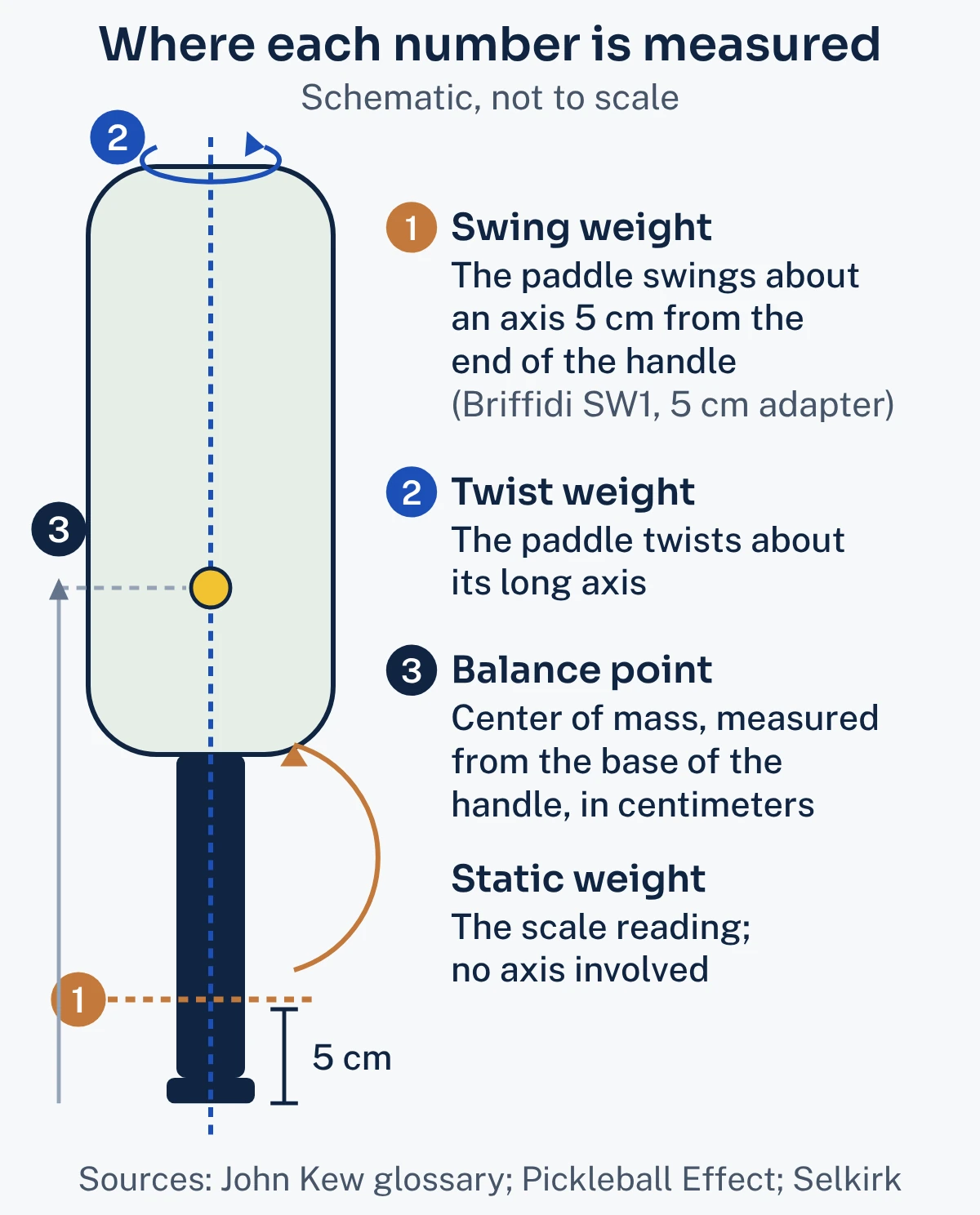
John Kew, an independent tester, defines the other two in the site’s glossary. Twist weight is “a dynamic measurement of a paddle’s rotational inertia using a twisting motion along the paddle’s long axis”. And: “Balance Point – the center of mass of a paddle, as measured from the base of the handle up onto the paddle handle and face, in centimeters.” The glossary adds: “In general, a higher balance point feels head-heavy and less maneuverable, and a lower balance point feels head-light and more maneuverable.”
Selkirk’s static, swing and twist weight article sums up twist weight: “Twist weight gauges rotational stability on off-center hits.” Its twist weight guide links it to shape: “Paddles with wider, more standard shapes typically have better twist weights.” and “In contrast, elongated paddles may exhibit lower twist weights, impacting overall stability and forgiveness.”
The numbers do not always move together. Pickleball Effect’s Perseus Pro IV review (March 4, 2025) found: “The Pro IV has a higher static weight but lower swingweight and balance point than the 3S. This makes the Pro IV more maneuverable and easier to accelerate despite the heavier static weight.” Selkirk explains why: “The further you place the weight away from the butt cap, the higher the swing weight will be.” Our paddle weight guide covers static weight and the weight classes.
How swing weight is measured
Selkirk says: “Swing weight is typically measured using specialized equipment, such as a swing weight machine.” Selkirk says such devices analyze the paddle’s response to swinging, “providing a numerical value in kg*cm^2.” Pickleball Warehouse describes how they work: “Devices that measure paddle swingweight attach at the handle and allow the paddle to swing back and forth several times.”
Each source names its own setup:
- Pickleball Effect uses the Briffidi SW1, “Fitted with the 5 cm Pickleball Adapter.” Its Perseus review notes: “All measurements are done by Pickleball Effect using Briffidi equipment.”
- John Kew uses the same machine, “as measured with a Briffidi SW1 using a 5 cm adapter, which positions the rotational axis 5 cm from the end of the handle (approximately the center of the hand for a standard grip)”.
- Pickleball Warehouse: “Pickleball Warehouse uses the HEAD 4-in-1 diagnostic machine.” It adds: “We measure a sample set of the same model and use the average as the swingweight number posted on our paddle descriptions.”
- Pickleball Studio, an independent reviewer, says of its paddle database: “we measure it on every paddle in our database”. It also says its testing involves “weighing it, calculating swing weight and twist weight”. The pages read for this article do not name its equipment.
Why the same paddle gets different numbers
Pickleball Warehouse names two reasons. The first is where the machine holds the paddle: “How far up or down the handle the device holds the paddle changes the reading, and not all swingweight machines attach to the handle at same spot.” The second is the paddle itself: “Because there are variances within the manufacturing process and materials like graphite, carbon and polypropylene are not completely uniform, no two paddles are going to be equal in all aspects, and that would affect swingweight readings.”
Here is one paddle, the JOOLA Perseus Pro IV, as three sources report it:
| Source (type, date) | Perseus Pro IV 16mm | Perseus Pro IV 14mm | Equipment, as the source states it |
|---|---|---|---|
| Pickleball Effect (tester, Mar 4, 2025) | 118 | 116 | Briffidi equipment |
| Pickleball Studio (reviewer, review Mar 25, 2025; database card read Oct 22, 2026) | 118 in the review text; 116 on the page’s database card | 113 in the review text | Not named; “we measure it on every paddle in our database” and “calculating swing weight and twist weight” |
| Pickleball Warehouse (retailer, undated) | 81.1 | Not tested | HEAD 4-in-1 machine |
Pickleball Effect lists “Swingweight: 118 (moderately high)” for the 16mm. Pickleball Studio’s review lists “Swing Weight: 118 (Perseus 16mm), 113 (Perseus 14mm), 117 (Agassi 16mm)”. Pickleball Warehouse’s Pro IV shape test gives the Perseus 81.1 and says “The 16 mm version of each shape was measured for these findings on a HEAD 4 in 1 machine”. The same Studio page carries a second figure for the 16mm: its database card for the Perseus 16mm shows 116 (read October 22, 2026), against 118 in the review text dated March 25, 2025. For the 14mm, Pickleball Effect has 116 and Pickleball Studio’s review text 113. Pickleball Warehouse’s HEAD reading is far lower, which fits its own note: “In addition, different measuring devices could result in varying numbers.” Pickleball Effect warns about the same thing: “Every tester uses different equipment, environments and methodologies, so the scales don’t line up perfectly.” Our 14 mm vs 16 mm comparison covers the other differences between the two core thicknesses.
Is swing weight a fact about the paddle?
The sources disagree on this. Pickleball Science, written by “a licensed Professional Engineer (PE)” (August 3, 2024), says: “Contrary to popular belief, a paddle’s swing weight is not an intrinsic property of the paddle, nor will the same paddle provide the same swing weight for every player.” Its reason is the pivot point: “Paddle manufacturers and paddle reviewers often do not tell us where they assume the pivot point to be.” And: “Since there do not appear to be industry standards on the location of the pivot point, it may be difficult to make apples-to-apples comparisons of swing weights among different paddle manufacturers or reviewers.” Selkirk also says swing weight “is not a finite measurement like static weight is.”
Pickleball Effect takes the other side for numbers taken on one rig: “A swing weight of 118 is a fact about the paddle, and it holds up against every other paddle we’ve measured.” Even so, it tells readers to compare within its own data: “Every measurement published by Pickleball Effect is built to be read against the other paddles in this database.”
What swing weight changes: power, hand speed and stability
Makers, testers and retailers broadly agree on the direction. They differ on how strongly they say it.
| Source (type) | Higher swing weight | Lower swing weight |
|---|---|---|
| Selkirk (maker) | “adds power and stability but slows hand speed” | “boosts quickness at the net” |
| Pickleball Studio (reviewer) | “more power on drives and serves” | “faster hands at the net” |
| John Kew (tester), calculator page | “more plow-through & power” | “easier maneuverability” |
| Pickleball Warehouse (retailer) | “equates to more power” (summary bullet) | “paddles with lower swingweight numbers should feel easier to maneuver” |
| Inside the Den (publication) | “potentially providing more power and stability” | “more maneuverable and easier to control (i.e., faster hands)”, though they “might sacrifice some power” |
Each cell is quoted from the source’s own sentence: Selkirk’s three-weights article, Pickleball Studio’s paddle database page, John Kew’s calculator page, Pickleball Warehouse’s explainer, and Inside the Den, the US Open Pickleball Championships’ publication (dated September 5, 2023). Inside the Den hedges with “potentially”: “Pickleball paddles with higher swing weights will feel heavier when swung, potentially providing more power and stability in your shots.”
Selkirk’s swing weight guide makes the stability claim and sets a limit on it: “Paddles with higher swing weights offer better stability, allowing for smoother and more controlled shots.” And: “However, excessively heavy swing weights may impede the paddle’s maneuverability, affecting a player’s ability to react quickly during fast-paced gameplay.”
Two sources warn against reading too much into one number. Pickleball Warehouse, in its Pro IV article, writes: “While swingweight and twistweight aren’t complete indicators of power or control – since other elements like core stiffness, surface texture, and sweetspot size also matter – they become especially useful when the rest of the paddle is a constant.” Its explainer’s summary bullet says “A higher swingweight equates to more power.”, but the explainer’s body is more guarded: the higher-swinging paddle “could be more of a challenge to keep up with fast volley exchanges near the kitchen”, and the lighter-swinging one “may require more effort from the player to generate power from the baseline”. The Pro IV article hedges too. Pickleball Effect lists what a swing weight number cannot tell you: “Whether you’ll get it around in a hands battle”. Its answer: “That depends on how the weight is distributed, how the paddle feels at contact, and how it behaves when you’re late.”
For paddles chosen around these trade-offs, our power paddle roundup and control paddle roundup compare picks from each side, and our guide to what makes a control paddle covers swing weight among the other traits.
Is there a good swing weight? Three sets of bands
No single number is right for everyone, and the sources do not even agree where “low” ends. Here are three published scales:
| Band | Eleven Zero (maker, Mar 15, 2026) | John Kew (tester, page undated, read Oct 22, 2026) | Pickleball Central (retailer, page undated, read Oct 22, 2026) |
|---|---|---|---|
| Bottom bands | Low: under 110 | Low: less than 113 | Very Low: 110 and below; Low: 111 to 115 |
| Middle band | Medium: 110 to 120 | Mid: 113 to 120 | Medium: 116 to 120 |
| Top bands | High: 120 and up | High: 121 or more | High: 120 to 124; Very High: 125 and over |
| Method stated | No | Briffidi SW1, 5 cm adapter | No |
The bands come from Eleven Zero’s weight guide, John Kew’s glossary and Pickleball Central’s paddle guide. So a 112 is low for John Kew and Pickleball Central but medium for Eleven Zero, and Pickleball Central’s chart puts 120 in both its Medium and High bands, and so does Eleven Zero’s (“110 to 120” and “120+”).
Two more reference points, each on its own scale:
- Pickleball Effect’s database average was 114.2 when read on October 22, 2026; the figure moves as paddles are added (“The database is updated as new paddles are tested.”). Its shape averages on the same date were 109.2 for widebody paddles and 117.6 for elongated ones. Our elongated paddle roundup compares long-face paddles.
- Pickleball Science gives a range that depends on where the pivot sits: “Swing weights for most pickleball paddles should fall withing the range of 400 – 700 oz-in2 or 70 – 130 kg-cm2 if they are gripped 2” from the bottom of the handle.”
What makers list
Some makers print a swing weight for their own paddles; the method behind it is not stated on the pages below. In its weight guide (March 15, 2026), Eleven Zero lists its EZ Power K-16 “(16mm, swing weight 120)” and calls it “The heaviest swing we make.” Its EZ Speed S14 is listed “(14mm, swing weight 106)”, “The lightest swing in our line”. Six Zero describes its Quartz paddle as having “a low swing weight of 108” (page undated, read October 22, 2026). Not every maker publishes one: JOOLA’s spec comparison page has columns for average weight, core thickness and size, but none for swing weight.
A maker’s figure and a tester’s can differ for the same paddle. For the Selkirk LUXX Control Air Invikta, Selkirk’s own product page lists, in its Invikta spec block, “Average Swingweight (may vary +/- .2 pts):” 113 and “Average Twistweight (may vary +/- 0.3 pts):” 6.0 (page undated, read October 22, 2026). Pickleball Effect measured it higher: “The LUXX’s swing weight of 117 is right around average” (page undated, read October 22, 2026). Both paddles below have published numbers from more than one source, shown above.
| # | Preview | Product | Price | Link |
|---|---|---|---|---|
| 1 |  | JOOLA Ben Johns Perseus Pro IV 16mm Pickleball Paddle…Elongated, 16 mm core | Check on Amazon | |
| 2 |  | Selkirk Sport LUXX Control Pickleball Paddle | Invikta…Elongated, 19 mm core | Check on Amazon |
The Perseus Pro IV is compared in our elongated paddle roundup and the LUXX Control Air Invikta in our carbon fiber paddle roundup; both are also in our main paddle roundup.
How to find a paddle’s swing weight
Look it up in one tester’s database
Pickleball Effect, John Kew and Pickleball Studio each publish a sortable paddle database with swing weight. Compare paddles within one database, for the scale reasons above.
Check the maker’s spec sheet
Where a maker lists swing weight, it is the maker’s figure; as the LUXX example above shows, a tester’s number for the same paddle can differ.
Estimate it from three measurements
John Kew’s swing weight calculator says: “Use this tool to estimate pickleball paddle swing weight from static weight, balance point, and length using John Kew’s regression formula.” For the balance point it explains: “Balance point is the distance from the butt cap to the point where the paddle balances on a narrow edge or rod.” It gives the result in “kg·cm²” and claims “the formula estimates swing weight with 97% accuracy, which is typically within 1 swing weight point; rarely up to 2 points.” It adds: “It’s best used for comparisons and experimentation, not as an official manufacturer spec.” Pickleball Science’s article (linked above) sets out a second estimating method from the paddle’s weight, balance point and grip position.
Adding weight to a paddle changes its swing weight, which this article does not cover; our lead tape roundup compares the tapes sold for it.
Good to know
USA Pickleball’s Equipment Standards Manual (Revision 3, January 2025) sets no swing weight limit; the term does not appear in it. Its weight rule, 2.E.4, reads in full: “Weight. There is no restriction on paddle weight.” The 2026 Official Rulebook has the same rule, 3.D.3: “Weight. There is no restriction on paddle weight.” Neither uses the term swing weight.
Ready to buy?
Our best pickleball paddles roundup lists maker and tester swing weights for its picks where they are published. Our elongated, power and control roundups compare paddles for each style.
Frequently Asked Questions
Q. Is a higher swing weight better?
Not by itself. The sources tie a higher number to more power and stability and a lower one to quicker hands, so the trade-off depends on how you play. Pickleball Effect adds that the number alone cannot tell you how a paddle handles fast exchanges.
Q. Does a heavier paddle always have a higher swing weight?
No. Pickleball Effect found the Perseus Pro IV heavier on the scale than the 3S but lower in swing weight, because of where the weight sits.
Q. Is swing weight the same as twist weight?
No. Swing weight is measured about an axis across the handle; twist weight is measured about the paddle’s long axis and describes how much the face turns on off-center hits.
Q. Do elongated paddles have higher swing weights?
On average in Pickleball Effect’s database, yes: its elongated average (117.6) sat above its widebody average (109.2) on October 22, 2026. Selkirk and Pickleball Warehouse both name length among the things that set swing weight.
Q. Can I compare swing weights from different websites?
Only with care. The same 16mm Perseus Pro IV reads 118 at Pickleball Effect, 116 or 118 on Pickleball Studio’s page, and 81.1 on Pickleball Warehouse’s HEAD machine.
Q. What units is swing weight measured in?
Selkirk and John Kew’s calculator give it in kg·cm². Pickleball Science also works in oz-in², a different unit, so check which one a page uses.
Sources (26)
- Selkirk (maker), Understanding swing weight: The key to choosing the right pickleball paddle
- Selkirk (maker), Understanding the difference between static, swing, and twist weight in pickleball
- Selkirk (maker), Understanding twist weight: The key to paddle stability
- Pickleball Effect (independent tester), How We Test Pickleball Paddles
- Pickleball Effect, JOOLA Perseus Pro IV review
- Pickleball Effect, Selkirk LUXX Control Air Invikta InfiniGrit
- Pickleball Effect, Paddle database
- Pickleball Effect, Six Zero Coral Pro Widebody
- Pickleball Effect, CRBN TruFoam Genesis 1
- John Kew Pickleball (independent tester), Glossary
- John Kew Pickleball, Swing Weight Calculator
- John Kew Pickleball, About
- Pickleball Studio (independent reviewer), Paddle database
- Pickleball Studio, JOOLA Perseus & Agassi Pro IV Review
- Pickleball Warehouse (retailer), Pickleball Paddle Swingweight Explained
- Pickleball Warehouse (retailer), Testing JOOLA Pro IV Paddle Shapes
- Pickleball Central (retailer), Paddle buying guide
- Pickleball Science (engineering blog), What do the Swing Weight Numbers Mean?
- Pickleball Science, About
- Inside the Den (US Open Pickleball Championships), What Is Swing Weight & Twist Weight on Your Pickleball Paddle
- Eleven Zero (maker), Pickleball Paddle Weights: How Heavy to Go and Where to Add Them
- Selkirk (maker), LUXX Control Air with InfiniGrit (product page)
- Six Zero (maker), Quartz
- JOOLA (maker), Pickleball Paddle Specifications
- USA Pickleball, Equipment Standards Manual (Revision 3, January 2025)
- USA Pickleball, 2026 Official Rulebook
Product prices and availability are accurate as of the date/time indicated and are subject to change. Any price and availability information displayed on Amazon.com at the time of purchase will apply to the purchase of this product.