The short answer
Weigh the paddle, cut lead or tungsten tape to the grams you want and stick it to the edge, in matching pairs unless it goes at the top. Then play and adjust. Makers and testers link the top to power and swing weight, the sides to stability, and the throat to stability with little added swing weight.
Selkirk sums up why players do it: “some players benefit from additional weight — or weight moved to different parts of a paddle — to help dictate their stability, power, and hand speed.” Pickleball Studio’s lead tape guide lists the payoffs as added power, enhanced control, improved stability and a larger sweet spot.
Related guide: How to Increase the Sweet Spot on a Pickleball Paddle
What you need
- Weighted tape: a lead or tungsten roll you cut to length, or pre-cut strips. Six Zero’s lead tape is “1 gram per inch” on a 60 inch, ½ inch wide roll; CRBN sells “12 pre-cut adhesive weight strips, each 5 x 1 cm and 3 grams”; Selkirk’s tungsten tape comes in “pre-cut 0.1 oz strips”.
- A kitchen scale, to weigh the paddle first (Pickleland, The Dink).
- A ruler for a roll, since Pickleball Studio and Pickleland both measure before cutting.
- Scissors. Pickleland rounds the strip corners with them. Pickleball Effect says of its tungsten roll: “You can even just tear it with your fingers.”
- Rubbing alcohol to clean the edge guard, and a pencil or painter’s tape to mark matching spots (Pickleland).
- Cover tape. Pickleball Studio names “electrical, gaffer, or Prolite Edge Tape (my favorite)”, plus a credit card to press it down.
Three tapes from our lead tape roundup show three formats, with each maker’s figures compared there: pre-cut 3 g lead strips, a 0.5 g per inch tungsten roll and a quarter-inch lead roll.
| # | Preview | Product | Price | Link |
|---|---|---|---|---|
| 1 |  | CRBN Pickleball, Extra Strength Lead Tape 3g Lead Tape for…Coated 3 g lead strips | Check on Amazon | |
| 2 |  | Tungsten Weighted Tape – 1/2 Gram Per InchTungsten roll, 0.5 g/in | Check on Amazon | |
| 3 |  | Pickleball Paddle Lead Tape – add Power to Pickleball…Quarter-inch lead roll | $9.99 | Check on Amazon |
Where the weight goes, and what each spot changes
GAMMA, RPM, The Dink, Pickleland and John Kew use clock positions. RPM calls the top corners 10 and 2. Wilson’s tape page leaves the choice open: “Apply anywhere from the paddle’s top edge to the handle edge, at the sides or on the corners depending on the alteration you’re after.”
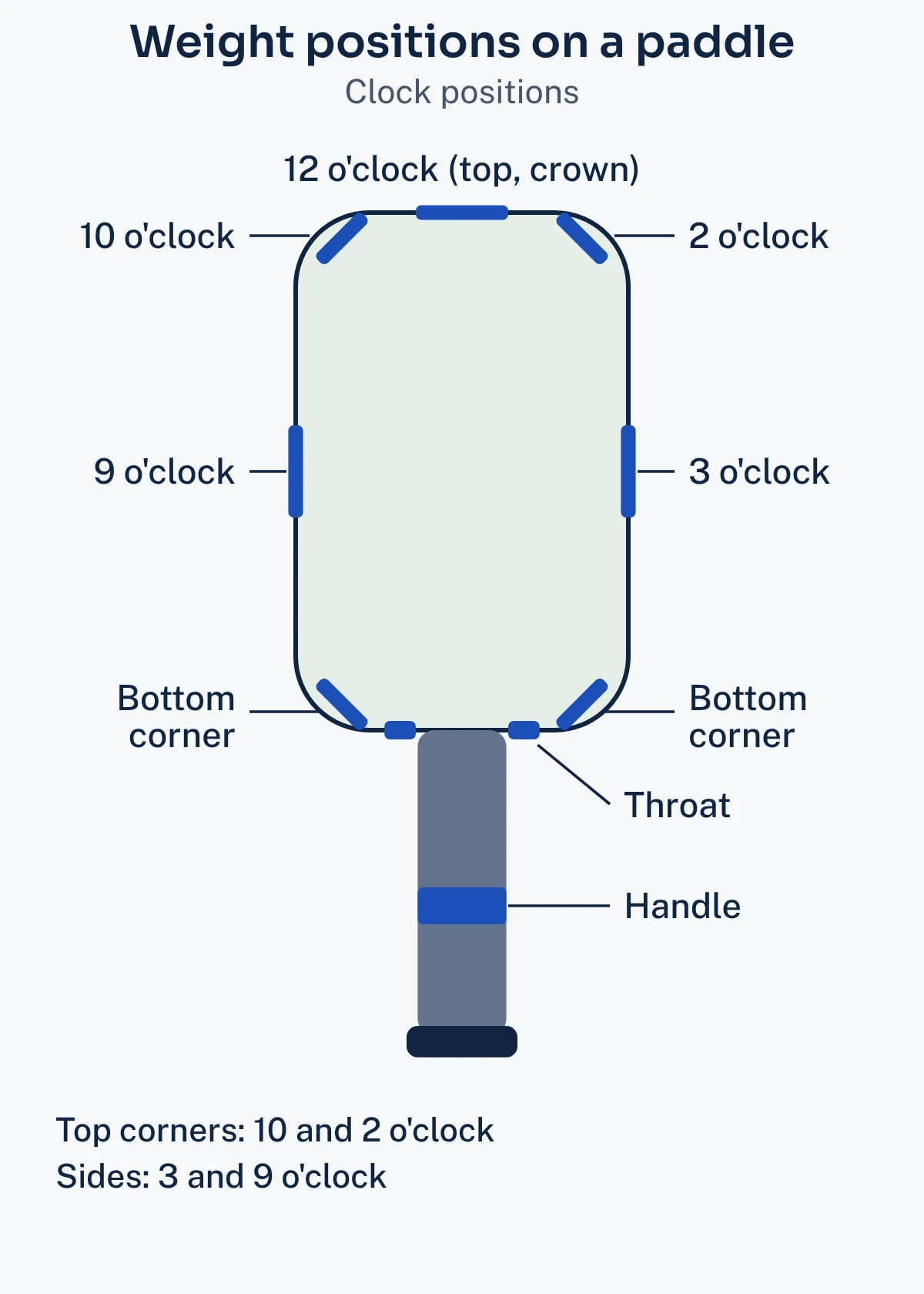
| Position | Makers say | Testers and guides say |
|---|---|---|
| 12 o’clock (top, crown) | GAMMA: “Increases power and swing weight”. Six Zero: “maximize plow through and increase swing weight”. | Pickleball Studio: “Adding weight to the head increases power while making it harder to swing.” The Dink: adds power, with “decreased hand speed”. |
| Top corners (10 and 2) | Six Zero: “increase power and raise the sweet spot”. RPM’s blog: “it drastically increases the paddle’s twist weight”, at “a significant price tag” in swing weight. RPM’s lead tape customization page: “Moderate increase in both swing weight and twist weight.” | Pickleball Studio: “increases power noticeably while being ideal for low swing weight paddles”. |
| Sides (3 and 9) | GAMMA: “Improves stability and expands the sweet spot”. Selkirk: it “increases twist weight, which essentially makes the sweet spot feel much larger and more forgiving.” | Pickleball Studio: “increases some power while adding stability”. The Dink: “This zone is best for stability.” |
| Bottom corners, low on the head | Six Zero: “enhance stability and slightly lower the sweet spot”. Selkirk, on the bottom: it “keeps the balance point low.” | The Dink, low on the head near the throat: “increased stability and an expanded sweet spot”. John Kew: “3g of tungsten tape at 8 and 4 o’clock to boost twist weight” on two Ronbus models (May 30, 2025). |
| Throat | Six Zero: “increased stability with minimal swing weight change”. RPM: it “boosts your twist weight (stability) without sending your swing weight through the roof.” | Pickleball Studio: “It won’t increase the swing weight much”. John Kew, on the Holbrook Arma (June 6, 2025): 3–6 g “at the throat and low on the face” improves “plow-through and sweet spot size”. |
| Handle | GAMMA: “Enhances control and shifts balance for better feel”. Pickleball Effect: “More stability and control”. | Pickleland: “Moves balance toward your hand, so the head feels lighter”. Pickleball Studio: “more often than not, this doesn’t enhance as intended”. |
Pickleland is a pickleball club that sells tape, and Pickleball Effect sells its own tungsten tape. For what swing weight and twist weight mean, see our swing weight explainer.
Where the sources disagree
- The first spot to try. Selkirk calls the bottom “a great starting point for most players”. Pickleball Studio: “It’s best to start at the bottom corners or up the sides.” RPM: “For most players, the throat is the safest bet”. Pickleland: “If you only try one setup, make it a strip on each side at 3 and 9 o’clock.”
- The handle. GAMMA and Pickleball Effect list control as a handle effect; Pickleball Studio writes: “You could add some to the handle itself, but more often than not, this doesn’t enhance as intended.”
- The top corners. RPM’s two pages differ. Its blog post, The Art of Weighted Tape: “Players love this spot for a reason: it drastically increases the paddle’s twist weight.” Its lead tape customization page, under “2 o’clock and 10 o’clock — Upper Corners”: “Compromise position. Moderate increase in both swing weight and twist weight. More swing weight than 3/9; more twist weight than 12 o’clock.” Pickleland’s chart, which it says is “summarized from RPM Pickleball’s lead tape guide and The Dink’s customization guide”, follows the customization page.
- The top alone. GAMMA, Six Zero and Pickleball Studio name power and swing weight gains. RPM says it “doesn’t do much for stability” and writes that “this setup is rarely recommended unless you are a singles specialist looking for pure power”.
On shape, The Dink writes: “Elongated paddles already carry more weight up top, so go easy in Zone 1 if that’s your shape.” Selkirk: “For edgeless paddles, wrapping tape around the perimeter can boost stability.”
How much weight to add
The sources split on whether to start light or heavy:
- Start small. The Dink: “Less than you think. A few grams changes how a paddle feels in your hand, so start small and build.” Pickleland: “Start with 2–3 grams. Play a full session before you add more.”
- Start heavy and back off. Pickleball Studio: “I recommend adding as much as you can handle before it’s too heavy.” And: “So if you don’t know your threshold, then start with a higher weight and tone it down until it feels right.” Its own ceiling: “My number is 8.7oz total on most paddles.”
Pickleball Studio’s worked example (December 1, 2024): “Personally, if a paddle is around 8oz and has a swing weight below 115, I default between adding 0.4 – 0.6oz of tape.” For about 17 g of 2 g per inch tape it cuts 8.5 inches, split into two 4.25 inch strips, one per side. Pre-cut strips skip the arithmetic.
What testers measured. Pickleball Effect (Braydon Unsicker, April 20, 2025) measured the setups Franklin’s pros use on the Franklin C45, built with its own tungsten tape. It lists the stock paddle at “Swingweight: 107 (very light)”.
| Setup (player) | Tape placement | Static weight | Twist weight |
|---|---|---|---|
| Stock (Jorja Johnson) | None | 7.7 oz | 5.65 |
| JW Johnson, Will Howells | 1 to 2 g on each corner | 8 oz | 6.34 |
| Parris Todd | 0.5 g per inch around the whole head and handle | 8.3 oz | 6.59 in its text, 6.7 in its table |
| Hayden Patriquin | Each corner, up to 8.9 oz | 8.9 oz | 7.95 |
For the Parris Todd setup it reports “a big bump in swing weight to 117 and a good twist weight bump to 6.59”; of the heaviest, “this setup isn’t practical for many players; it’s just too heavy.”
John Kew (newsletter, July 5, 2026) tested a Pickle Poppers Pop N Treasure “at 8.0 oz static, 120.7 swing weight, and 6.2 twist weight”: “Adding 3 gram pods at 9 and 3 brought the twist weight to just under 7.” For scale, Pickleball Studio says “most people notice a significant difference when the swing weight changes by 10 points.”
How to add weight, step by step
Read your paddle’s warranty
Makers differ: CRBN allows edge guard weights, Six Zero excludes damage from “clamp-on weight accessories or third-party weighting systems” and “Any modifications made to the paddle after purchasing” (wording in the warranty table below). If your maker’s page is silent, ask before you tape.
Weigh the paddle
Pickleland: “Weigh the paddle first if you have a kitchen scale, so you know your baseline.” Our paddle weight guide explains listed and measured weights.
Pick the spot and the amount
from the table and the amount section above.
Measure and cut the tape, or take pre-cut strips
Check the width: “Any 13mm or thinner edgeless paddles will not work with the wider option,” Pickleball Studio writes of half-inch tape. Pickleland: “Round the corners of the strip with scissors so they don’t catch and peel.” GAMMA’s lead tape page carries this warning: “⚠️ WARNING: This product can expose you to chemicals including lead, which is known to the State of California to cause cancer, birth defects or other reproductive harm. For more information, go to www.P65Warnings.ca.gov”
Clean the edge
Pickleland: “Clean the edge guard with a little rubbing alcohol and let it dry.”
Mark matching positions
Pickleland: “Mark the position with a pencil or a small piece of painter’s tape, so both sides match.” Pickleball Studio: “If you plan to add tape anywhere other than directly at the top, then you’ll need to use two strips.”
Stick the tape on in matching pairs, at the edge
The Dink: “Then add tape in matching pairs on both sides of the paddle so you don’t throw off the balance, and play a session before adding more.” Pickleland: “Apply under light tension, pressing it flat along the edge guard.” Stay within rule 3.D.7 (full text below): tape on the face may go no more than “0.5 inch (1.27 cm) inside the edge guard” where one is in place. Tapes made to wrap over the edge are compared in our edge guard tape roundup.
Cover it
Pickleball Studio: “If you’re using actual lead tape, then you’ll want to cover it after installing.” The Dink: “We also recommend adding electric tape over the lead tape to ensure everything holds together.” Pickleball Studio starts the electrical tape at the throat, presses it down as it goes, and uses 3/4 inch tape on 16 mm or thicker paddles and 1/2 inch on thinner or edgeless ones.
Play, then adjust and re-measure
Pickleland: “Play a full session before you judge it, then adjust.” John Kew’s swing weight calculator page: “Re-measure your paddle after adding lead tape or changing grip setups, then plug the new values into the calculator to see how swing weight shifts.” Pickleball Effect says of its tungsten strips: “You can peel them off if needed, but repeated removal may weaken the adhesive over time.”
What USA Pickleball’s 2026 rulebook allows
These are paddle specifications from section 3.D of the 2026 USA Pickleball Official Rulebook, read on October 22, 2026, not rules of play.
- 3.D.3: “Weight. There is no restriction on paddle weight.”
- 3.D.6: “Allowable Alterations. Altered paddles must meet all specifications. The only allowable alterations or additions by a player to a commercially produced paddle as certified are:” The list includes:
- 3.D.6.a: “Addition or replacement of edge guard tape (see Rule 3.D.7).”
- 3.D.6.b: “Addition of weighted tape (see Rule 3.D.7).”
- 3.D.6.c: “Addition or removal of weights for an Original Equipment Manufacturer (OEM) integrated weight system.”
- 3.D.7: “Decals and Tape. Decals and tape on the paddle face must not extend more than 1.0 inch (2.54 cm) above the top of the grip nor more than 0.5 inch (1.27 cm) inside the outer edge of the paddle or, if an edge guard is in place, 0.5 inch (1.27 cm) inside the edge guard.”
What paddle warranties say about added weight
From each maker’s warranty page, read on October 22, 2026:
| Maker | Warranty wording |
|---|---|
| Six Zero | Not covered: “Any damage to the edge guard or paddle structure resulting from the use of clamp-on weight accessories or third-party weighting systems.” |
| Six Zero | Also not covered: “Any modifications made to the paddle after purchasing.” |
| CRBN | “Adding edge guard weights, overgrips, and edge guard tape is completely fine and won’t affect your warranty. However, any modifications to the paddle’s structure or face will void the warranty.” |
| Selkirk | “Normal wear and tear, damage caused by abuse, negligence/user modification, chips to the top or sides of edgeless paddles, and the natural breakdown or fading of graphics or textures over extended use are not covered.” |
| JOOLA | Among exclusions: “Modified or repaired by anyone not authorized by JOOLA.” |
Six Zero’s first item goes on: “This includes, but is not limited to, edge guard separation, loosening, cracking, or structural compromise related to added weight or pressure at the paddle edge.” Selkirk’s and JOOLA’s pages name modification without mentioning tape, so ask them before you add weight.
Mistakes and troubleshooting
- Uneven sides. Pickleland: “Keep both sides equal.”
- The paddle feels sluggish. Selkirk: “If your paddle feels sluggish, you might have too much weight at the top.” Its fix: “Try moving it toward the middle to keep the mass while regaining your speed.” On the C45, Pickleball Effect “took four inches of tape off the top to reduce the swingweight”.
- Expecting tape to reshape the power curve down the face. John Kew added 5 g per side to a Paddletek TKO-CX 12.7 and re-measured the power curve down the face: “The finding: lead tape improves your lateral sweet spot, it does not reshape the centerline power curve.”
- Residue when you move tape. Pickleball Effect: “After the tape has been firmly applied to the paddle there can be residue left behind on the paddle due to the strength of the adhesive, but it does easily rub off.”
- Tape too wide or too far onto the face. See step 4 and rule 3.D.7.
- A paddle with its own weight system, or a warranty that says nothing. Ask the paddle’s maker before you add tape.
Ready to buy?
Compare lead and tungsten tapes in our lead tape roundup. To change paddles instead, start with our best pickleball paddles roundup, or see our power paddle and control paddle picks.
Frequently Asked Questions
Q. Where should I put lead tape on my pickleball paddle?
The sources name different first spots: Selkirk the bottom, Pickleball Studio the bottom corners or sides, RPM the throat and Pickleland 3 and 9 o’clock. The position table shows what each says each spot changes.
Q. How much lead tape should I put on a pickleball paddle?
Pickleland starts with 2 to 3 grams and The Dink with a few grams; Pickleball Studio starts heavier and tones it down. Franklin’s pros, as measured by Pickleball Effect, range from 1 to 2 g per corner to an 8.9 oz paddle.
Q. How much swing weight does lead tape add?
No source gives one figure; it depends on where and how much. In Pickleball Effect’s test, 0.5 g per inch tape around the head and handle took a Franklin C45 from 107 to 117.
Q. Does lead tape make the sweet spot bigger?
GAMMA, Selkirk and The Dink say weight on the sides expands the sweet spot or makes it feel larger. John Kew’s July 2026 test found tape widens it side to side, but “it does not reshape the centerline power curve”.
Q. Do pro players add weight to their paddles?
Some do. Pickleball Effect reports that Franklin shared its pros’ C45 setups, which it rebuilt with its own tungsten tape: JW Johnson and Will Howells add 1 to 2 g per corner, Parris Todd wraps the head and handle in 0.5 g per inch tape, Hayden Patriquin weights the corners to 8.9 oz, and Jorja Johnson plays it stock.
Q. What is a good weight for a pickleball paddle?
There is no single answer. The Dink: “Most paddles weigh between 7-8.2oz off the shelf. These days, players are adding tape and playing at a final weight of 8.5-9oz.” Our paddle weight guide compares makers’ weight classes.
Q. Lead or tungsten tape?
USA Pickleball’s rule 3.D.6.b says “weighted tape” and names no metal. Pickleball Effect and Selkirk sell tungsten tape as an alternative to lead; our lead tape roundup compares both.
Sources (23)
- USA Pickleball, 2026 Official Rulebook (PDF)
- Pickleball Studio, The Ultimate Guide to Using Lead Tape (Chris Olson, December 1, 2024)
- Pickleball Effect, Franklin C45 Review and Weight Set Up Analysis (Braydon Unsicker, April 20, 2025)
- John Kew Pickleball, 4,000 RPM Pickleball + Lead Tape Data (July 5, 2026)
- John Kew Pickleball, Ronbus Ripple V2 review (May 30, 2025)
- John Kew Pickleball, Holbrook Arma review (June 6, 2025)
- John Kew Pickleball, Swing Weight Calculator
- The Dink, Where Should You Add Lead Tape to Your Pickleball Paddle?
- Pickleland (pickleball club and tape seller), Pickleball Lead Tape guide (October 9, 2026)
- Selkirk, How to add weight to your pickleball paddle for maximum performance (June 2, 2026)
- Selkirk, Why tungsten tape is a game-changer for weighting pickleball paddles
- RPM Pickleball, The Art of Weighted Tape (February 12, 2026)
- RPM Pickleball, Lead Tape & Paddle Customization (RPM Lab)
- Six Zero, Weighted Lead Tape
- GAMMA, Lead Tape 0.25 x 72
- Wilson, Pickleball Paddle Lead Tape
- CRBN, Lead Tape Strips
- Pickleball Effect, Tungsten Tape Strips
- Pickleball Effect, Tungsten Weighted Tape
- Six Zero, Warranty and Return Policy
- CRBN, Warranty
- Selkirk, Selkirk paddle warranty
- JOOLA, Warranty
Product prices and availability are accurate as of the date/time indicated and are subject to change. Any price and availability information displayed on Amazon.com at the time of purchase will apply to the purchase of this product.