The short answer
Add a matched pair of lead or tungsten tape strips to the paddle’s sides, at 3 and 9 o’clock. GAMMA and RPM Pickleball say weight there expands the sweet spot, and Selkirk says it makes it feel much larger. RPM adds that tape cannot move the sweet spot dramatically: a much bigger change needs a different paddle.
Testers mean something specific by a bigger sweet spot. Pickleball Effect, a tester that also sells tungsten and edge tape, ties it to twist weight, the paddle’s resistance to twisting on off-center hits: “A higher twistweight indicates a bigger sweet spot. Twistweight numbers range from 5 – 8.” Pickleland, a pickleball club in Texas that sells tape, puts it this way: “Higher twistweight means fewer mishits that squirt sideways. That’s what “a bigger sweet spot” really means.” Our explainer on swing weight and twist weight covers how those numbers are measured.
This guide covers the equipment side only: where tape goes, which paddle features come with a bigger sweet spot, and what tape cannot change. For cutting, covering and the full rule text, see our guide on how to add weight to a pickleball paddle.
What you need
- Your paddle’s twist weight, from the maker’s spec sheet or a tester’s database. Pickleball Effect says of its paddle database (undated, read Oct 26, 2026): “Every paddle we’ve tested, measured on our own units with the same equipment every time.”
- A kitchen scale. The Dink’s lead tape page (dated May 8, 2023, updated since; read Oct 26, 2026) starts there: “Weigh your paddle first if you have a kitchen scale.”
- Weighted tape, in pre-cut strips or a roll. RPM Pickleball (undated, read Oct 26, 2026) says tungsten gives the “same weight in a narrower strip. Same physics apply.”
- Rubbing alcohol and a pencil or painter’s tape, which Pickleland uses to clean the edge guard and mark matching spots on both sides.
- Cover tape for lead tape. The Dink writes: “We also recommend adding electric tape over the lead tape to ensure everything holds together.”
Three tapes from our lead tape roundup suit a matched pair on the sides: two packs of pre-cut 3 g lead strips, from CRBN and Wilson, and a 0.5 g per inch tungsten roll from Pickleball Effect, the tester quoted throughout this guide, which also sells tape. The roundup compares each maker’s figures.
| # | Preview | Product | Price | Link |
|---|---|---|---|---|
| 1 |  | CRBN Pickleball, Extra Strength Lead Tape 3g Lead Tape for…Pre-cut 3 g lead strips | Check on Amazon | |
| 2 |  | WILSON Pickleball Paddle Lead Tape – BlackPre-cut 3 g lead strips | $19.00 Prime | Check on Amazon |
| 3 |  | Tungsten Weighted Tape – 1/2 Gram Per InchTungsten roll, 0.5 g per inch | Check on Amazon |
Which tape positions make the sweet spot bigger
Weighted tape goes on the paddle’s edge, so makers and testers describe placement by clock position. This is what each source says a position does to the sweet spot. Pages that show no date are marked “undated, read Oct 26, 2026”; their figures may have changed since.
| Position | What the source says | Source |
|---|---|---|
| Sides (3 and 9 o’clock) | “Improves stability and expands the sweet spot” | GAMMA, lead tape page (undated, read Oct 26, 2026) |
| Sides | “increases twist weight, which essentially makes the sweet spot feel much larger and more forgiving” | Selkirk, June 2026 |
| Sides | “Effective sweet spot expands laterally.” | RPM Pickleball (undated, read Oct 26, 2026) |
| Lower sides | “adds stability and a more solid sweet spot while preserving hand speed” | Pickleball Studio, December 2024 |
| On edge-guarded paddles: lower corners, a little on top | “On edge-guarded paddles, strategic placements — such as doubling up tape on the lower corners and adding a small amount up top — can expand the sweet spot, improve stability, and fine-tune swing weight.” | Selkirk, tungsten tape post (undated, read Oct 26, 2026) |
| Four corners | “increases your sweet spot the most” | The Dink, April 2024 |
| Throat | “Sweet spot shifts slightly lower.” | RPM Pickleball (undated, read Oct 26, 2026) |
| Top (12 o’clock) | “Minimal twist weight effect”; “Sweet spot moves slightly higher.” | RPM Pickleball (undated, read Oct 26, 2026) |
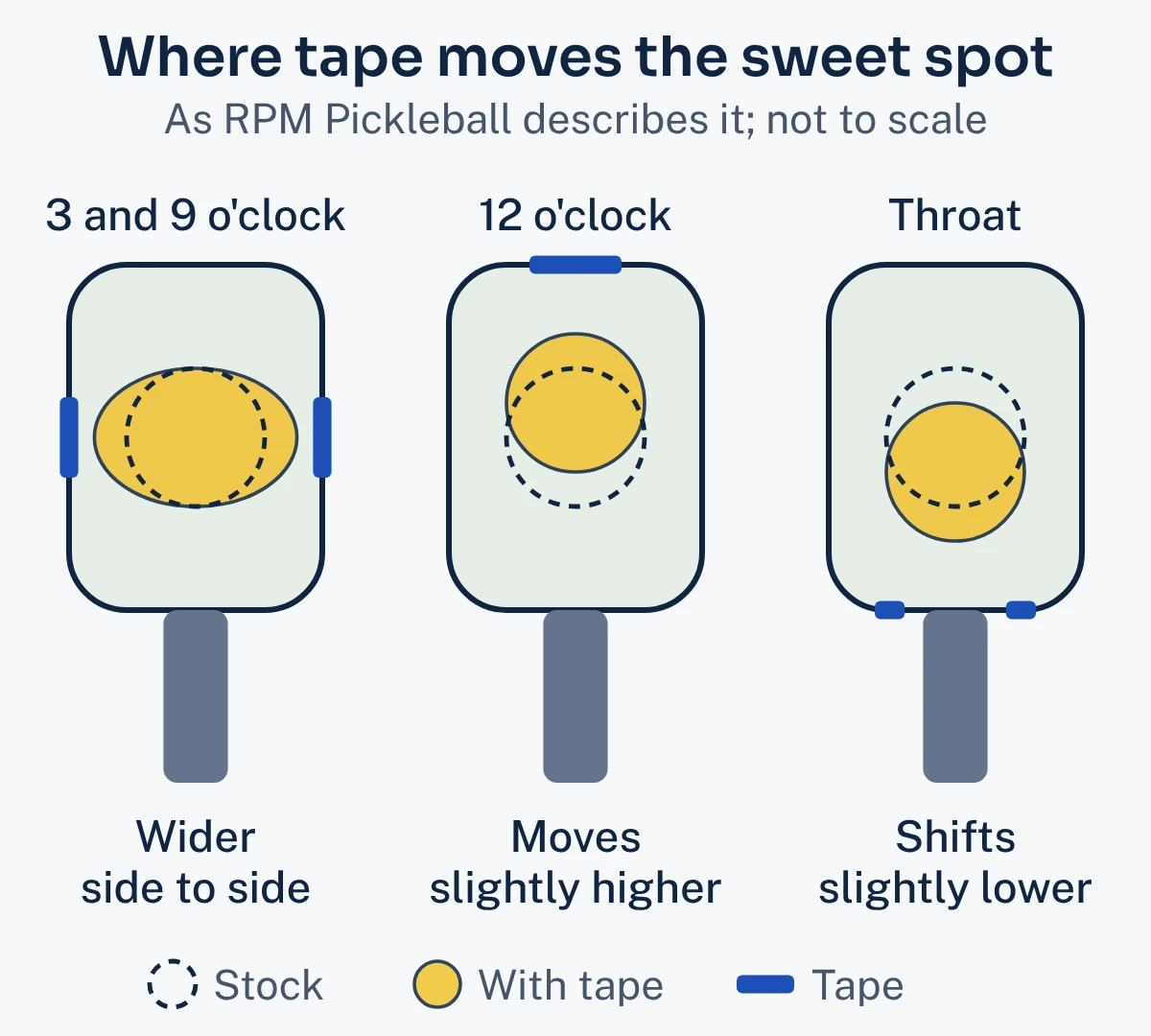
The sources do not agree on which spot grows the sweet spot most. The Dink’s 2024 guide gives that to the four corners. RPM (undated, read Oct 26, 2026) says the sides maximize “twist weight increase per gram”. Pickleland’s placement chart also calls 3 and 9 o’clock the “Biggest twistweight gain per gram”, but Pickleland says the chart is “summarized from RPM Pickleball’s lead tape guide and The Dink’s customization guide (April 2026)”, so it is not a second voice beside RPM. For a first try, Pickleland’s advice is the sides: “If you only try one setup, make it a strip on each side at 3 and 9 o’clock.”
How to add weight for a bigger sweet spot, step by step
Look up the twist weight and the warranty
For shoppers new to these numbers, Pickleball Effect’s buyer’s guide recommends paddles with “a twistweight above 6”, which gives you a point of comparison. On warranties, CRBN says adding edge guard weights “is completely fine and won’t affect your warranty”, while Six Zero lists “Any modifications made to the paddle after purchasing” among what it does not cover. Ask the maker before taping if its terms are unclear.
Weigh the paddle
Note the figure so you can compare after each change, as The Dink and Pickleland both weigh first.
Add one matched pair at 3 and 9 o’clock
Pickleland says: “Start with 2–3 grams in total, play a full session, and add more only if you want it.” RPM’s troubleshooting table (undated, read Oct 26, 2026), for off-center shots that “fly sideways”, gives “1–2g each at 3 and 9 o’clock”. Keep the two sides equal: Pickleland warns that “Unequal weight at 3 and 9 o’clock makes the paddle twist in one direction.”
Keep the tape on the edge
USA Pickleball’s 2026 rulebook, rule 3.D.7, reads: “Decals and Tape. Decals and tape on the paddle face must not extend more than 1.0 inch (2.54 cm) above the top of the grip nor more than 0.5 inch (1.27 cm) inside the outer edge of the paddle or, if an edge guard is in place, 0.5 inch (1.27 cm) inside the edge guard.” RPM (undated, read Oct 26, 2026) adds: “Lead tape placed directly on the paddle face surface (not the edge guard) may bring the paddle out of compliance if it alters the face texture (Ra surface roughness) or creates a compressible layer.” Clean the edge guard first and cover lead tape, as above.
Play a full session, then re-measure
RPM’s method (undated, read Oct 26, 2026) is to “Add small amounts (2–3g at a time), play for a full session, then assess.” John Kew’s swing weight calculator page (undated, read Oct 26, 2026) says to “Re-measure your paddle after adding lead tape or changing grip setups”.
Move the weight if the sweet spot sits too high or too low
RPM’s table (undated, read Oct 26, 2026) pairs “Sweet spot feels too high” with “2–3g at handle/butt”, and “Sweet spot feels too low” with “1–2g at 12 o’clock”.
What the measurements show
Two testers published a paddle’s twist weight before and after adding weight to the sides. Each figure is that tester’s own measurement, so read across a row, not between rows.
| Paddle (tester, date) | Weight added | Twist weight before | Twist weight after |
|---|---|---|---|
| Six Zero DBD Infinity 16mm (Pickleball Effect, Nov 10, 2023) | Two inches of 1g lead tape on each side, about an inch above the bottom corners | 5.9 | 6.43 |
| Pickle Poppers Pop N Treasure (John Kew, July 5, 2026) | 3 gram pods at 9 and 3 o’clock | 6.2 | just under 7 |
Pickleball Effect’s after figure counts its edge tape and overgrips too, and its swing weight rose from 110 to 114: “This is a 9% increase in twistweight and a 3.6% increase in swingweight.” Its review names the usual trade-off: “Typically when you add lead tape it improves the sweet spot but it takes away its good maneuverability.” It also says of the stock paddle that “you don’t have to add lead tape for it to be good.”
Choosing a paddle with a bigger sweet spot
When you are buying rather than taping, these features come with a bigger sweet spot in the makers’ and testers’ own descriptions.
| Feature | What the source says | Source |
|---|---|---|
| Thicker core | “a thicker core increases softness, sweet spot size, and control” | Pickleball Effect, March 2025 |
| 16 mm against 14 mm | “In nearly every matched pair compared in this article, the 16mm version held onto more stability on off-center hits than its 14mm counterpart.” | Pickleball Effect, July 2026 |
| Widebody shape | “Larger sweet spot”; “Sweet spot located in middle of paddle” | Pickleball Effect, June 2026 |
| Elongated shape | “Smaller sweet spot from side to side”; “Sweet spot located higher on face” | Pickleball Effect, June 2026 |
| Shorter handle | “can increase the hitting surface and often improve the sweet spot” | Pickleball Effect, June 2026 |
| More flexible foam at the edges (one paddle line, the Gearbox Pressure X 8E and 8M) | “Gearbox puts its stiffer carbon rib structure in the center and more flexible foam at the edges, so off-center hits get more help and the sweet spot plays bigger than its twist weight suggests.” | Pickleball Effect, October 2026 (playtest impression, not a measurement) |
The Gearbox row is Pickleball Effect’s playtest impression of one paddle, not a measurement. Its review says the paddle’s on-court twist weight “is my comparison from playtesting, not a measurement”, so read the row as one paddle’s construction, not as a general feature.
Core thickness. Pickleball Effect’s July 2026 article qualifies its own finding: “It’s not an absolute guarantee in every single case on the market.” It also says “16mm paddles feel more stable mostly because they’re bigger and heavier, not because foam construction makes them disproportionately harder to twist.” Our 14mm vs 16mm comparison sets four models side by side in both thicknesses.
Shape. Pickleball Effect gives the typical twist weights it has measured “Across the hundreds of paddles in my database” as 5.9–6.3 for elongated paddles, 6.2–6.7 for hybrids and 6.6–7.2 for widebodies. Pickleball Effect adds: “Unless you know you have a strong preference, I wouldn’t obsess over these numbers. They’re best used to compare paddles that are already similar.” Selkirk, which sells paddles in several shapes, writes: “The widebody shape is ideal for players who want a generous sweet spot for a more forgiving paddle.” Our widebody paddle roundup lists widebodies by their makers’ own specs.
Edgeless paddles. Here the sources disagree. Selkirk’s construction guide (December 2023) says: “Some paddles are edgeless, which provides players with a bigger paddle face, and therefore, a larger sweet spot.” Pickleball Effect opened its review of the edgeless Six Zero DBD Infinity the same year with the question “Edgeless paddles typically have sweet spot issues, how big is the sweet spot?”, and measured that paddle’s twist weight at 5.9. For edgeless paddles, Selkirk’s tungsten tape post (undated, read Oct 26, 2026) says “wrapping tape around the perimeter can boost stability.” Edge guards vary in weight: The Dink’s April 2024 guide says “Some edge guards are light and add next to nothing in weight, but some are thicker and can add a more significant amount.” Our guide on how to put edge tape on a pickleball paddle covers fitting it, and our edgeless paddle roundup covers the paddles.
What tape cannot change
RPM Pickleball’s customization page (undated, read Oct 26, 2026) has a section headed “What Lead Tape Cannot Do”. It says: “It cannot move the sweet spot dramatically. Adding a few grams shifts the center of percussion perhaps 0.5–1.0 inch. Players needing a much larger sweet spot adjustment need a different paddle.” It adds: “Lead tape won’t make a stiff paddle softer or a slow-spinning face generate more RPM.”
John Kew put the question to a test in July 2026: “We added 5 grams per side to the dead zones on a Paddletek TKO-CX 12.7 and re-measured the KewCOR curve down the face.” The readings at the 2 and 3 inch marks rose (0.321 to 0.340, and 0.351 to 0.363), the 4 inch mark fell (0.411 to 0.389), and the 5 inch peak showed “no movement”. Kew’s conclusion: “The finding: lead tape improves your lateral sweet spot, it does not reshape the centerline power curve. Lateral forgiveness is real, but it is measured by twist weight, not KewCOR.”
The rulebook limits what an owner can change. USA Pickleball’s 2026 rulebook, rule 3.D.6, reads: “Allowable Alterations. Altered paddles must meet all specifications. The only allowable alterations or additions by a player to a commercially produced paddle as certified are:”
- 3.D.6.a: “Addition or replacement of edge guard tape (see Rule 3.D.7).”
- 3.D.6.b: “Addition of weighted tape (see Rule 3.D.7).”
- 3.D.6.c: “Addition or removal of weights for an Original Equipment Manufacturer (OEM) integrated weight system.”
- 3.D.6.d: “Replacement of OEM interchangeable grips.”
- 3.D.6.e: “Replacement of OEM interchangeable paddle faces.”
- 3.D.6.f: “Addition of name decals or other identification markings on the paddle face (see Rule 3.D.7).”
- 3.D.6.g: “Changes to the grip size via inserts.”
- 3.D.6.h: “Addition or replacement of grip wrap.”
- 3.D.6.i: “Handwritten pen markings on the paddle surface for identification purposes only (name, signature, phone, email address), or an autograph. No aftermarket graphics are allowed on a commercially made paddle.”
The list has no item for changing a paddle’s core, thickness or shape. Rule 3.D.7, quoted in step 4, keeps tape within 0.5 inch of the edge or edge guard, so tape cannot go in the middle of the face.
Pickleland, the club that sells tape, says the same in its own words: “Tape fine-tunes a paddle that already suits you. It won’t rescue one that doesn’t.” One owner on r/Pickleball, asked in a July 2025 thread how to enlarge the sweet spot of a JOOLA Hyperion C2, replied: “Even with tape it just doesn’t have a big sweet spot compared to more modern paddles.”
Mistakes and troubleshooting
- Uneven sides. Pickleland lists this as a mistake: “Uneven sides. Unequal weight at 3 and 9 o’clock makes the paddle twist in one direction.”
- Too much at once. RPM (undated, read Oct 26, 2026): “players who add 5g at once often can’t isolate which change produced the on-court result.”
- Weight at the top for a wider sweet spot. RPM (undated, read Oct 26, 2026) gives 12 o’clock “Minimal twist weight effect”; it moves the sweet spot slightly higher instead.
- An edge guard added after the weight. The Dink: “If you decide to add an edge guard, be sure to play with your paddle first before adding any other weight to it.”
- Tape reaching into the face. Rule 3.D.7 sets the 0.5 inch limit quoted above.
- Expecting tape to fix a paddle. RPM’s limit above is the guide: a much larger change needs a different paddle.
- When to ask. Ask the maker before taping a paddle under warranty if its terms are unclear. For sanctioned play, RPM’s advice is: “When in doubt, request equipment inspection.”
Ready to buy?
Our lead tape roundup compares lead and tungsten tapes by format and weight per inch. If you are choosing a new paddle instead, start with our widebody paddle roundup.
Frequently Asked Questions
Q. Does lead tape make the sweet spot bigger?
On the sides, the makers and testers above say yes, by raising twist weight. John Kew’s KewCOR test measured only the curve down the face, and found tape did not reshape that centerline power curve, so it could not show the side-to-side gain. Kew says the side-to-side gain is real but shows in twist weight, not KewCOR.
Q. Where is the sweet spot on a pickleball paddle?
The Dink writes: “Sweet spots start in the middle and spread out, typically in an oval shape.” Pickleball Effect places it in the middle on a widebody and higher on the face of an elongated paddle.
Q. Is lead or tungsten tape better for the sweet spot?
RPM Pickleball (undated, read Oct 26, 2026) says tungsten is denser, giving the “same weight in a narrower strip. Same physics apply.”
Q. Is 8.7 oz too heavy for a pickleball paddle?
USA Pickleball’s 2026 rulebook, rule 3.D.3, says: “There is no restriction on paddle weight.” Pickleball Studio writes: “My number is 8.7oz total on most paddles. That’s when I start to have issues with the weight. It could be very different for you since it varies for most individuals”. The Dink’s lead tape page (dated May 8, 2023, updated since; read Oct 26, 2026) says players are “adding tape and playing at a final weight of 8.5-9oz.”
Q. What paddle gives a beginner a bigger sweet spot?
Selkirk’s beginner guide says: “For beginners, a traditional pickleball paddle shape with a thick core — around 16mm — is the best option.” Our beginner paddle roundup compares paddles for new players.
Sources (23)
- Pickleball Effect, A Pickleball Paddle Buyer’s Guide (March 1, 2025)
- Pickleball Effect, The Definitive Guide for Choosing a Pickleball Paddle (June 30, 2026)
- Pickleball Effect, 14mm vs 16mm Pickleball Paddles: Does Core Thickness Still Matter in 2026? (July 24, 2026)
- Pickleball Effect, Six Zero Double Black Diamond Infinity 16mm review (November 10, 2023)
- Pickleball Effect, Gearbox Pressure X In-Depth Review (October 15, 2026)
- Pickleball Effect, paddle database (undated page, read October 26, 2026)
- John Kew Pickleball, 4,000 RPM Pickleball + Lead Tape Data (July 5, 2026)
- John Kew Pickleball, swing weight calculator (undated, read October 26, 2026)
- RPM Pickleball, Lead Tape & Paddle Customization (undated page, read October 26, 2026)
- GAMMA, Lead Tape 0.25 in product page (undated page, read October 26, 2026)
- Selkirk, How to add weight to your pickleball paddle (June 2, 2026)
- Selkirk, Why tungsten tape is a game-changer for weighting pickleball paddles (undated page, read October 26, 2026)
- Selkirk, The ultimate guide to pickleball paddle construction (December 18, 2023)
- Selkirk, The ultimate guide to pickleball paddle shapes (November 15, 2024)
- Selkirk, The best pickleball paddles for beginners (August 30, 2024)
- The Dink, guide to adding weight to pickleball paddles (April 16, 2024)
- The Dink, lead tape for pickleball paddles (dated May 8, 2023, updated since; read October 26, 2026)
- Pickleball Studio, ultimate lead tape guide (December 1, 2024)
- Pickleland (a pickleball club), pickleball lead tape guide (October 9, 2026)
- CRBN, warranty page
- Six Zero, warranty and return policy
- USA Pickleball, 2026 Official Rulebook (PDF)
- r/Pickleball, “How to best make the sweet spot bigger?” (forum thread, July 2025)
Product prices and availability are accurate as of the date/time indicated and are subject to change. Any price and availability information displayed on Amazon.com at the time of purchase will apply to the purchase of this product.